The metric uses signature and a time-valued interval : a comoving clock has . Here is cosmic proper time, a scale factor with dimensions of length, the speed of light, a dimensionless comoving radial coordinate, and the usual polar and azimuthal angles. With curvature normalized to , , respectively. Homogeneity and isotropy apply to each constant- spatial slice. A comoving object's fixed coordinates do not imply a constant proper separation: spatial lengths scale with .
Radial null propagation obeys in magnitude. Two neighbouring wave crests between the same comoving emitter and observer have the same radial integral, giving . The wavelength redshift is consequentlyPeculiar Doppler shifts are excluded by the comoving assumption. Define angular diameter distance by , where is proper transverse size at emission. The transverse metric gives , henceThis distance is neither the photon travel time times nor the object's present proper distance.
The comoving particle horizon at , with the initial boundary at the Big Bang, is . Its proper radial distance is ; for a power-law scale factor , ,Thus a matter-only flat Einstein-de Sitter universe, , has , and the flat radiation-only case, , has . Strictly, Einstein-de Sitter denotes the pressureless matter model; the radiation calculation uses the flat zero- radiation analogue requested here.
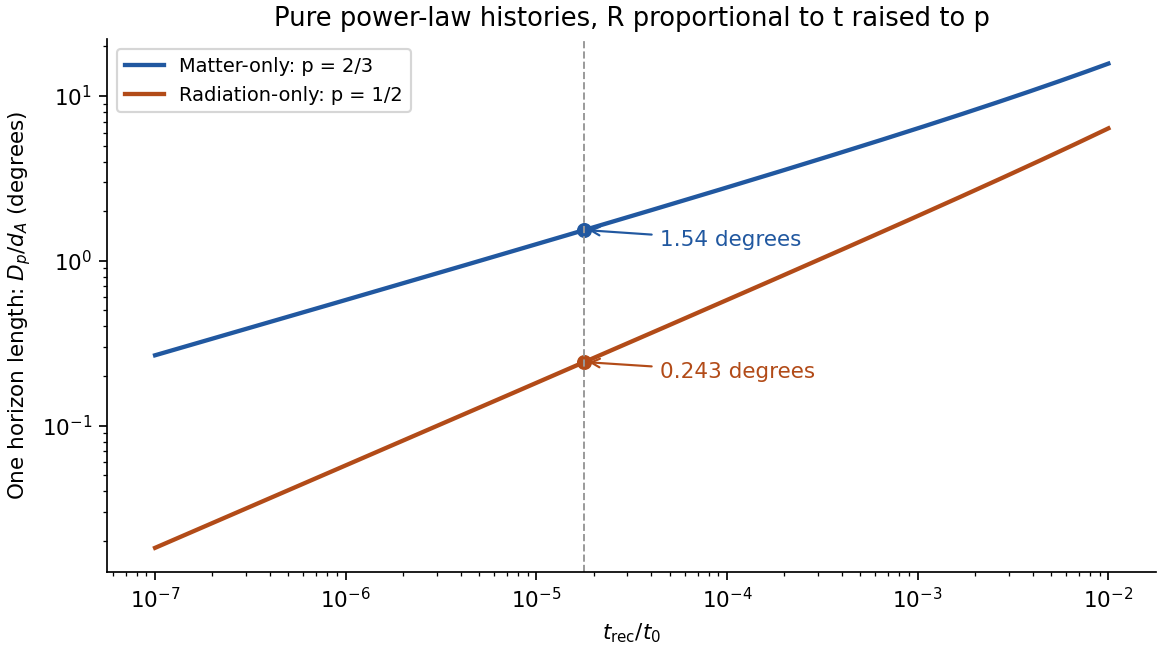
For the source seen at time , the radial coordinate is the integral from recombination to today, not the earlier horizon integral. In these flat models,Taking the linear horizon scale in the question to be , its small angular extent isThereforeUsing the supplied times gives and . There is a genuine radius/diameter convention to state: the supplied is a radial horizon distance. If angular diameter means the full diameter of a spherical horizon patch of radius , the two answers are instead and . Both conventions follow from the same distance calculation; a factor of two should not be hidden in the word horizon.
Matter-only evolution is the better of these two approximations because the universe is already matter dominated around recombination and evolves mostly through a subsequent matter era, rather than remaining radiation dominated to the present. Neither is exact: pre-recombination radiation changes the particle horizon, and late-time dark energy changes the distance to the last-scattering surface. No supplied ages have been replaced by later best-fit values.
The cosmic microwave background originates near last scattering and samples many horizon-sized regions. In an always-decelerating hot-Big-Bang model, widely separated last-scattering patches lack overlapping early causal histories, motivating the horizon problem. The measured acoustic angular scale uses the smaller sound horizon, not automatically this light-travel particle horizon; baryon-photon pressure changes the propagation speed. Inflation supplies an earlier accelerated expansion during which the comoving Hubble radius shrinks, allowing a patch with a common earlier causal history to expand to the size of the observable universe. Quantum perturbations can then seed later acoustic and density fluctuations. This does not require local signals to propagate faster than light, and the Hubble radius must not be equated indiscriminately with the particle horizon. CMB temperature and lensing spectra test the resulting perturbation and expansion model.[ref]
Planck 2013 results. XVI. Cosmological parameters by Planck Collaboration. abstract; temperature/lensing spectra and the spatially flat standard cosmological model

Articles by others on the same topic
There are currently no matching articles.