2016 paper: Public original PDF, physical page 800. Student-answer availability for this paper remains unverified.
Original paper: Public original PDF, physical pages800–803; question pages801–803.
An active galactic nucleus is a compact, exceptionally luminous central source powered chiefly by black-hole accretion rather than ordinary stellar fusion. Typical signatures include a broad spectral-energy distribution extending from radio to X-rays, rapid variability implying a small emitting region, strong optical or ultraviolet emission lines and, in some objects, radio jets and lobes. Broad permitted lines indicate rapidly moving dense gas; narrower forbidden lines can arise farther out. Obscuration and viewing orientation can hide the broad-line region, and many active nuclei are radio quiet, so no one signature is required in every object.
For the Schwarzschild circular-ring energy shift, set and let be the photon energy in the orbiting gas frame. A local static observer in Schwarzschild spacetime measures . For gas receding along the line-of-sight component of its velocity, special-relativistic frequency transformation givesPropagation from that static frame to a distant stationary observer contributes . HenceThe factors describe gravitational redshift, transverse time dilation and the longitudinal Doppler shift. Here the emitter is on the maximally receding azimuth of a circular disc ring. A general azimuth has a smaller projected velocity, and a fully ray-traced image must use the photon direction at emission rather than equating that local direction with the distant inclination. The supplied expression is the direct-projection transfer model, not a complete light-bending calculation.
The innermost stable circular orbit is the marginal stable timelike circular geodesic separating stable circular motion from radial instability. In Schwarzschild spacetime,For example, the circular-orbit specific angular momentum satisfies ; its radial stability changes where , at . This is outside both the horizon at and the circular photon orbit at .
The printed local orbital-speed relation gives . Combining the gravitational and transverse factors,At the ISCO, , soThe Edge-on Schwarzschild ISCO redshift envelope is reached for an edge-on disc on its receding side:The approaching edge has . For a fixed inclination below degrees the maximum is smaller; the quoted number is an upper envelope, not the value for every observer. Within the stated ring model the receding factor increases inward across stable orbits, so the inner edge sets that envelope. Emission from a plunging region, occultation and returning rays are outside this ISCO-emitting model.
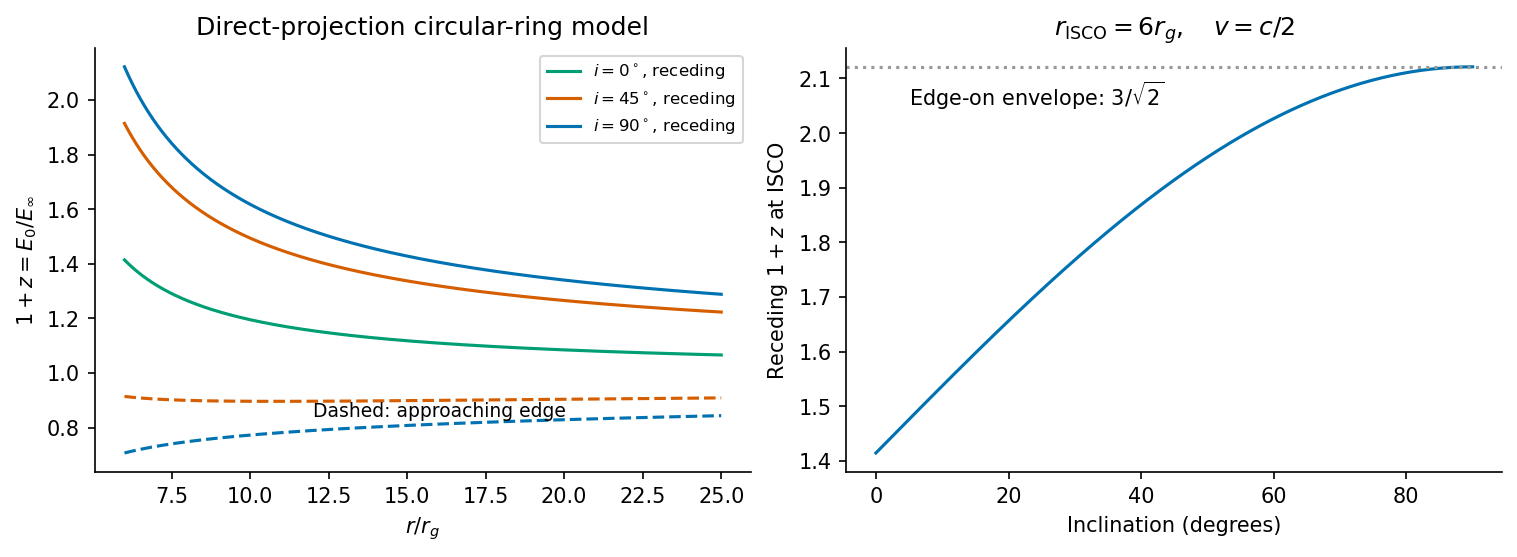
Original Schwarzschild circular-ring transfer calculation showing inclination dependence and the edge-on ISCO redshift envelope
. Details. The Kerr ISCO efficiency limits follow from equatorial circular orbits in the Kerr metric. Prograde motion has a smaller ISCO than the non-spinning case, while retrograde motion has a larger one. A zero-torque thin disc radiating the orbital binding energy before the gas plunges has efficiency , where is energy per unit rest-mass energy at infinity. The ideal limiting values areThus more orbital binding energy is available in the prograde inner disc. The extremal values are formal geodesic limits: photon capture, inner stresses, outflows and finite accretion thickness change the efficiency of real flows. An ISCO inside the ergoregion is not a claim that material or radiation escapes from inside the horizon.
For accretion output relative to galactic binding energy, distinguish accreted rest mass from the mass retained by the black hole. At constant radiative efficiency, building a hole from a negligible seed to emitsA non-negligible seed replaces by the actual mass increase. Let the first use of mean the total three-dimensional rms random speed. For an approximately virialized galaxy with negligible boundary term, and . The ratio to the magnitude of its gravitational potential energy is thereforeIf “binding energy” means the net energy needed to unbind the virialized system, , the ratio is twice as large. The widely used order-of-magnitude estimate drops the retained-mass correction and writes ; it should not be confused with a precisely fixed structural coefficient.
For the numerical parameters given,No efficiency is specified, so this function is the numerical result. For an explicitly chosen illustration , it is about , or relative to the net virial binding energy. The non-spinning zero-torque efficiency gives about relative to ; the ideal retrograde and prograde limits give about and , respectively. Spin affects the ratio through the adopted efficiency and orbital orientation, not through a universal rule that a larger unsigned spin always means a larger efficiency.
Such large energy ratios make even a modest coupling of the output to galactic gas dynamically important. Radiation and winds can heat or eject gas and reduce star formation or later black-hole feeding. For the illustration a percent-level coupling is already comparable to . Energy available is not energy necessarily deposited: cooling, escape directions, gas geometry, photon opacity and the duration of activity determine the actual feedback. It does not follow that the entire stellar galaxy must be disrupted.
For the swept-shell calculation, the problem now explicitly redefines as a one-dimensional line-of-sight dispersion. The specified isothermal profile hasNeglecting central-hole gravity and the shell's self-gravity, the inward force due to the remaining interior component isIn a single-scattering momentum-driven model with the shell intercepting the central luminosity, . At the hydrogen Eddington luminosity this becomes . Sustained outward acceleration against that weight requiresand henceThe radius cancels because the swept isothermal mass is proportional to . This is the isothermal-galaxy momentum-balance shell threshold, with its fourth-power dispersion scaling.
The coefficient identifies the approximations. Self-gravity in a thin spherical shell expansion adds the shell's inward pressure-equivalent force and replaces by . A shell intercepting only a fraction of the photon momentum needs a larger luminosity; Thomson-thin material does not automatically receive . Conversely, multiple scattering or an energy-driven hot wind changes the force model. A shell already carrying sufficient outward kinetic energy need not satisfy this instantaneous acceleration condition everywhere to escape. The printed inequality is the stated quasistatic, fully coupled momentum-balance estimate, not an assumption-free lower bound for every possible shell trajectory.
Use the geodesic radial comoving coordinate, in which the Friedmann-Lemaître-Robertson-Walker metric has the formOn a slice of constant cosmic time, the radial proper-length element is . ThereforeIf one starts from a curvature coordinate with radial element , then ; the curvature coordinate itself is not generally the used above.
For a comoving galaxy, , so . The definitions areThis recession law concerns proper distances on common cosmic-time slices. It is not a local special-relativistic relative velocity measurement; a large recession rate is not a signal exceeding the local speed of light.
For a comoving volume , total fluid energy is . Adiabatic energy conservation gives . Expanding,henceHere is mass-equivalent energy density. Radiation loses energy both by dilution and by pressure work; pressureless matter only dilutes in this description.
In the time-unit convention for the cosmological constant, it represents a uniform vacuum contribution with pressure equal to minus its energy density. There is a units convention in the printed field equations: their term is , so the symbol there has units of inverse time squared. If the geometrical constant is instead given in inverse length squared, this symbol equals . The curvature parameter labels constant-curvature spatial slices; with a conventional scale-factor normalization it is for positively curved, flat and negatively curved slices. It fixes local curvature sign, not every possible global spatial topology.
For a flat fluid-only model without a cosmological constant and with , the two field equations giveThe two printed cases and their scale-factor laws are worked under the literal inline labels below.
Inflation is accelerated expansion, , equivalently a decreasing comoving Hubble radius on an expanding branch. An approximately constant positive vacuum-like energy can give nearly exponential expansion. Enough inflation can put regions now widely separated inside a common earlier causal patch, suppress and dilute unwanted relics such as monopoles. These are the horizon, flatness and relic-abundance motivations. Reheating is needed to populate the subsequent hot universe. Quantum fluctuations can seed primordial perturbations, but inflation alone is not a universal solution to the initial singularity or a proof that all initial conditions inflate.
Now adopt the printed natural units . For the Homogeneous massive-scalar equation in an expanding universe,The continuity equation givesWhere , this implies the expanding-universe Klein-Gordon equationA regular canonical-field solution extends it through isolated turning points by continuity. Purely dividing the conservation equation does not determine a trajectory on an interval where is identically zero; canonical field dynamics, or variation of its action, supplies the equation there. In particular a constant nonzero massive field is not an exact freely evolving solution.
With ,ThereforeThis inflation condition for a homogeneous massive scalar means a potential-dominated field has sufficiently negative pressure to accelerate expansion. In quadratic chaotic inflation, a large initial field with can enter slow roll, with and . The potential slow-roll parameter is , so a large field relative to the gravitational scale can support many e-folds. The field eventually rolls far enough that this regime ends and oscillation and reheating become relevant. Large potential energy with arbitrary initial kinetic energy does not by itself guarantee an inflationary interval.
Differentiating the flat Friedmann equation and then using the scalar equation,For the expanding branch,This Nonincreasing Hubble rate for a canonical inflaton decreases strictly where the field rolls and can be momentarily stationary at a turning point; the statement “always decreasing” means nonincreasing. This does not conflict with acceleration, because remains positive when .
At horizon exit, larger comoving wavelengths leave earlier, when is larger. For a canonical field in slow roll, with reduced Planck mass ,The decreasing expansion rate gives a red tensor tilt at this order. The scalar curvature spectrum also contains the conversion from field fluctuations to curvature:Here counts elapsed e-folds. Thus the Decreasing Hubble rate does not alone fix scalar tilt. Evolution of matters. For the quadratic slow-roll model, and . If e-folds remain until the end, leading estimates give and tensor-to-scalar ratio , with small end-of-inflation corrections.
The relevant contemporary comparison is a nearly scale-invariant but red scalar spectrum. The February2015 Planck analysis reported for its temperature, low-polarization and lensing combination, and an upper limit at95percent confidence. The scalar tilt is qualitatively consistent with a slowly evolving inflaton, but that result does not establish the quadratic potential; its relatively large tensor prediction was already disfavored against lower-tensor alternatives in that analysis.[ref]
Planck 2015 inflation constraints by Planck Collaboration. February2015 original version, abstract; dataset combination, spectral index and tensor bound
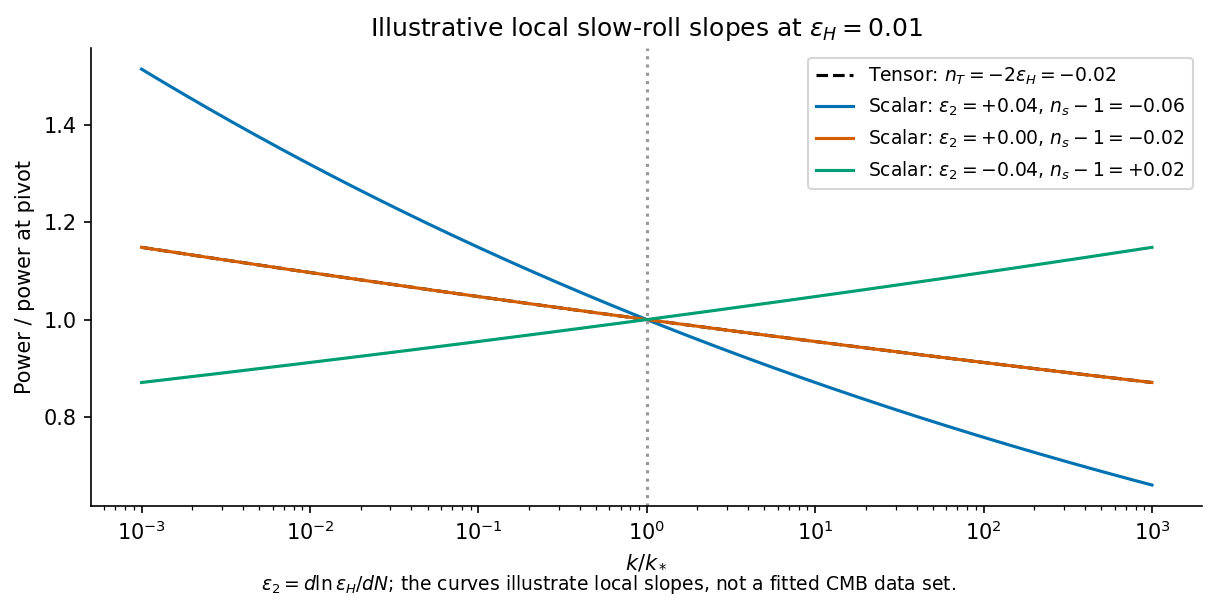
Original slow-roll illustration distinguishing a red tensor spectrum from the additional epsilon evolution controlling scalar tilt
. Details. For dust, and . The continuity equation gives , and the flat, zero- Friedmann equation integrates to . ThusDirectly, a power-law scale factor has , which gives the same constant. This is the usual pressureless Einstein-de Sitter model.
For radiation, and . The continuity equation gives , so the flat, zero- background expands as . HenceRadiation pressure doubles the deceleration parameter relative to dust at the same density parameter. The printed radiation-filled Einstein-de Sitter wording is interpreted as a flat radiation-only model; the conventional name Einstein-de Sitter normally refers to the dust case.
Astrophysical jets are directed plasma outflows whose bulk energy and momentum remain concentrated near an axis over distances much larger than the launch region. They occur around accreting black holes and neutron stars and in forming stellar systems, with very different characteristic speeds and scales. An accretion reservoir supplies binding energy; a rotating black hole can additionally provide spin energy through electromagnetic stresses. An observed jet therefore does not uniquely identify either a black hole or a particular launch mechanism.
Magnetic fields couple the rotating engine to the outflow. Gas tied to suitable open field lines can be accelerated centrifugally from a disc; a large-scale poloidal field threading a rotating hole can support outward electromagnetic energy flux. Farther out, magnetic stresses, hoop stresses and external pressure can aid collimation. Pressure-driven acceleration, magnetic-to-kinetic conversion and entrainment depend on loading and environment. A simple stationary axisymmetric picture does not guarantee stability against kinks, mixing or disruption.
The emission commonly contains synchrotron radiation from relativistic electrons spiraling in magnetic fields. Its broad continuum and linear polarization constrain the particles and ordered field component; inverse Compton scattering can extend radiation to higher photon energies. Compact knots can be shocks or moving patterns rather than individual material parcels. Interaction with the surroundings creates shocks, hotspots, cocoons and radio lobes, transporting energy far beyond the central emission region.
Relativistic viewing effects are crucial. If a feature moves at speed at angle toward the observer, its Doppler factor isA comoving emission frequency is observed at . For a discrete isotropically emitting moving feature with spectral index , the flux enhancement scales as in the usual unresolved-blob approximation. Continuous-jet conventions give a different exponent, so apparent brightness is not a direct orientation-free jet-power measurement.
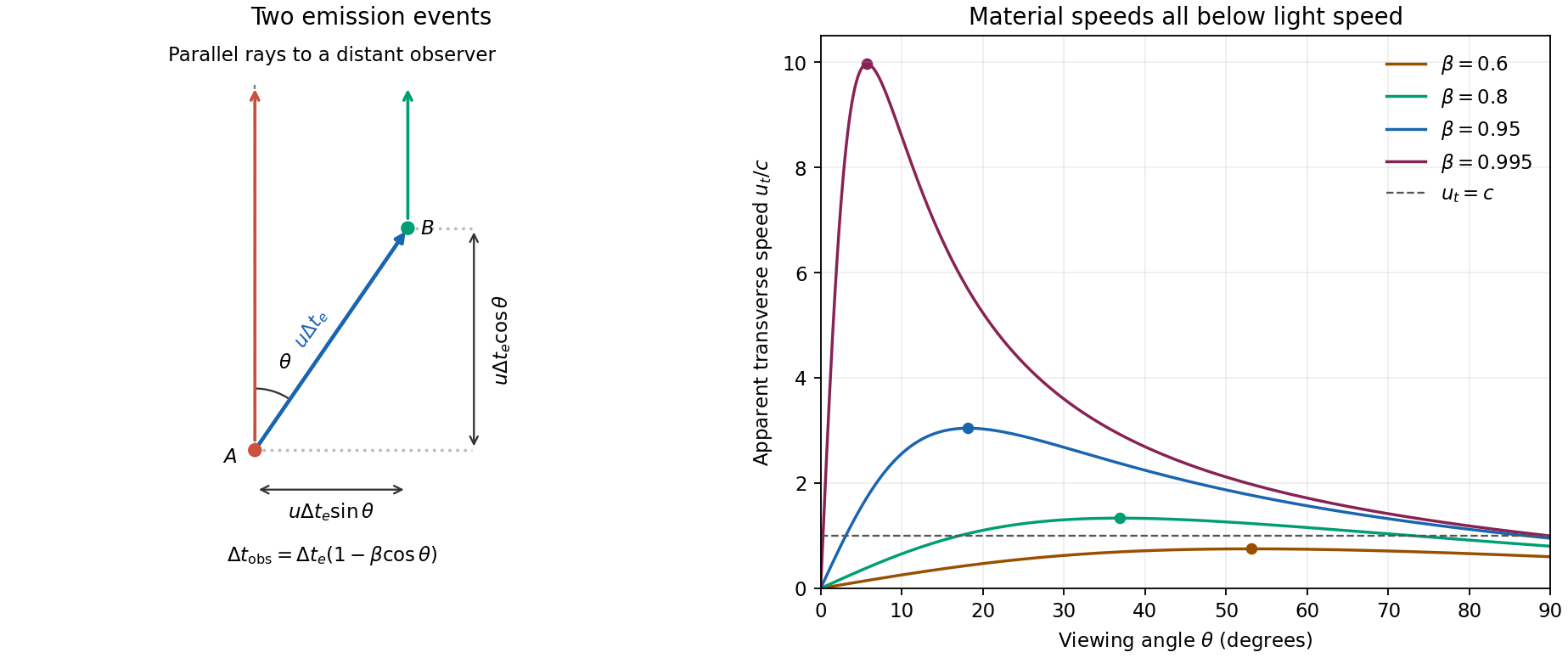
Light-travel delays also produce apparent superluminal motion. In a source time interval , the transverse displacement is , but the observer receives the two signals separated by . ThereforeThe maximum is , at . An apparent speed above violates no local speed limit. The receding jet is deboosted, so an intrinsically two-sided source may look one-sided; absorption and environmental differences can also contribute.
Jets feed back on their host systems by depositing mechanical energy, inflating cavities, accelerating particles and modifying surrounding gas. Radio luminosity measures only part of that budget; unseen ions, magnetic fields, radiative losses and work on the environment all matter. Connecting the compact engine to a large lobe therefore requires both relativistic emission physics and the dynamics of its surroundings.
Gravitational lensing maps source directions into observed image directions because spacetime curvature deflects null geodesics. In the weak-field limit the deflection by a point mass at impact parameter isFor a thin lens, angular diameter distances relate the angles throughA point lens has Einstein angleand in a one-dimensional source alignment its two images satisfyExact alignment gives an Einstein ring for an ideal circular lens; finite source size and departures from symmetry alter the ideal image.
The mapping's Jacobian determines area magnification and parity. Its determinant can vanish on critical curves, whose source-plane images are caustics; a source near a caustic can produce highly stretched arcs or changing image multiplicity. In geometric optics, gravity is achromatic and preserves surface brightness after the usual redshift factors, while changing the apparent solid angle and total flux. Frequency-dependent source size, extinction and plasma propagation can modify an observed broadband image without changing this basic gravitational law.
Strong lensing produces multiple images, arcs and relative time delays. In angular variables the delay surface is proportional toup to an irrelevant additive constant. The geometrical path and gravitational potential delay both contribute. Monitoring a variable multiply imaged source can constrain the time-delay distance, provided the lens mass distribution and external convergence are modeled.
Weak lensing produces small coherent distortions in background galaxy shapes. Convergence describes isotropic focusing and shear describes anisotropic stretching. In a thin-lens convention,Statistical shear correlations probe projected matter structure and cosmological growth; intrinsic alignments, shape noise and selection require control. Compact masses can instead produce microlensing magnification changes when individual image separations are unresolved.
Lensing weighs both luminous and dark gravitating matter and can reveal mass concentrations without requiring hydrostatic equilibrium. It is nevertheless a projected and model-dependent inference: the mass-sheet degeneracy, line-of-sight structure and uncertain source redshifts can mimic changes in inferred mass or distance. Strong, weak and microlensing therefore constrain different scales and complement dynamical, photometric and cosmological measurements rather than automatically recovering a unique three-dimensional mass map.
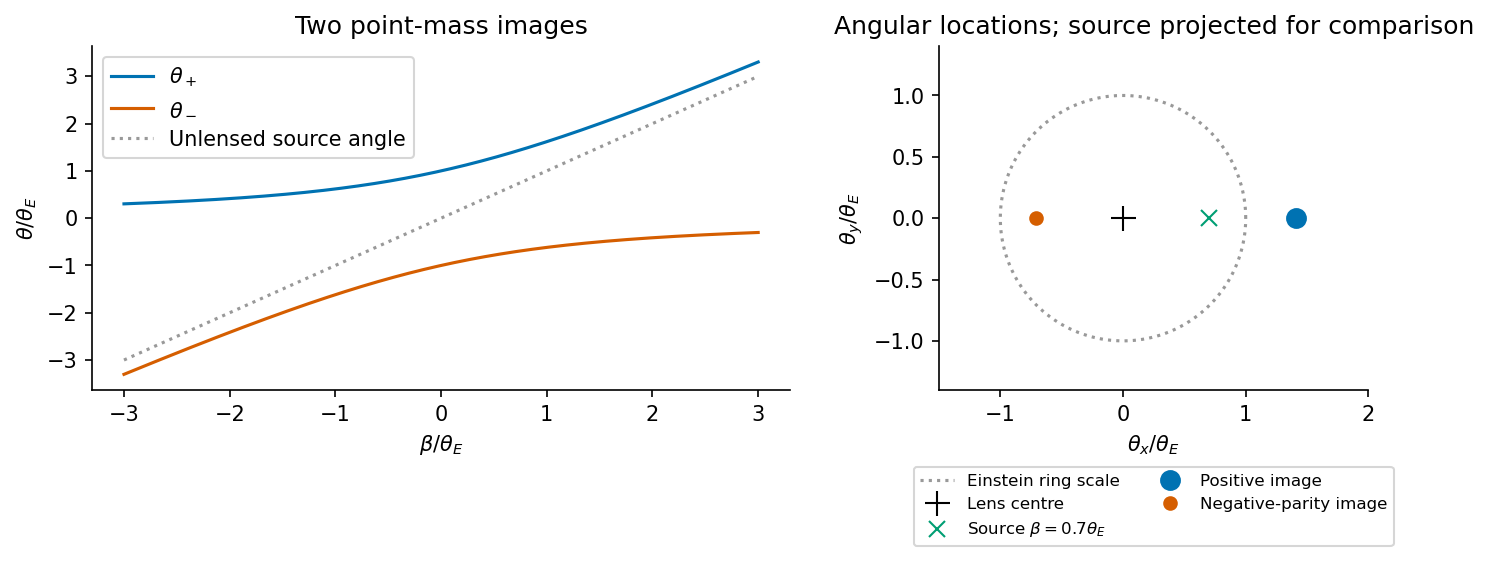
Original dimensionless point-mass lens equation and both image positions as the source moves away from alignment
. Details. The age of the universe is a proper time along comoving cosmological observers, inferred within an expansion model; stellar ages provide partly independent consistency checks. In an expanding FLRW model with a big-bang origin,where . The Hubble time is a characteristic scale, not generally the age. For flat radiation and dust universes, and , respectively.
For a flat matter-plus-vacuum model neglecting radiation in the age integral,As an explicitly illustrative contemporary model, the Planck2015 temperature-plus-lensing estimates and give about . This is an inference under the assumed flat cosmology, not a model-independent clock reading or a numerical constant supplied in the examination.[ref]
Planck 2015 cosmological parameters by Planck Collaboration. February2015 original-version abstract, temperature/lensing flat-LambdaCDM parameter values
The lookback time to an object observed at redshift isThe object's age at emission cannot exceed this cosmic time, and its formation occurs later than the big bang. A stellar population observed at large redshift therefore constrains both stellar evolution and the cosmological time available, rather than simply carrying today's cosmic age.
A star cluster's main-sequence turnoff traces the most massive stars still burning core hydrogen. More massive stars generally consume their usable fuel faster; fitting a color-magnitude diagram with stellar-evolution tracks can infer the population's formation time. The estimate depends on distance, reddening, composition, helium abundance, mixing and the binary population. Old globular clusters give lower limits on the cosmic age, with a formation delay between the big bang and the cluster.
White-dwarf cooling sequences provide another clock: thermal energy and crystallization physics determine how luminosity decreases after the remnant forms. The faint-end population must be combined with progenitor lifetimes and the star-formation history. Radioactive abundance ratios supply nucleocosmochronology. If two isotopes with decay constants start at ratio , their measured ratio satisfiesThe initial production ratio and subsequent chemical mixing can dominate the uncertainty; a measured abundance ratio alone is not an exact formation date.
Kinematic expansion ages can estimate young remnants but require a dynamical model because deceleration changes the relation between present speed and elapsed time. Agreement among cosmological, stellar, cooling and radioactive estimates is powerful precisely because their systematic errors differ. An apparently over-age object calls for examining both the astrophysical clock and the cosmological assumptions before claiming a contradiction.
Supernovae are explosive stellar events with different energy sources and progenitors; a remnant is the expanding ejecta and shocked environment left afterward. Their spectra classify the observed event, while explosion mechanisms give a related but distinct physical classification. Lack of hydrogen absorption defines TypeI spectroscopically; TypeII shows hydrogen. TypeIa typically shows silicon features, while stripped-envelope core-collapse events can be TypeIb or Ic.
In core collapse, an evolved massive star's central core loses support as nuclear processing ceases to supply stable pressure support, electron captures reduce electron pressure and photodisintegration consumes energy. Collapse can form a neutron star or black hole. A shock launched near core bounce loses energy, so a successful explosion requires additional processes, often modeled through neutrino heating aided by multidimensional flow; some collapses fail to eject a bright ordinary supernova. The compact remnant and neutrino emission distinguish this channel physically from a thermonuclear disruption.
TypeIa explosions involve thermonuclear burning of a carbon-oxygen white dwarf in a binary-related evolutionary channel. Both near-Chandrasekhar and sub-Chandrasekhar routes are studied; no single progenitor path is forced by the spectral classification alone. Radioactive nickel and cobalt decay can power much of the later optical emission. Empirical light-curve standardization makes these events useful distance indicators, but dust, population differences and calibration must be controlled; they are not intrinsically identical candles.
Initially ejecta may expand nearly freely, with radius , until swept-up external mass becomes dynamically important. The shock heats the surrounding gas and a reverse shock heats ejecta. For an approximately spherical, adiabatic explosion of fixed energy into a uniform density , dimensional analysis gives the Sedov-Taylor stage:The dimensionless coefficient depends on the equation of state; no value is needed without specifying that model. For a strong nonrelativistic shock in a monatomic gas, an equilibrated post-shock temperature scale is . Collisionless electron and ion temperatures may differ.
Later radiative losses can produce a dense cooled shell. Idealized pressure-driven and momentum-conserving snowplough models then have different expansion exponents; the environment and continuing interior pressure determine which description applies. For uniform ambient density and conserved shell momentum, gives . Real remnants can be asymmetric and encounter nonuniform winds or clouds.
Thermal X-ray emission traces shocked plasma, optical lines trace cooling gas, and radio synchrotron emission traces relativistic electrons and magnetic fields. Shocks can accelerate cosmic rays and alter the energy budget. Ejecta abundances, a surviving compact object, pulsar-powered nebulae and the remnant's dynamics help reconstruct the explosion, but present morphology alone does not uniquely identify the progenitor.
Supernovae enrich the interstellar medium, stir and heat galactic gas and can drive outflows or trigger local compression. Their feedback couples small stellar scales to galaxy evolution. Quantifying that effect requires accounting for cooling and the collective environment rather than assigning all explosion energy to a permanently retained galactic reservoir.
The equivalence principle connects the universality of freely falling motion to the local description of gravity. In Newtonian language a test body's response to a given field is proportional to . Equality of that ratio for different non-gravitating test bodies gives the weak equivalence principle: identical initial conditions yield identical free-fall trajectories, independent of composition. Negligible nongravitational forces and negligible disturbance of the background are part of the test-body limit.
The Einstein equivalence principle adds local Lorentz invariance and local position invariance for nongravitational experiments. A sufficiently small freely falling laboratory obeys the local laws of special relativity independently of its spacetime location and freely falling velocity. Uniform acceleration of a small laboratory can imitate the leading local effects attributed to a gravitational field. An observer held at rest in a gravitational field generally needs proper acceleration; a freely falling observer does not.
Mathematically, local inertial coordinates can set the metric to Minkowski form and the Christoffel symbols to zero at an event. The geodesic equation there has no connection term at that point:This coordinate choice does not remove curvature. With a standard curvature convention, nearby free-fall trajectories have relative accelerationThe tidal signal survives in an extended laboratory. Thus the principle is local and does not identify every gravitational field with acceleration globally. Finite-size spin and tidal couplings also qualify the ideal point-test-body statement.
The strong equivalence principle extends the universality to gravitational experiments and bodies whose gravitational self-energy is important. It is stronger than the Einstein principle and need not hold in every metric theory that satisfies local nongravitational equivalence. Comparing the Earth and Moon as they fall toward the Sun probes this distinction as well as composition effects. Lunar laser-ranging analyses test differential acceleration by fitting the lunar orbit and measured ranges; an interpretation in terms of self-energy requires separating ordinary composition-dependent violations.[ref]
Lunar Laser Ranging Tests of the Equivalence Principle by James G. Williams and others. 2012 abstract, differential Earth-Moon free fall and dependence on composition and gravitational self-energy
Redshift and clock comparisons test local position invariance; laboratory Lorentz tests and universality-of-free-fall experiments test other components. These are complementary tests, not deductions from a single numerical equality of inertial and gravitational mass. The principle motivates geometric gravity and minimal coupling, but does not by itself derive the complete Einstein field equations or determine the value of the gravitational constant.
Original solutions for the Physics and MASt Physics paper. [ref]
https://www.whatdotheyknow.com/request/natural_science_tripos_physics_e_2/response/2340776/attach/2/FOI%202023%20399%20Zahid%20materials.pdf?cookie_passthrough=1. Original examination PDF, physical pages 728–731
photon orbit and the Newtonian limit. Write and . For a timelike circular Schwarzschild geodesic,The denominator tends to zero at , so the energy per unit rest mass diverges as a massive circular orbit approaches that radius. The corresponding local orbital speed measured by a static observer satisfies and tends to one. This suggests a null circular orbit, but one must not simply insert into a massive-particle formula. For a photon, the radial effective potential is proportional to ; its derivative vanishes at and its second derivative there is negative. Thus the photon sphere is at , and its circular null orbits are unstable.
At , expansion givesThe second term is the total Newtonian circular-orbit energy, kinetic plus potential; the relativistic energy also includes rest energy. Here is the conserved energy referred to a stationary observer at infinity, not the local kinetic energy.
The stable inner edge. At fixed angular momentum, write . The timelike radial geodesic equation can be writtenThe circular condition gives . Substituting into the second derivative taken at fixed givesTimelike circular orbits exist for ; they are stable against radial perturbations for and unstable for . ThereforeThe boundary orbit is marginally stable. Differentiating also gives a minimum there, consistently with this fixed-angular-momentum stability calculation.
accretion efficiency and black-hole spin. Matter supplied slowly from far away initially brings rest energy . A radiatively efficient, zero-inner-torque thin disk releases the binding energy down to the innermost stable circular orbit; the remaining energy is carried into the hole during the plunge. ThusHere denotes the efficiency called in this question. The ideal relation assumes negligible additional dissipation during plunge and neglects photon capture and advection. A hot radiatively inefficient flow need not have this efficiency.
For a Kerr black hole, an equatorial prograde disk has a smaller innermost stable circular orbit and greater binding-energy efficiency than the Schwarzschild value; a retrograde disk has the opposite trend. The formal extremal prograde limits are and . These are ideal limiting values, not a universal realized efficiency. photon capture and the accretion geometry affect the achievable black-hole spin and escaping radiation.
radiation force and the limiting luminosity. For isotropic luminosity , the outward radiation momentum flux at radius is . In fully ionized hydrogen, Thomson scattering acts mainly on the electron, while electrostatic coupling makes the electron and proton move together. Neglecting the electron mass, one electron–proton pair experiencesEquating them yieldsThis Eddington luminosity uses electron-scattering opacity, spherical or isotropic force balance and negligible relativistic corrections at the force-comparison radius. Composition, other opacity, anisotropy and photon trapping can change the relevant limit.
Exponential growth and doubling. Distinguish rest-mass supply from black-hole mass growth :At the Eddington limit,Using the printed scattering cross section gives . The Salpeter time is an e-folding time; the Eddington-limited doubling time isfor the Schwarzschild thin-disk efficiency. If one approximates , the factor is dropped and the estimate is about . The retained-energy version is the mass-conserving expression.
The efficiency bound. A growth factor requires e-folds. Eddington-limited accretion is the fastest growth allowed by the adopted luminosity bound at fixed efficiency, so growth within a time requiresThis efficiency upper bound from Eddington-limited growth is an upper bound: higher efficiency radiates more of each supplied rest mass, and the luminosity ceiling therefore allows less mass to enter per unit time. A duty cycle below unity or sub-Eddington luminosity tightens it. The approximate convention would instead give ; both figures refer to the same effect, with different treatment of the radiated mass deficit. Mergers, super-Eddington growth or a different seed history would change the premises.
Coherent prograde accretion spins up the hole, moves the inner edge inward and increases . For fixed the mass-growth e-folding time then grows, so the logarithmic growth curve becomes less steep; one cannot simply retain the initial Schwarzschild efficiency throughout. Episodic misaligned accretion can have a different black-hole spin history. In general,
energy available to affect the galaxy. Let denote galaxy mass, keeping it distinct from black-hole mass. At constant efficiency, negligible seed mass and no merger contribution, the emitted energy in building isFor and the nonspinning efficiency this is approximately . The common small-efficiency approximation gives , and a fiducial would give about with retained mass included. These differences do not alter the conclusion: the available accretion energy substantially exceeds the stated galactic binding-energy estimate.
Only a coupling fraction of order one percent would then be energetically sufficient to affect the gas strongly. radiation, winds or jets can heat gas, drive outflows and suppress further cooling and star formation, providing active-galactic-nucleus feedback and possible self-regulation of black-hole growth. energy availability alone does not prove that the whole galaxy is expelled: most radiation can escape, jets can be collimated, heated gas can cool, and collisionless stars couple differently from gas.
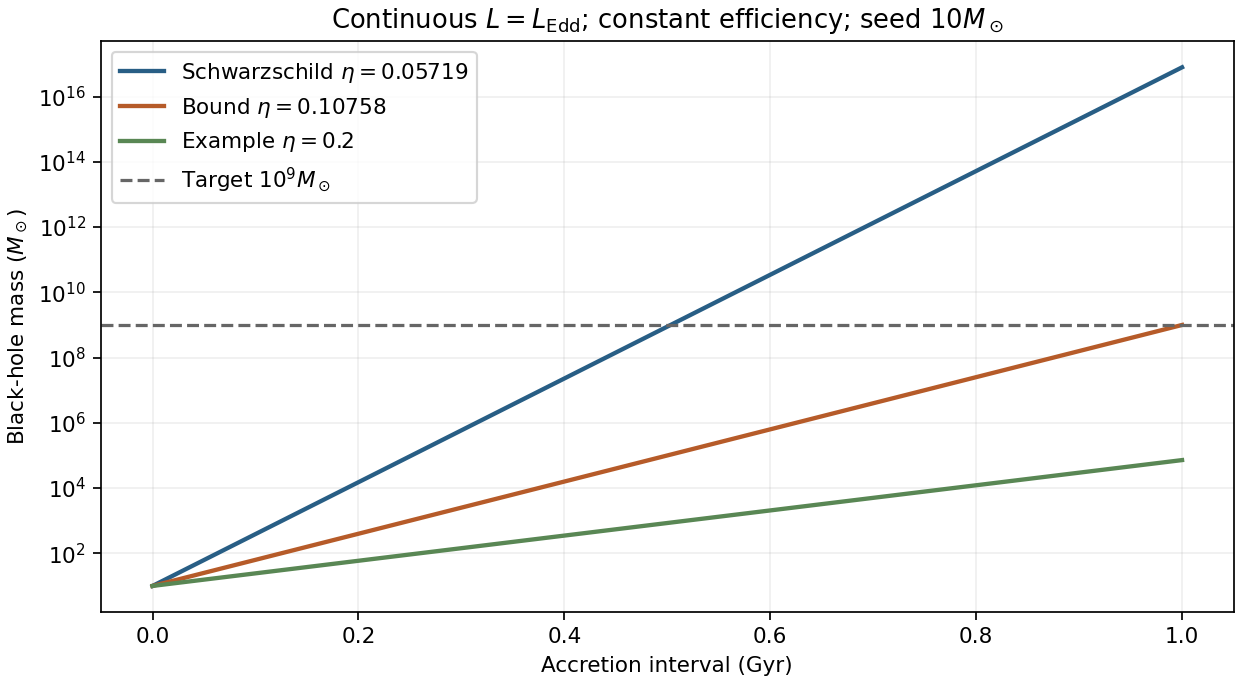
Original comparison of Eddington-limited growth at fixed efficiencies, including the radiated mass deficit
. Details. Definitions and pressure convention. is the scale factor, cosmic time and dots time derivatives. is the gravitational constant, the speed of light, the mass-equivalent density of the material fluid and the spatial-curvature sign in this normalization. here has units of inverse time squared, rather than inverse length squared. Comparison of the acceleration equation with fixesThis is a pressure parameter, unrelated to Question 1's radiative efficiency. pressureless matter has and . When solving the generalized model below, is assumed constant.
Evidence for a positive vacuum component. Standardized Type Ia supernovae measure the luminosity-distance–redshift relation. Their corrected apparent magnitudes at cosmological distances imply greater distances than a decelerating matter-dominated model of comparable parameters, favoring late accelerated expansion. Light-curve standardization, interstellar extinction, selection bias and possible population evolution must be controlled rather than treating every supernova as an identical candle.[ref]
Observational Evidence from Supernovae for an Accelerating Universe and a Cosmological Constant by Adam Riess and others. Abstract and distance–redshift analysis
[ref]Measurements of Omega and Lambda from 42 High-Redshift Supernovae by Saul Perlmutter and others. Abstract and cosmological likelihood analysis
The cosmic microwave background and baryon acoustic oscillation measurements constrain geometry and matter density in combination. Near spatial flatness together with a subcritical matter density leaves room for an additional smooth component; cosmic ages and structure growth supply consistency tests. A positive cosmological constant fits these observations within the standard framework. They do not establish that every allowed dark-energy theory must be a strictly constant vacuum energy; the inference depends on the cosmological and gravitational model.
pressureless matter evolution. Set and . Since , eliminating givesFor , and . ThereforeOn the expanding Big-Bang branch with positive , chooseThe origin is the Big Bang; an arbitrary time translation would shift this origin. Integrating gives . At early times , while at late times .
Age and the density fractions. Dividing the flat constraint by , with , givesThe solution implies , soHere , using the printed megaparsec conversion. Taking one year as days givesFor the same , an Einstein-de Sitter universe hasA cosmic model must be older than its oldest objects, with additional time allowed for their formation. Old stellar populations are dated through stellar-evolution fitting, particularly the globular cluster main-sequence turnoff, with uncertainties from distances, composition and input stellar physics. A pre-examination globular-cluster age constraint on cosmology obtained a lower cosmic-age limit of after allowing for formation time. This conflicts with the model but is compatible with the calculation.[ref]
New Globular Cluster Age Estimates and Constraints on the Cosmic Equation of State and The Matter Density of the Universe by Lawrence M. Krauss and Brian Chaboyer. Abstract and stellar-age/formation-time analysis
Individual stellar age estimates are not exact clocks, and the numerical is the result for the specified and matter fraction, not a claim to be a contemporary best-fit age.Constant nonzero pressure parameter. Eliminating before setting the pressure to zero instead givesHenceFor constant , the positive-density expanding Big-Bang branch isEquivalently use in the pressureless matter solution. The scale factor obeys , and the early limit is . The age of a flat barotropic matter-vacuum universe with the same present density fractions and isThusThe small positive pressure makes the early universe expand with a smaller age at the same late expansion parameters.
The acceleration transition. Normalize the present scale factor to one. Constant and the continuity equation give . Dividing the acceleration equation by givesAt the barotropic matter-vacuum acceleration transition its right-hand side vanishes. For the parameters here, , so the past transition isAt greater redshift the material term dominates and expansion decelerates; at smaller redshift vacuum energy dominates and expansion accelerates. The pressure factor belongs in the numerator of the gravitating material term; omitting it would confuse this model with pressureless matter.
Three tracers give complementary estimates of a cluster's gravitating mass. First, galaxy redshifts measure a line-of-sight velocity dispersion . For a roughly stationary bound cluster, the virial theorem gives a cluster velocity-dispersion mass estimatewith a coefficient depending on the density profile and orbital anisotropy. The galaxy luminosity and plausible stellar mass-to-light ratio supply too little mass to bind typical rich clusters. Foreground interlopers, substructure, velocity anisotropy and a recent merger can bias the dynamical estimate; a large dispersion is not by itself proof of equilibrium.
Second, diffuse X-ray emission measures a hot intracluster plasma, not merely unresolved starlight. Spectral continuum and lines constrain its temperature, while surface-brightness profiles constrain its density after line-of-sight projection and emissivity modeling. If the gas has constant composition and is approximately spherical and in hydrostatic equilibrium,This cluster hydrostatic mass estimator uses as the mean mass per pressure-supporting particle. The inferred potential requires substantially more mass than the stars plus measured gas, although the gas contains much of the visible baryonic mass. Turbulence, bulk motion, temperature structure and departures from hydrostatic equilibrium are important systematic errors.
Third, strong-lensing arcs and multiple images, together with coherent weak-lensing shear of background galaxies, measure projected gravitational deflection. In general relativity,This cluster gravitational-lensing mass estimate does not require the cluster galaxies or gas to be in dynamical equilibrium. It does require source-distance information, a lens model and control of point-spread-function-induced shapes, line-of-sight projection, unrelated line-of-sight structure and the mass-sheet degeneracy.
The convergence of dynamical, hydrostatic and lensing masses, exceeding the baryonic inventory, is the principal evidence. The Bullet Cluster adds a spatial test: collisional X-ray gas lags behind the galaxies during the merger, while the inferred lensing concentrations lie nearer the collisionless galaxy component. An additional weakly collisional gravitating mass accounts naturally for that separation.[ref]
A direct empirical proof of the existence of dark matter by Douglas Clowe and others. L109–L113, optical/X-ray/lensing comparison
The conclusion assumes a gravitational framework and does not identify the microscopic dark-matter particle; the different tracer systematics should be evaluated rather than treating three mass estimates as completely assumption free.cosmic inflation is an early interval of accelerated expansion, . For expansion this means a shrinking comoving Hubble radius, . A nearly constant positive scalar potential can supply it: in units,Potential domination gives and approximately exponential expansion. Sustaining the interval requires sufficiently slow evolution, not just setting the initial field velocity to zero on a steep potential.
The horizon problem is the near equality of conditions in widely separated microwave-background regions that could not equilibrate in the standard decelerating hot Big Bang history. cosmic inflation permits the currently observed patch to descend from an earlier region small enough to have been causally connected, before that patch is stretched to enormous size. The claim concerns a causal history extended before the conventional hot phase; merely accelerating a collection of already disconnected regions would not explain their common temperature.
For the flatness problem, the Friedmann constraint givesA growing drives this curvature fraction toward zero, whereas ordinary matter- or radiation-dominated deceleration makes it grow. cosmic inflation therefore suppresses observable curvature without requiring an equally extreme initial tuning within the later hot evolution.
Pre-existing monopoles and other unwanted relics are also diluted by the volume increase: a conserved particle number density falls as over e-folds. The transition to the hot universe must reheat efficiently, and its temperature must not regenerate an excluded relic population. The required number of e-folds is model and reheating dependent; “about sixty” is a useful scale for many scenarios rather than a universal exact requirement.
cosmic inflation also supplies a mechanism for perturbations. quantum fluctuations are stretched beyond the Hubble radius, and nearly scale-invariant comoving curvature perturbations can later seed cosmic structure. Simple single-field slow-roll models commonly predict approximately adiabatic, nearly Gaussian fluctuations, with a small spectral tilt; tensor perturbations would provide an additional test. Acoustic coherence and the observed scalar spectrum are compatible with this account, but they do not single out one inflaton potential. cosmic inflation addresses causal homogeneity, curvature and relic dilution while motivating the initial perturbations; it does not automatically solve the cosmological constant problem or determine reheating.
A radio pulsar is a rapidly rotating, magnetized neutron star whose emission beam periodically crosses the line of sight. Collapse of a massive stellar core can leave such a compact remnant. Angular-momentum conservation during contraction helps explain rapid rotation, while amplified magnetic fields and a plasma-filled magnetosphere enable particle acceleration and beamed emission. The pulses are not repeated stellar contractions. Not every newborn neutron star is seen as a radio pulsar, because emission, beaming and observational selection matter.
rotation supplies energy to radiation and the magnetized wind. With approximately constant moment of inertia ,An ideal fixed magnetic-dipole torque has . Its integration givesso the pulsar characteristic age approximates the true age only for a short birth period, constant torque coefficient and braking index three. Real magnetospheres, field evolution and kinematic contributions to observed complicate both age and inferred magnetic field.
As the star spins down, the available accelerating potential falls. If particle acceleration and pair production can no longer sustain the radio-emitting magnetosphere, the object crosses a model-dependent pulsar death line and ceases to be detectable as an ordinary radio pulsar. It still exists as a cooling neutron star; “death” refers to the emission state, not disappearance of the star. The death boundary is not a precisely universal spin period.
In a surviving binary, later Roche-lobe overflow from a companion can create an accretion disc. Transferred angular momentum spins the old neutron star up, and the accretion luminosity can produce an X-ray binary. Long accretion episodes can produce millisecond rotation, commonly accompanied by a smaller inferred external magnetic field. After mass transfer declines, the radio pulsar can switch on again as a recycled pulsar, often with a white dwarf companion. Other binary histories can leave a second neutron star, an ablated companion or an isolated recycled object; there is no single obligatory evolutionary sequence.
A direct observational bridge is the coherent approximately X-ray pulsation discovered with RXTE in SAX J1808.4-3658, an accretion-powered binary. It demonstrated an accreting neutron star rotating at a rate appropriate to recycled millisecond radio pulsars.[ref]
Discovery of the first accretion-powered millisecond X-ray pulsar by Rudy Wijnands and Michiel van der Klis. Abstract, coherent pulsations and interpretation
Timing analysis must correct orbital Doppler shifts, telescope and solar-system timing, and instrumental aliases. Radio dispersion, sky coverage and beaming selection affect demographic inferences. The sequence is rotational pulsar spin-down, possible loss of radio activity, and possible accretion-driven recycling—not a necessary path for every neutron star.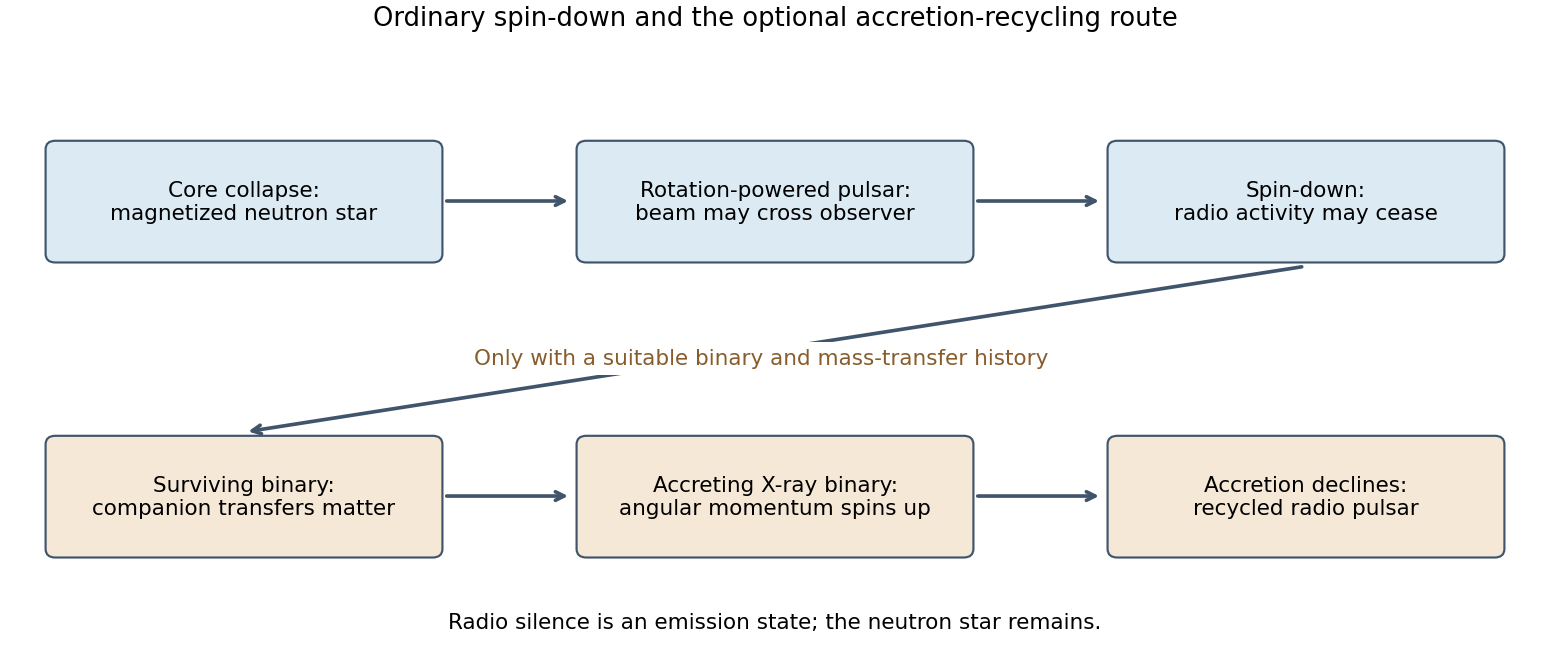
Original schematic of ordinary pulsar spin-down and the conditional binary-recycling route
. Details. The cosmic microwave background has an almost perfect blackbody spectrum at about . This is strong evidence for an earlier hot, dense phase in which radiation thermalized, followed by expansion that redshifted the photon spectrum while preserving its Planck form. COBE FIRAS compared the sky with a precision reference blackbody; instrument temperature, gain, foregrounds and calibrator emissivity were crucial controls. Agreement with a blackbody constrains substantial late energy injection or photon-production distortions.[ref]
Nobel Lecture: From the Big Bang to the Nobel Prize and beyond by John C. Mather. FIRAS measurement and external-blackbody calibration account
After subtracting the dominant dipole associated mainly with observer motion, anisotropies at the level of roughly reveal primordial structure. COBE DMR established large-angular-scale anisotropy; multifrequency measurements and independent maps were needed to distinguish it from Galactic emission and instrumental artifacts.[ref]
Structure in the COBE Differential Microwave Radiometer First-Year Maps by George F. Smoot and others. L1–L5, statistical and systematic checks
Approximate isotropy supports a homogeneous background model under the usual cosmological assumptions, but isotropy at one observing position is not alone a proof of spatial homogeneity everywhere.The temperature CMB angular power spectrum has multiple acoustic peaks. Their coherent pattern follows oscillations in the pre-recombination photon-baryon fluid. Peak positions compare the sound horizon with angular diameter distance and hence constrain geometry together with expansion parameters. Relative peak heights test baryon inertia, matter–radiation equality and gravitational-potential evolution, motivating both baryonic and nonbaryonic matter. Cosmic microwave background diffusion damping suppresses small-scale power. Cosmic microwave background polarization and temperature–polarization correlations provide further tests of scattering, acoustic phase and reionization; gravitational lensing remaps the observed pattern and probes intervening structure.
By the time of this examination, the Planck 2013 temperature and lensing analysis supported a spatially flat six-parameter model with cold dark matter and a cosmological constant. This is a joint fit within an explicit model, not an inference that each peak uniquely measures one parameter.[ref]
Planck 2013 results. XVI. Cosmological parameters by Planck Collaboration. Abstract and cosmological parameter/extension analysis
Foreground separation requires frequency coverage, sky masks, beam and noise characterization, and consistency across instruments. The primary microwave background has geometric and other parameter degeneracies, so acoustic-ruler, supernova and structure observations are valuable complements. The spectrum establishes a thermal hot-universe history; anisotropy and polarization constrain its geometry, contents and primordial perturbations. None of these observations by itself demonstrates a unique cosmic inflation mechanism.mass from motion. A resolved Keplerian orbit gives when the orbiting object has negligible mass. At the Galactic centre, repeated infrared astrometry and spectroscopy measure sky motion, acceleration and line-of-sight velocity of stars around Sagittarius A*. Resolving a compact enclosed mass and fitting complete orbits avoids reliance on a single projected velocity. Source confusion, reference-frame stability, distance, inclination and possible extended mass must be included in the fit.[ref]
For an unresolved stellar-mass binary in a circular orbit, the donor's velocity semiamplitude and orbital period give the binary mass functionIt provides a lower mass bound; donor mass and orbital inclination are needed for an actual mass estimate. For an eccentric orbit, multiply the observational combination by when evaluating the binary mass function. Resolved gas or maser rotation and stellar-dynamical models also measure masses, provided pressure support, noncircular motion and line-of-sight projection are modeled. Resolving the black-hole sphere of influence improves separation of central mass from the host galaxy.
For active nuclei, reverberation mapping measures a lag between variable continuum and broad-line response. With a line velocity scale ,The factor accounts for geometry and kinematics and is not known simply from the lag. Cadence, line responsivity, inclination and winds require control. Rapid variability demonstrates compactness but is not by itself a unique mass measurement.
black-hole spin from strong-field emission. Define . Large-radius Keplerian motion is principally a mass probe and usually insensitive to black-hole spin. In the Kerr model, the radius and binding energy of the innermost stable circular orbit vary with and orbital orientation, making inner-disk radiation useful.
black-hole continuum fitting infers an inner emitting radius from the disk's thermal spectrum and flux normalization, then identifies it with the innermost stable circular orbit in a relativistic thin-disk model. Independent mass, distance and inclination, together with atmospheric spectral hardening, absorption and contamination, are needed. Spectra should be selected in a disk-dominated regime where truncation and strong advection are limited. A 2011 Cygnus X-1 analysis combined such spectra with independently constrained binary parameters and reported a near-extreme black-hole spin conditional on black-hole spin–orbit alignment and its disk model.[ref]
The Extreme Spin of the Black Hole in Cygnus X-1 by Lijun Gou and others. Abstract, thermal-continuum fit and dominant mass/distance/inclination/flux-calibration uncertainties
black-hole reflection spectroscopy instead models a relativistically broadened iron-line and reflection continuum: orbital Doppler shifts and beaming broaden the profile, while gravitational redshift contributes to the extended red wing. Its innermost emitting radius can constrain black-hole spin if reflection extends to the stable inner edge. Ionization, abundance, absorption, coronal illumination, disk thickness and possible truncation are competing parameters; a broad line is not a direct black-hole spin reading independent of these assumptions. Timing or precession models can add information but introduce their own dynamical identification.
mass is principally inferred from gravitating dynamics; black-hole spin is inferred from strong-field effects with a specified spacetime and accretion model. Agreement between independent methods is especially valuable because disk inner radius, inclination and radiation-transfer assumptions can otherwise mimic a change of black-hole spin.
Original solutions covering all questions and all five note alternatives. [ref]
https://www.whatdotheyknow.com/request/natural_science_tripos_physics_e_2/response/2340776/attach/2/FOI%202023%20399%20Zahid%20materials.pdf?cookie_passthrough=1#page=654. Original public PDF, physical pages 654–657; dated 14 January 2014
Corotation reaches the speed of light at . Extrapolating a dipole field gives and magnetic energy density , suppressing order-one factors. An outward electromagnetic energy flux of scale through area of scale therefore givesThis assumes a dipole-dominated field tied to the rotating star and an effective outgoing Poynting flux near the light cylinder. The dipole extrapolation, angular pattern and surface-field convention affect the coefficient. A strictly aligned vacuum dipole would not radiate, whereas an oblique vacuum dipole does. A plasma-filled magnetosphere opens field lines and can spin down even an aligned rotator, so the light-cylinder estimate is a scaling argument, not an exact vacuum emission calculation or literal rigid motion at . Force-free calculations explicitly demonstrate this distinction.[ref]
Time-dependent force-free pulsar magnetospheres: axisymmetric and oblique rotators by Anatoly Spitkovsky. abstract and spin-down luminosity versus inclination
The energy comes primarily from stellar rotation. With constant moment of inertia , , and conservation of energy gives . ThusFor constant , differentiating gives , hence . Evolving field strength, inclination, moment of inertia or additional torques invalidate the constant- prediction; generally in this parametrization.
For radial inflow onto mass , take and . magnetic pressure decreases as , while ram pressure scales as . Balancing them yieldsNumerical factors and disc geometry are not determined by this spherical estimate. The displayed proportionality holds fixed and requires a magnetospheric boundary outside the stellar surface.
In a disc, inflowing matter near has specific angular momentum approximately . If it is transferred to a slower star, the material torque is and . The corotation radius is , distinct from the light-cylinder radius. As stellar spin approaches the inner disc's Keplerian frequency, net spin-up weakens. If lies outside corotation, the field rotates faster than the disc and can centrifugally expel matter in the propeller regime. A characteristic equilibrium isfor fixed mass and magnetic-coupling convention. A complete magnetic torque model can change the coefficient; a star also cannot rotate past its mass-shedding limit, of order .
For opacity per unit mass , an isotropic radiative force balances gravity at . Efficient release of surface gravitational binding energy gives and therefore the surface accretion Eddington rateThe radius dependence matters: it uses efficiency , not an arbitrarily fixed reference efficiency. Substituting this maximal rate into the equilibrium period givesmass, opacity and geometry factors are held fixed. This is the classical radiatively efficient Eddington-limited scaling, not a universal upper bound on every mass supply rate: beaming, advection, outflows and opacity changes can alter it. For sufficiently small field, and the magnetic scaling must be replaced by surface-disc and mass-shedding physics.
The metric uses signature and a time-valued interval : a comoving clock has . Here is cosmic proper time, a scale factor with dimensions of length, the speed of light, a dimensionless comoving radial coordinate, and the usual polar and azimuthal angles. With curvature normalized to , , respectively. Homogeneity and isotropy apply to each constant- spatial slice. A comoving object's fixed coordinates do not imply a constant proper separation: spatial lengths scale with .
Radial null propagation obeys in magnitude. Two neighbouring wave crests between the same comoving emitter and observer have the same radial integral, giving . The wavelength redshift is consequentlyPeculiar Doppler shifts are excluded by the comoving assumption. Define angular diameter distance by , where is proper transverse size at emission. The transverse metric gives , henceThis distance is neither the photon travel time times nor the object's present proper distance.
The comoving particle horizon at , with the initial boundary at the Big Bang, is . Its proper radial distance is ; for a power-law scale factor , ,Thus a matter-only flat Einstein-de Sitter universe, , has , and the flat radiation-only case, , has . Strictly, Einstein-de Sitter denotes the pressureless matter model; the radiation calculation uses the flat zero- radiation analogue requested here.
For the source seen at time , the radial coordinate is the integral from recombination to today, not the earlier horizon integral. In these flat models,Taking the linear horizon scale in the question to be , its small angular extent isThereforeUsing the supplied times gives and . There is a genuine radius/diameter convention to state: the supplied is a radial horizon distance. If angular diameter means the full diameter of a spherical horizon patch of radius , the two answers are instead and . Both conventions follow from the same distance calculation; a factor of two should not be hidden in the word horizon.
Matter-only evolution is the better of these two approximations because the universe is already matter dominated around recombination and evolves mostly through a subsequent matter era, rather than remaining radiation dominated to the present. Neither is exact: pre-recombination radiation changes the particle horizon, and late-time dark energy changes the distance to the last-scattering surface. No supplied ages have been replaced by later best-fit values.
The cosmic microwave background originates near last scattering and samples many horizon-sized regions. In an always-decelerating hot-Big-Bang model, widely separated last-scattering patches lack overlapping early causal histories, motivating the horizon problem. The measured acoustic angular scale uses the smaller sound horizon, not automatically this light-travel particle horizon; baryon-photon pressure changes the propagation speed. Inflation supplies an earlier accelerated expansion during which the comoving Hubble radius shrinks, allowing a patch with a common earlier causal history to expand to the size of the observable universe. Quantum perturbations can then seed later acoustic and density fluctuations. This does not require local signals to propagate faster than light, and the Hubble radius must not be equated indiscriminately with the particle horizon. CMB temperature and lensing spectra test the resulting perturbation and expansion model.[ref]
Planck 2013 results. XVI. Cosmological parameters by Planck Collaboration. abstract; temperature/lensing spectra and the spatially flat standard cosmological model
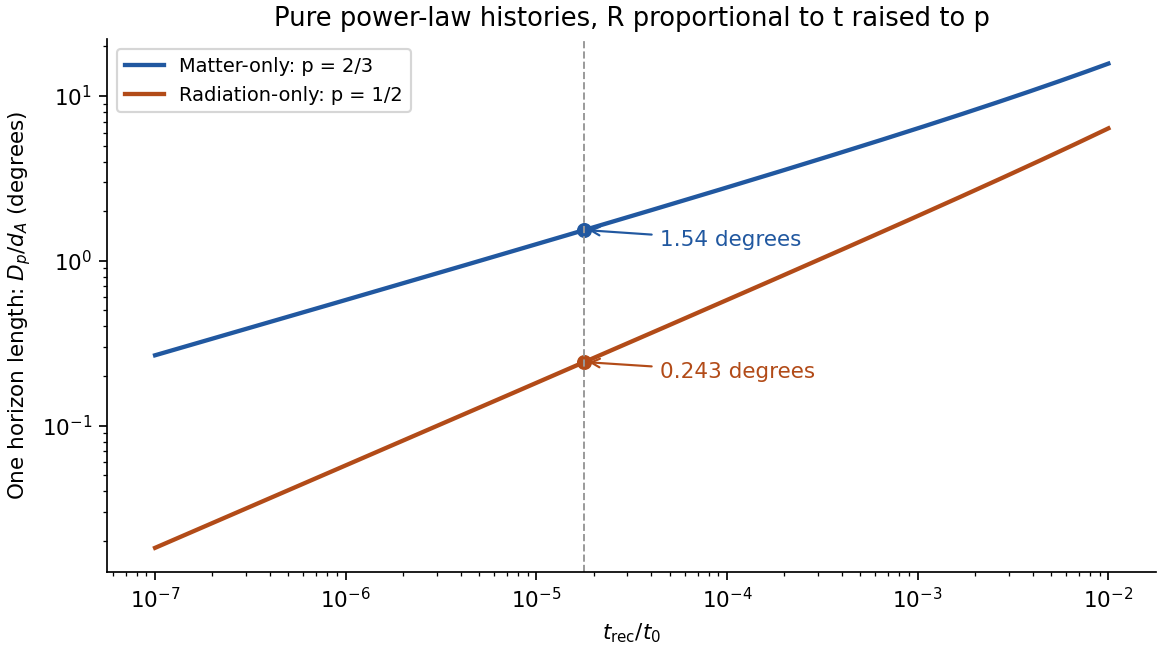
Original horizon-length angular extents in the two stated power-law cosmologies; full patch diameters are twice the plotted values
. Details. An active galactic nucleus is powered by accretion onto a central supermassive black hole. Binding-energy release gives , so a compact source can outshine its host without converting its entire mass into radiation. A disc produces a thermal continuum, a hot corona can Comptonize disc photons into X-rays, and surrounding gas produces broad and narrow emission lines. Dust can obscure and reradiate the central emission. Orientation explains part of the diversity between unobscured and obscured nuclei, but accretion state and intrinsic variability also matter.
relativistic jets channel energy and momentum into collimated magnetized outflows. Disc rotation and, in some models, black-hole rotation supply the energy; magnetic stresses accelerate the plasma and connect the engine to the outflow. synchrotron radiation traces relativistic electrons and magnetic fields, while inverse Compton scattering can produce higher-energy emission. Bright knots, terminal hotspots and large radio lobes show that the deposited energy is not confined to the unresolved nucleus.
For bulk speed at viewing angle , the Doppler factor is , and an approaching feature hasLight-travel delay can therefore give apparent superluminal motion without any material or signal travelling locally faster than light. Beaming also makes approaching jets appear brighter and more rapidly variable; a one-sided image is not proof of a physically one-sided outflow. Spectral, polarization and resolved-motion measurements constrain the geometry and emission mechanisms. Jets can inflate cavities and heat surrounding gas, linking black-hole accretion to galaxy and cluster feedback.
Write the dimensionless scale factor as and the density contrast as . Gravity amplifies overdensities while expansion and pressure oppose growth. In a sub-Hubble Newtonian single-fluid approximation, a comoving Fourier mode obeysFor pressureless matter in an Einstein-de Sitter background, the growing solution is and the decaying solution is . Jeans support suppresses growth when the pressure term dominates. The equation is not a substitute for relativistic perturbation theory on horizon-sized scales.
cold dark matter clusters without baryonic pressure support. Sub-horizon growth is much weaker during radiation domination, and baryons are initially tied to the photon fluid, producing acoustic oscillations rather than unrestricted collapse. Horizon entry, radiation-matter equality, acoustic evolution and diffusion therefore give a scale-dependent transfer function. The primordial curvature spectrum and the later matter-density spectrum are not the same function: evolution and the gravitational constraints relate them. Late dark-energy domination reduces the growth rate.
When approaches unity, linear theory fails. Collapse, virialization, mergers and tidal interactions form a hierarchy of haloes. Gas must cool and lose angular momentum to make dense stellar systems; feedback then changes its supply and distribution. Simulations combine collisionless gravitational dynamics with increasingly complex gas physics rather than extending the linear growing mode indefinitely. Galaxy clustering measures biased tracers of matter; gravitational lensing and CMB constraints provide complementary tests. Approximately adiabatic, nearly scale-invariant initial perturbations explain the coherent acoustic pattern and supply seeds for this later growth.[ref]
Without feedback, efficiently cooling gas would turn into stars too readily. Young stars return radiation, winds and supernova energy and momentum to their surroundings. This can heat gas, disrupt dense clouds and drive outflows, with the strongest fractional effect in shallow potential wells. The outflow mass-loading factor is useful, but its dependence on escape speed differs between energy-limited and momentum-limited models. Some expelled gas later recycles; feedback also transports metals and changes subsequent cooling.
active-galactic-nucleus feedback is important in massive galaxies and hot haloes. Radiative or mechanical power from black-hole accretion can suppress the supply of cold gas. Collimated jets inflate radio/X-ray cavities, while broader winds can carry significant momentum and kinetic energy. For a relativistic cavity fluid with adiabatic index , its enthalpy is approximately , so estimates mechanical power. Comparing it with the gas cooling luminosity tests whether that energy budget is sufficient, rather than merely showing that a radio source is present.
Deep Chandra observations of Perseus resolved bubbles, a density jump and weak surface-brightness ripples consistent with repeated mechanical disturbance of the intracluster gas. Their interpretation as heating requires a dissipation mechanism and a coupling history, not just a large instantaneous power.[ref]
A deep Chandra observation of the Perseus cluster: shocks and ripples by A. C. Fabian and others. abstract; density front, radio bubbles and the proposed heating/cooling balance
Observed outflow geometry, filling factors, cavity ages and cooling corrections create substantial uncertainties. Feedback can also compress gas and locally promote star formation. Simulations must track radiative losses and the scale on which energy or momentum couples: depositing unresolved thermal energy is not automatically equivalent to driving a resolved wind. A successful model should explain stellar masses, gas fractions, metallicity and circumgalactic or intracluster thermodynamics together.
The weak equivalence principle is universality of free fall for sufficiently small test bodies, independent of composition, when non-gravitational forces and self-gravity are negligible. Equality of inertial and passive gravitational mass makes this possible in the Newtonian limit. The Einstein equivalence principle adds local Lorentz invariance and local position invariance for nongravitational experiments: a small freely falling laboratory has the local physics of special relativity.
This motivates a universal spacetime metric. Freely falling unforced test particles follow geodesics, . At a point one can choose local inertial coordinates with vanishing connection, but curvature and tidal relative acceleration remain measurable over a finite region. Gravity cannot be transformed away globally. A uniformly accelerating small laboratory and a local gravitational field can have the same nongravitational experimental behaviour without having identical global geometry.
Clock comparisons predict a fractional rate difference of order in a weak static field. The Pound-Rebka experiment tested the associated photon redshift through resonant gamma-ray emission and absorption at different heights, using controlled Doppler shifts to match the tiny energy displacement. Such a result tests the metric redshift prediction, not uniquely every component of the gravitational field equations.[ref]
general relativity adds the dynamical Einstein field equations,The equivalence principle alone does not derive this unique equation; assumptions about covariance, dynamics and the Newtonian limit are also needed. The strong equivalence principle extends the universality claim to self-gravitating systems and gravitational experiments. Alternative metric theories can satisfy the weaker local principles while differing in gravitational dynamics, so composition tests, clock/redshift tests and self-gravity tests probe distinct claims.
core-collapse supernovae follow loss of pressure support in the evolved core of a massive star. electron capture and nuclear dissociation contribute to collapse; formation of a hot compact object launches a shock that can stall as dissociation and neutrino losses drain it. neutrino heating and multidimensional fluid motions can revive the shock, but some collapses fail to produce a normal bright explosion. The remnant may be a neutron star or black hole. The neutrino burst detected from SN 1987A provides direct evidence for the core-collapse energy channel: the water-Cherenkov signal is a particle-interaction measurement, requiring detector-response and accidental-background checks rather than an optical light-curve inference.[ref]
Observation of a Neutrino Burst from the Supernova SN1987A by K. Hirata and others. pp.1490–1493, burst observation and detector interpretation
Type Ia supernovae instead involve thermonuclear destruction of a degenerate carbon-oxygen white dwarf. They leave expanding ejecta without an ordinary surviving neutron-star core. The ignition channel need not have a unique total mass or binary history. Radioactive nickel/cobalt decay powers much of the later luminosity, and empirical light-curve corrections make these events useful distance indicators. Spectral type is not identical to explosion mechanism: hydrogen-rich Type II events are core collapse, but stripped-envelope Ib/c events can also be core collapse despite lacking conspicuous hydrogen.
The ejecta first expand nearly freely while swept-up mass is small. A strong shock heats ambient gas, and once swept-up material dominates, an approximately adiabatic remnant approaches the Sedov-Taylor scalingSubsequent radiative cooling makes a dense shell and ends that energy-conserving approximation. Thermal X-ray lines probe shocked gas and nucleosynthetic ejecta; radio and nonthermal X-rays trace relativistic particles and magnetic fields. shock acceleration makes remnants plausible contributors to Galactic cosmic rays. Expansion, ambient-density structure, cooling and cosmic-ray energy losses complicate energy estimates; a bright synchrotron shell alone is not proof of a specific accelerated-particle composition. Supernovae return metals and mechanical energy to the interstellar medium and therefore connect stellar death to the feedback cycle.
[ref]
https://www.whatdotheyknow.com/request/natural_science_tripos_physics_e_2/response/2340776/attach/2/FOI%202023%20399%20Zahid%20materials.pdf?cookie_passthrough=1. Original public PDF, physical pages 563–566; dated 15 January 2013
For a blob in a relativistic jet, take two emission events separated by time in the galaxy frame. The blob moves transversely by , while its second photon has less distance to travel to the distant observer. Therefore the arrival interval is andDifferentiating with respect to viewing angle gives . The maximum occurs at and equals . Hence apparent superluminal motion is possible precisely when , or . This is an arrival-time effect; the material and every local signal still travel slower than light.


For , and . Thus the Doppler factor isThe Lorentz-invariant specific intensity gives . Since , a power-law spectrum with gives . This is Doppler boosting of a moving blob: the spectral flux density of an unresolved, intrinsically isotropic blob has the same boost. Comparing identical approaching and receding blobs, with no differential absorption,A spatially steady continuous jet can have a different boost exponent because the emitting material contributing at one arrival time differs; it must not silently replace the specified blob model.
Using the stipulated peak of the photon-photon pair production cross section, not the exact head-on threshold, givesThe relevant photons are near infrared. Interpret the quoted as target-band energy flux, or energy flux per logarithmic frequency interval, consistent with its units ; it is not a spectral flux density per hertz. For isotropic emission . In a stationary source of radius , the order-of-magnitude photon energy density is , soThe luminosity variability size bound gives . Taking the largest allowed radius gives the smallest stationary-source optical depth in this estimate:This assumes the gamma rays and target photons occupy the same region, with an approximately isotropic target field and an order-unity geometric escape factor. A smaller region makes the gamma-ray compactness problem worse.
Here , , and . ConsequentlySuch a stationary co-spatial source would absorb almost all of its high-energy photons.
Let primes denote the blob rest frame and continue to ignore cosmological redshift. For fixed observed gamma-ray energy, . The co-moving target energy at the assumed cross-section peak is therefore . The internal pair-production target energy in a relativistic blob acquires a second Doppler shift when this same target population is observed along our line of sight:It would be incorrect to transform only the gamma ray while treating the internal target radiation as a stationary external field. The target photons responsible for collisions span directions in the blob frame; the observed energy here labels the corresponding part of the internally emitted radiation spectrum.
relativistic beaming both increases the allowed rest-frame source radius, , and lowers the inferred rest-frame luminosity, . The beamed gamma-ray optical depth then follows from :For an unbroken power-law spectrum , , so . In particular, gives the stated . Spectral breaks, an external target field or non-coincident emission regions change this inference. Under the requested scaling, transparency requiresThis minimum uses the most favourable nearly axial view, . The exact axial relation gives ; a less favourable viewing angle requires a larger Lorentz factor. The numerical bound is conditional on the stipulated opacity scaling and internal-source geometry.
The Friedmann-Lemaître-Robertson-Walker metric describes homogeneous, isotropic spatial slices. Here is cosmic time, equal to the proper time of a comoving observer; is the length-valued scale factor; and are dimensionless comoving radial, polar and azimuthal coordinates. The speed of light is , andfor positive, zero and negative cosmological spatial curvature. The convention used makes a squared time interval, with signature ; multiplying the metric by gives the more usual squared-length convention. At fixed , radial proper length is , while a sphere has area .
luminosity distance is defined by for bolometric radiative flux and intrinsic luminosity . Radial null propagation gives . Applying the same path integral to two successive wave crests gives , hence . Each photon loses an energy factor , and their arrival rate loses another. For transparent propagation and isotropic emission,The two redshift factors have distinct physical origins; geometrical dilution alone is insufficient.
With , differentiating yields . Therefore the radial comoving coordinate isThis is independent of any particular matter model; the transverse comoving distance is , which equals only for flat space.
For pressureless matter, the continuity equation integrates to . The cosmological constant is kept separately from this matter density. In the flat Friedmann equation, defineThe flat dust-vacuum Hubble parameter is thereforeIn the equation's convention is mass-equivalent energy density and has units ; the geometrical cosmological constant convention instead writes . The model contains dust and vacuum energy with negligible radiation over the relevant late epochs: “matter-dominated” here does not require matter to exceed vacuum energy today.
The cosmic microwave background supplies a standard ruler through its acoustic scale: the angular positions of the Cosmic microwave background acoustic peaks constrain cosmological spatial curvature, while their relative heights constrain matter and baryon densities. Together with independent distance information, these favour a nearly flat Lambda-CDM model containing substantial cold dark matter and vacuum energy. The cosmic microwave background alone has a geometrical degeneracy between parameters affecting distance to last scattering; its analysis also includes early radiation, which the late-time formula above omits. The nine-year WMAP results were already available as a December 2012 preprint.[ref]
Nine-Year Wilkinson Microwave Anisotropy Probe (WMAP) Observations: Final Maps and Results by C. L. Bennett and others. Version 1 abstract: combined-data curvature constraint and consistency with the six-parameter Lambda-CDM model
A standardized Type Ia supernova at appreciable redshift is fainter, hence farther in luminosity distance, than in a matter-only Einstein-de Sitter universe with the same local expansion scale. Fitting the supernova Hubble diagram supports late acceleration; in flat dust plus vacuum, is negative for . Light-curve and colour corrections, extinction, calibration, selection bias and possible population evolution must be controlled. The supernova evidence and cosmic microwave background constraints are complementary; together they favour this model without proving that every alternative dark-energy model is impossible.[ref]
Observational Evidence from Supernovae for an Accelerating Universe and a Cosmological Constant by Adam Riess and others. Abstract and cosmological fits of the supernova distance-redshift relation
[ref]For the final comparison, assume , a common and in model (a). ThenThus and the integrands obey . Because all three models are flat, compare the normalization-independent distance , rather than separately normalized coordinates. The luminosity-distance ordering of flat dust-vacuum universes is , henceModel (b) gives the largest received flux, model (c) the smallest. Equalities replace the strict ordering at the endpoint values of the vacuum fraction; all have the same leading local Hubble law as .
In a close binary star, the rotating effective gravitational potential defines two Roche lobes meeting at the inner Lagrange point. Stellar expansion or orbital shrinkage can bring the donor into Roche-lobe overflow. Gas then flows through the inner Lagrange point; its angular momentum can form an accretion disk around the companion. wind mass transfer in a binary star is also possible without Roche-lobe filling. For a circular, synchronized binary, the Eggleton Roche-lobe radius approximation isThis describes the lobe geometry, not the donor's dynamical response.[ref]
conservative binary mass transfer has fixed total mass and orbital angular momentum, neglecting stellar spin. Using givesSince , transfer from the more massive donor initially shrinks the orbit; after binary mass ratio reversal it expands. Stability depends on both stars and their changing lobes. Let and . A small mass loss reduces the relative overfill if . Use the adiabatic donor response for dynamical stability, and its thermal response for slower adjustment; an equilibrium mass-radius law alone cannot decide both.
Stable transfer can proceed on nuclear or thermal timescales, while dynamically unstable overflow may create a common envelope, orbital spiral-in and either envelope ejection or a merger. Escaping gas, gravitational radiation and magnetic braking make evolution nonconservative by changing orbital angular momentum. accretion onto a compact stellar object releases power of order , producing bright X-ray binaries; radiation-driven outflows can limit retained mass. Eclipses, radial velocities and disk emission constrain the geometry and masses, but inclination, irradiation and assumptions about mass or angular-momentum loss affect the inference. The essential feedback is the donor's radius relative to its evolving Roche lobe.
A galaxy cluster deflects background light through its projected gravitational field. In the thin-lens approximation for gravitational lensing, maps image to source angle. Its surface mass density enters throughHere is signed lensing magnification; observed brightness uses . The 's are angular diameter distances to lens, source and between them; denotes lensing shear, not a Lorentz factor. strong gravitational lensing creates arcs and multiple images near critical curves. For an axisymmetric lens, a tangential Einstein ring satisfies mean enclosed convergence one, givingThis is projected enclosed mass, not a general three-dimensional mass profile inferred from a single arc.
weak gravitational lensing uses coherent distortions of many background galaxies. Their intrinsic orientations average approximately to zero, allowing an estimate of reduced shear and a projected mass map. The method traces all gravitating material without assuming hydrostatic equilibrium, which is valuable in merging clusters. Accurate work requires correction of the point spread function, calibrated shape measurement, source redshifts, foreground-member rejection and selection effects. Intrinsic shape noise, unrelated line-of-sight structures and lens-model degeneracies remain. The mass-sheet degeneracy leaves reduced shear unchanged under and , so absolute mass normalization needs additional information.
In the Bullet Cluster, weak gravitational lensing places the main projected mass peaks near the collisionless galaxies, displaced from the X-ray-emitting gas that contains most observed baryon mass. Comparing the lensing, optical and X-ray maps supports a dominant weakly collisional dark component under the usual gravity model; lensing alone does not identify its particle species. Cluster lensing measures projected gravitational mass independently of gas temperature or dynamical equilibrium.[ref]
cosmic inflation is an expanding epoch with , equivalently a shrinking comoving Hubble radius . In general relativity it requires for the total effective fluid. A scalar field whose potential energy dominates its kinetic energy has and can produce approximately exponential expansion. slow-roll inflation is one realization; rapid expansion alone without acceleration does not have the required effect.
The horizon problem is that widely separated regions of the cosmic microwave background have nearly the same temperature despite lying outside one another's causal domains in a purely decelerating hot Big Bang extrapolation. Sufficient inflation stretches a previously small causally connected region across our observable universe; relevant perturbation wavelengths can begin inside the Hubble radius, leave it during inflation and re-enter later. This does not require local signals to outrun light. Inflation supplies a possible earlier causal history, not a proof that every possible initial state becomes homogeneous.
For the flatness problem, the Friedmann equation gives when is length-valued. Since grows during inflation,Pre-existing unwanted massive relics such as magnetic monopoles are also diluted: conserved number density falls as . Enough inflation, followed by reheating that does not recreate the relic problem, can make their abundance negligible. These were central motivations of the original proposal, whose first phase-transition implementation also faced a graceful-exit problem.[ref]
Inflationary universe: A possible solution to the horizon and flatness problems by Alan H. Guth. Abstract: horizon, flatness, monopole suppression and limitations of the original scenario
quantum fluctuations of the inflating field and metric supply seeds for linear cosmological density perturbations. Simple single-field slow-roll models predict a dominant adiabatic mode with nearly Gaussian, nearly scale-invariant scalar cosmological perturbations, consistent with the cosmic microwave background; tensor cosmological perturbations are another possible test. These predictions are model-dependent, and consistency is not unique proof of inflation. reheating must connect the accelerated phase to the hot expanding universe. Inflation addresses causal reach, small cosmological spatial curvature and unwanted relic abundance, while providing a mechanism for primordial structure.
accretion onto a massive black hole releases luminosity . Even a small coupling of this energy to surrounding gas can matter because a galactic binding energy is only of order , with stellar velocity dispersion . active-galactic-nucleus feedback means that the energy or momentum changes the gas supply, cooling or star formation, potentially regulating further accretion. Large energy availability alone does not establish efficient coupling.
In a radiatively efficient bright nucleus, radiation pressure and winds can push on dusty or ionized gas. Outflows can remove fuel or shock-heat it; the outcome depends on cooling, covering factor, clumping and whether the flow escapes. In a mechanically dominated state, relativistic jets inflate radio cavities in a hot halo or galaxy cluster. Their expansion, shocks, sound waves and subsequent motions can distribute energy and suppress a cooling flow. The two descriptions identify useful channels rather than a universal sharp division between all nuclei.
An approximately pressure-balanced cavity containing a relativistic fluid has enthalpyX-ray pressure estimates, cavity volume and buoyant or sound-crossing ages permit comparison with radiative cooling losses. Radio images check the jet association; X-ray fronts and ripples help locate transferred energy. Deep Chandra observations of Perseus reveal such structures and motivate mechanical heating of the cooling atmosphere.[ref]
A deep Chandra observation of the Perseus cluster: shocks and ripples by A. C. Fabian and others. Abstract and discussion of radio-bubble-associated fronts, ripples and heating
Projection, nonrelativistic cavity contents, pressure gradients, uncertain ages and intermittent duty cycles affect the power estimate. Injected cavity energy need not all dissipate where cooling occurs. A successful negative feedback loop requires that falling gas increases accretion, heating then reduces cooling or inflow, and the delay does not destroy regulation. This can explain reduced cooling and the shortage of excessively massive star-forming galaxies; correlations between black-hole mass and bulge properties are supporting context rather than standalone proof of causation. The key comparison is coupled heating versus local cooling and binding, including where and when energy is deposited.
The age of the universe is a model-dependent elapsed cosmic time, not simply the inverse present Hubble constant. For a model with a hot Big Bang origin,An Einstein-de Sitter universe gives . The age of a flat matter-Lambda universe, neglecting early radiation, isThis follows by integrating and substituting . It tends to as the vacuum fraction tends to zero. Pure de Sitter spacetime instead has constant and no finite dust Big Bang age obtained from this integral. cosmic microwave background ages therefore depend on the assumed expansion model and fitted parameters; the WMAP nine-year combined-data Lambda-CDM model inference was approximately 13.8 billion years, not a direct clock reading.[ref]
Nine-Year Wilkinson Microwave Anisotropy Probe (WMAP) Observations: Final Maps and Results by C. L. Bennett and others. Version 1 abstract, inferred cosmic age
Old globular clusters provide an independent lower bound. Their main-sequence turnoff identifies stars just exhausting core hydrogen; the nuclear fuel divided by luminosity sets a mass-dependent lifetime, so a fitted colour-magnitude diagram constrains the common stellar age. Distance, extinction, metallicity, helium abundance, diffusion and stellar-model physics introduce uncertainties. The elapsed time before cluster formation must be added when comparing with the cosmic age.[ref]
white-dwarf cooling ages offer another clock: faint remnants have lost more stored thermal energy, but progenitor lifetimes must be added and crystallization, envelope properties and sample completeness affect the inference. nucleocosmochronology uses long-lived radioactive abundance ratios, with for two radioactive species, or a stable reference with . Uncertain initial production ratios and subsequent enrichment limit precision. Every reliably dated object must be younger than the universe by at least its formation delay; consistency among distinct clocks tests both cosmology and their astrophysical calibrations.
Articles by others on the same topic
There are currently no matching articles.