Since , products of integer linear combinations of remain of the same form. Thus the Eisenstein integers form a subring of , and hence an integral domain. Their Eisenstein norm isIt is a positive integer on nonzero elements and is multiplicative, because the complex modulus is multiplicative.
For with , write with real . Choose integers with , and let . With and ,Consequently belongs to and satisfies when . This proves is a Euclidean domain with Euclidean function , the Euclidean norm on the Eisenstein integers.
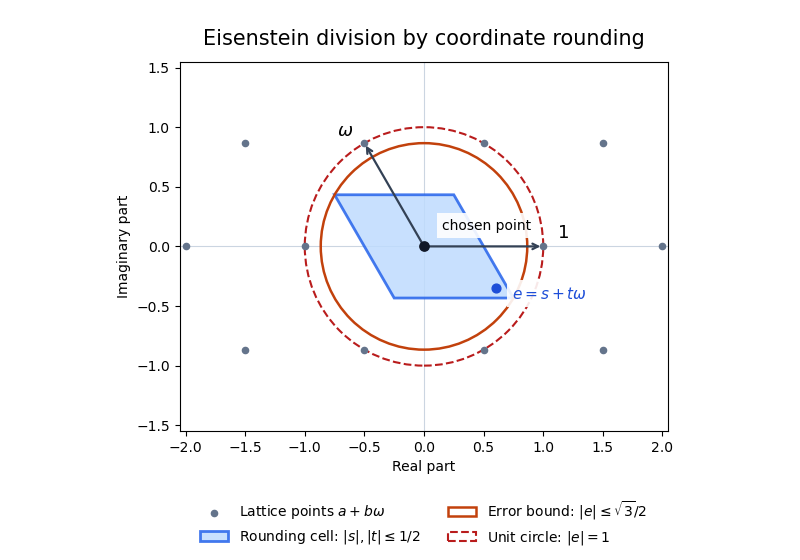

For the representation of the prime , first note that . Now suppose and . The factorizationshows that the Eisenstein integer divides a product. It divides neither factor: an element lies in exactly when both integer coefficients are divisible by , and the second coefficients here are and . Hence is not a prime element of .
To justify the necessary factorization step, in any principal ideal domain an irreducible element is prime. If , write . Since , irreducibility makes a unit or an associate of . The latter would give , so is a unit and for some . If , multiplication of this identity by gives . This proves irreducible elements of a principal ideal domain are prime without assuming unique factorization.
By part (a), is a principal ideal domain. The integer has norm , so it is a nonzero nonunit. Since it is not prime, the result just proved implies that it is reducible: with both nonunits. A nonzero element of is a unit exactly when its norm is one, since gives inverse and multiplicativity proves the converse. ThusThe only possible positive integer factors exceeding one are . Writing givesThis is the prime representation by the Eisenstein norm argument.
Articles by others on the same topic
There are currently no matching articles.