Source paper: released examination archive, member
2016/T/a15291w1.pdf. The printed cover dates the examination to 17 June 2017.For a ring , its ring characteristic is the least positive integer with , or zero if no positive such integer exists. Equivalently it is the least positive integer satisfying for every , because . This additive formulation also defines the characteristic of a rng when an identity is not assumed.
Let be an integral domain. Since , its characteristic is not one. If its positive characteristic were a composite integer with , minimality would give and , butThis contradicts the absence of zero divisors. ThereforeThis is the characteristic of an integral domain theorem. If an integral domain is defined without requiring an identity, the same conclusion follows from the additive definition: for a hypothetical composite characteristic , choose with , which exists by minimality of . Then for every , forcing for every and contradicting minimality again.
Take , a quotient ring with four residue classes. The class is nonzero but . Thus has a zero divisor and is not an integral domain.
No such ring exists. Characteristic two gives for every . Choose a nonzero element , which exists in a five-element set. Translation is an involution without fixed points: applying it twice gives , while would force by additive cancellation. Its disjoint pairs would partition all five elements, which is impossible because five is odd.
This argument applies even to a nonunital ring. With the unital convention, it is also the case of finite ring characteristic divides cardinality.
No such ring exists: every finite integral domain is a field. Here is the proof. For , the map defined by is injective, since gives and therefore . An injective self-map of a finite set is surjective, so some satisfies . Since an integral domain is commutative, as well. Thus every nonzero element has a multiplicative inverse, making a field.
The conclusion still holds if an identity was not initially required. Surjectivity first gives an element with . Then implies for every , and commutativity makes a two-sided identity. Applying the preceding argument with supplies all inverses.
A suitable field with four elements isWrite for the class of . Monic polynomial division over a ring gives a unique representative , with : existence follows by division, and uniqueness follows because a nonzero multiple of the degree-two modulus cannot have degree less than two. The four elements are therefore .
The defining relation gives , and hence . Thus the nonzero elements have inversesThe quotient ring is commutative and every nonzero element is a unit, so it is a field. This verifies the field property directly, without quoting a theorem about irreducible-polynomial quotients.
No field has six elements. A finite field has positive characteristic: the sequence must repeat. By part (a), this characteristic is a prime number . Translation by partitions the field into cycles of length , since returning to a starting point after steps is equivalent to . Thus divides six and or .
The multiples of form a copy of the prime field . For completeness, the inverse of a nonzero residue lies among these multiples: the integer Bezout identity gives . The entire field is a vector space over this subfield. A maximal linearly independent set is finite and spans, so it is a basis of some positive size . Unique basis coordinates give exactly elements. This proves finite field cardinality is a prime power here. But six is neither a power of two nor a power of three, a contradiction.
Under the unital ring convention used elsewhere in this wiki, no such pair exists. In a two-element ring the elements are and . Additive cancellation forces , and the identity axiom forces . The distributive property forces products involving zero to vanish. Every operation is therefore determined, giving the prime field as the unique possibility up to ring isomorphism.
If the word ring allows a nonunital ring, there are instead two non-isomorphic examples: and the zero-multiplication rng on the additive group . In the second example the unique nonzero element satisfies and ; every product is zero, so associativity and both distributive laws hold. An isomorphism would have to send to because it preserves zero and is bijective, but then it would send to both and , which is impossible. These exhaust the rngs with two elements, since can only be or . Specifying the identity convention is essential for this part.
A Euclidean domain is an integral domain with a Euclidean function such that, for with , there exist satisfyingThe polynomial ring has this property with . To perform polynomial division, subtract an appropriate multiple of the divisor to cancel the leading term of the current remainder. Its polynomial degree decreases strictly at each step, so the process terminates below the divisor's degree. The required division of leading coefficients is possible in the field . Thus a polynomial ring over a field is Euclidean, with the same argument applying to every field.
Now let be a nonzero ideal of a Euclidean domain, and choose with the least possible value of . For every , divide . The remainder belongs to , since . If it were nonzero, its smaller Euclidean value would contradict the choice of . Thus and every lies in . Conversely because is an ideal. Hence . The zero ideal is already , proving every Euclidean domain is a principal ideal domain.
The three answers, in the given order, are no, yes, yes.
For , consider the ideal . Its members have even constant coefficient, so and the ideal is proper. If , then divides the constant , forcing to be constant by additivity of polynomial degree in this integral domain. Since also divides , it must divide the coefficient , giving . That would make the whole ring, a contradiction. Thus is not a principal ideal domain, and part (a) shows it cannot be a Euclidean domain. This is the nonprincipal ideal generated by a prime and an indeterminate obstruction.
Evaluation at gives the ring isomorphismIndeed, division by the monic polynomial leaves a unique remainder , and its value is zero only when both integer coefficients vanish. Thus the quotient maps bijectively, with operations preserved, onto the Gaussian integers. These form a Euclidean domain for the Gaussian integer norm , a standard Euclidean example allowed in this part. Geometrically, rounding the real and imaginary coordinates gives a quotient error with squared modulus at most .
Finally,via . Every polynomial over occurs. The kernel consists exactly of polynomials whose -independent part has even coefficients: write to see that this is precisely . Hence the induced quotient map is a bijective ring homomorphism. Its target is a Euclidean domain with Euclidean function : a polynomial ring over a field is Euclidean by the division algorithm in part (a).
Since , products of integer linear combinations of remain of the same form. Thus the Eisenstein integers form a subring of , and hence an integral domain. Their Eisenstein norm isIt is a positive integer on nonzero elements and is multiplicative, because the complex modulus is multiplicative.
For with , write with real . Choose integers with , and let . With and ,Consequently belongs to and satisfies when . This proves is a Euclidean domain with Euclidean function , the Euclidean norm on the Eisenstein integers.
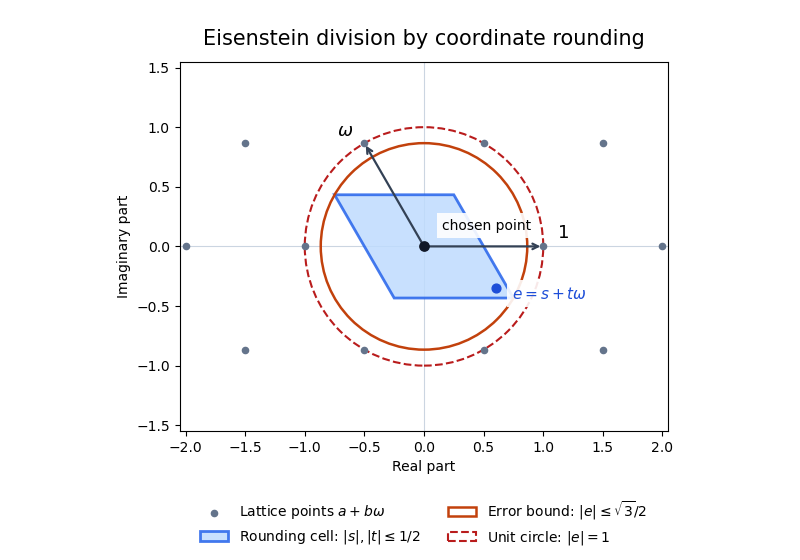

For the representation of the prime , first note that . Now suppose and . The factorizationshows that the Eisenstein integer divides a product. It divides neither factor: an element lies in exactly when both integer coefficients are divisible by , and the second coefficients here are and . Hence is not a prime element of .
To justify the necessary factorization step, in any principal ideal domain an irreducible element is prime. If , write . Since , irreducibility makes a unit or an associate of . The latter would give , so is a unit and for some . If , multiplication of this identity by gives . This proves irreducible elements of a principal ideal domain are prime without assuming unique factorization.
By part (a), is a principal ideal domain. The integer has norm , so it is a nonzero nonunit. Since it is not prime, the result just proved implies that it is reducible: with both nonunits. A nonzero element of is a unit exactly when its norm is one, since gives inverse and multiplicativity proves the converse. ThusThe only possible positive integer factors exceeding one are . Writing givesThis is the prime representation by the Eisenstein norm argument.
Write . A cyclic vector for is a vector whose successive iterates span ; equivalently, when ,are a basis. The equivalence follows because the first linear dependence in the iterates makes their preceding span invariant under , so no later iterate can enlarge it.
In this basis there are unique coefficients with . Put . Then , and commutation with powers of gives . Therefore kills an entire basis and is the zero map. No nonzero polynomial of degree less than annihilates , because that would be a linear dependence of the displayed basis. Thus .
The matrix of in the cyclic basis is the companion matrix with ones on its subdiagonal and last column . Expanding along its last column givesthe cofactors are . This proves the characteristic polynomial of a companion matrix formula here. HenceThis proves that a cyclic operator has equal minimal and characteristic polynomials. If , both polynomials are one by convention, so the equality remains valid.
The rational canonical form of is a block diagonal matrixsimilar to a matrix of , where the are monic nonconstant polynomials and the sum of their degrees is . They are the invariant factors of a linear operator. The block is the companion matrix for , representing multiplication by on . The invariant factors are uniquely determined by .
Every companion block has a cyclic vector and therefore has both minimal polynomial and characteristic polynomial equal to , by part (a). The determinant of a block diagonal matrix is the product of its block determinants, givingA polynomial annihilates the whole matrix exactly when it annihilates every block. On block , dividing by leaves a remainder of smaller degree; if that remainder annihilated the block without being zero, it would contradict minimality of . Thus the annihilation condition is exactly for every . The monic polynomial of least degree with this property is their least common multiple. The divisibility chain makes this , soThese are the minimal and characteristic polynomials from invariant factors formulae. On the zero vector space the product is empty and both polynomials are defined to be one.
If , then is a scalar matrix. Its invariant factors of a linear operator are four copies of , so its rational canonical form isHere and , including when .
Now let and putOn each two-dimensional invariant block, satisfies . The vectors form a cyclic vector basis, since their coordinate matrix is with determinant . Directly,Applying this basis change to both blocks givesThus and . In particular there are two invariant factors , rather than a single block for . Also for every real , so it is an irreducible polynomial over . This is an instance of rational canonical form under an affine change.
Finally implies . Substituting , in the preceding result gives , and henceIts minimal polynomial is and its characteristic polynomial is . The normalized reciprocal of is also , agreeing with rational canonical form of an inverse.
Articles by others on the same topic
There are currently no matching articles.