A Euclidean domain is an integral domain with a Euclidean function such that, for with , there exist satisfyingThe polynomial ring has this property with . To perform polynomial division, subtract an appropriate multiple of the divisor to cancel the leading term of the current remainder. Its polynomial degree decreases strictly at each step, so the process terminates below the divisor's degree. The required division of leading coefficients is possible in the field . Thus a polynomial ring over a field is Euclidean, with the same argument applying to every field.
Now let be a nonzero ideal of a Euclidean domain, and choose with the least possible value of . For every , divide . The remainder belongs to , since . If it were nonzero, its smaller Euclidean value would contradict the choice of . Thus and every lies in . Conversely because is an ideal. Hence . The zero ideal is already , proving every Euclidean domain is a principal ideal domain.
The three answers, in the given order, are no, yes, yes.
For , consider the ideal . Its members have even constant coefficient, so and the ideal is proper. If , then divides the constant , forcing to be constant by additivity of polynomial degree in this integral domain. Since also divides , it must divide the coefficient , giving . That would make the whole ring, a contradiction. Thus is not a principal ideal domain, and part (a) shows it cannot be a Euclidean domain. This is the nonprincipal ideal generated by a prime and an indeterminate obstruction.
Evaluation at gives the ring isomorphismIndeed, division by the monic polynomial leaves a unique remainder , and its value is zero only when both integer coefficients vanish. Thus the quotient maps bijectively, with operations preserved, onto the Gaussian integers. These form a Euclidean domain for the Gaussian integer norm , a standard Euclidean example allowed in this part. Geometrically, rounding the real and imaginary coordinates gives a quotient error with squared modulus at most .
Finally,via . Every polynomial over occurs. The kernel consists exactly of polynomials whose -independent part has even coefficients: write to see that this is precisely . Hence the induced quotient map is a bijective ring homomorphism. Its target is a Euclidean domain with Euclidean function : a polynomial ring over a field is Euclidean by the division algorithm in part (a).
Since , products of integer linear combinations of remain of the same form. Thus the Eisenstein integers form a subring of , and hence an integral domain. Their Eisenstein norm isIt is a positive integer on nonzero elements and is multiplicative, because the complex modulus is multiplicative.
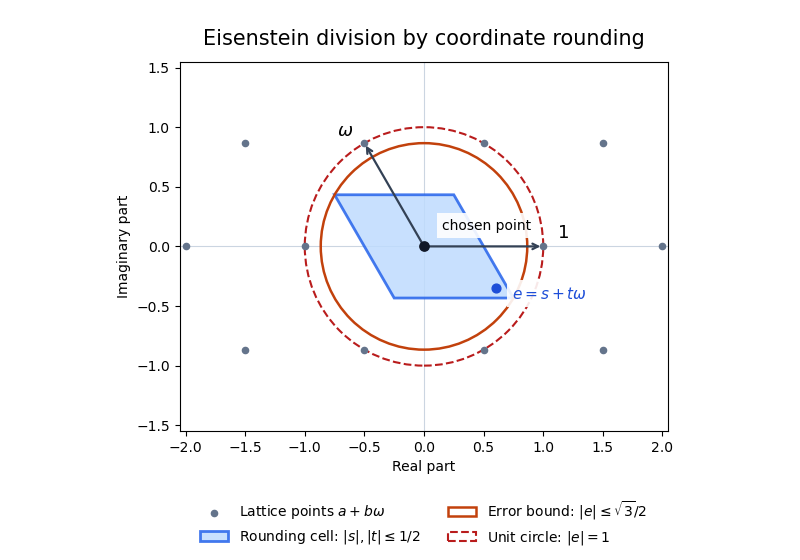
For with , write with real . Choose integers with , and let . With and ,Consequently belongs to and satisfies when . This proves is a Euclidean domain with Euclidean function , the Euclidean norm on the Eisenstein integers.

For the representation of the prime , first note that . Now suppose and . The factorizationshows that the Eisenstein integer divides a product. It divides neither factor: an element lies in exactly when both integer coefficients are divisible by , and the second coefficients here are and . Hence is not a prime element of .
To justify the necessary factorization step, in any principal ideal domain an irreducible element is prime. If , write . Since , irreducibility makes a unit or an associate of . The latter would give , so is a unit and for some . If , multiplication of this identity by gives . This proves irreducible elements of a principal ideal domain are prime without assuming unique factorization.
By part (a), is a principal ideal domain. The integer has norm , so it is a nonzero nonunit. Since it is not prime, the result just proved implies that it is reducible: with both nonunits. A nonzero element of is a unit exactly when its norm is one, since gives inverse and multiplicativity proves the converse. ThusThe only possible positive integer factors exceeding one are . Writing givesThis is the prime representation by the Eisenstein norm argument.
Articles by others on the same topic
There are currently no matching articles.