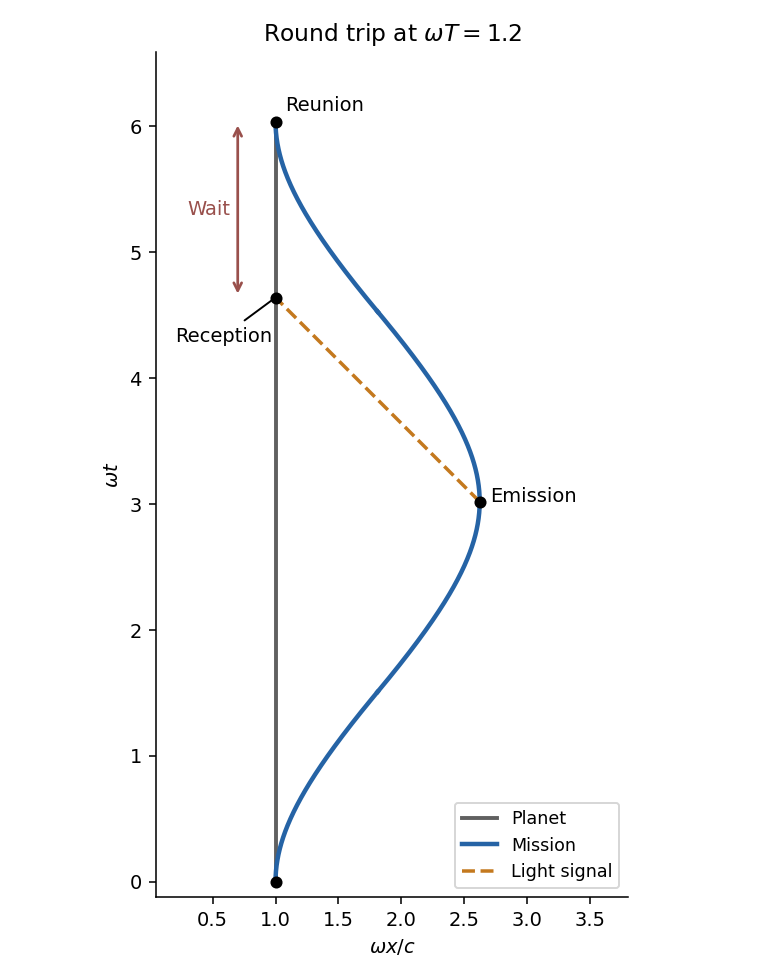
At and , the mission is at the planet's position . The final coordinate time from the last segment isThe planet is at rest in these coordinates, so its proper time elapsed equals this coordinate-time difference. The astronauts' proper time is the parameter interval, . ThereforeFor proper acceleration and , seconds, approximately one year. Thus and . Neglecting in the hyperbolic sine,The clocks compare two different timelike paths between the same departure and reunion events.
Put . At emission, , the middle segment givesThe planet is at , so the inward light signal takes coordinate timeIts arrival time on the planet is therefore . Subtract this from the mission's return time :For large at fixed acceleration this tends to . With the Earth-gravity value above, the wait is approximately two years, despite the millions of planet-years elapsed since departure in part (i).

Articles by others on the same topic
There are currently no matching articles.