Use the Minkowski metric with signature and write , . Future-pointing timelike means and . Thusso is again future-pointing timelike.
Let and . In a Lorentz frame where , the future-pointing vector has . Consequently , with equality exactly when has no spatial component in that frame. HenceTaking positive square roots provesEquality holds exactly when are positive scalar multiples of each other. This is the reverse triangle inequality for future timelike vectors, not the Euclidean triangle inequality.
Take spacetime coordinates . Differentiating the initial segment gives the four-velocityThe identity gives , and . The proper time element therefore satisfies , with the future orientation selecting . Thus is proper time along this path.
Since is proper time, the four-acceleration isIts Minkowski norm squared is , so the invariant magnitude of proper acceleration isThe vector is spacelike, which accounts for the minus sign under the square root.
Differentiate each segment and express the four-velocity using a continuous rapidity:At both rapidities are ; at both are . Hence the four-velocity is continuous at both junctions. This expression also gives everywhere, so the parameter remains proper time on the later segments.
Away from the junctions,with successively . The rapidity is continuous but its slope reverses. Thus the four-acceleration has a finite jump to its negative at each junction, while its magnitude stays on either side. There is no velocity jump; the idealized path is continuously differentiable but not twice differentiable at the switching events.
At and , the mission is at the planet's position . The final coordinate time from the last segment isThe planet is at rest in these coordinates, so its proper time elapsed equals this coordinate-time difference. The astronauts' proper time is the parameter interval, . ThereforeFor proper acceleration and , seconds, approximately one year. Thus and . Neglecting in the hyperbolic sine,The clocks compare two different timelike paths between the same departure and reunion events.
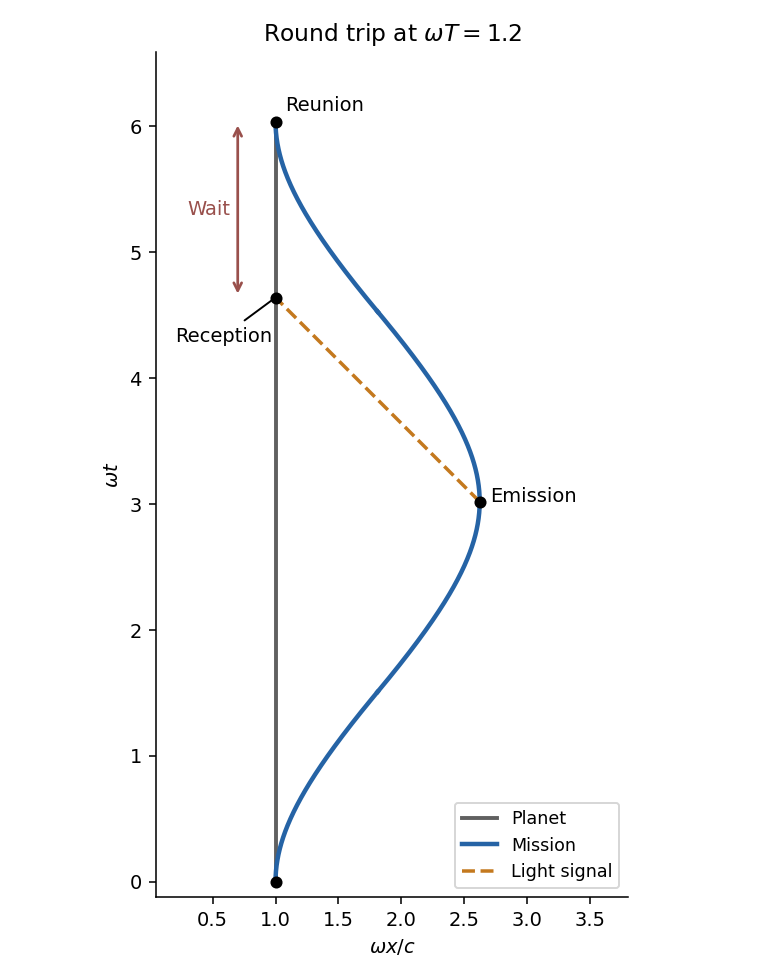
Put . At emission, , the middle segment givesThe planet is at , so the inward light signal takes coordinate timeIts arrival time on the planet is therefore . Subtract this from the mission's return time :For large at fixed acceleration this tends to . With the Earth-gravity value above, the wait is approximately two years, despite the millions of planet-years elapsed since departure in part (i).

Articles by others on the same topic
There are currently no matching articles.