The susceptible compartment retains individuals, gains recruits per generation and loses through infection. The mass-action interaction term represents new infections generated by encounters between susceptible and infectious individuals. Those new cases form the next infectious compartment, ; the current infectious generation leaves that compartment after one time step.
The initial conditions specify the starting susceptible and infectious counts. The parameter is the transmission coefficient in this deterministic approximation, while supplies new susceptible individuals. This is the discrete susceptible-infective model with recruitment.
At a fixed point the first equation gives . The second gives , so andThere is no disease-free fixed point: with , susceptibles still increase by each step.
Set . The Jacobian matrix of the update at the fixed point isIts characteristic equation and multipliers areFor , these are distinct complex conjugates with product one, so both have modulus one. The linearized iterates are bounded and oscillatory: neutral linear stability holds for , with no linear asymptotic attraction.
At , the repeated multiplier is , but . Writing gives , and , so generic linearized perturbations grow linearly. For , a real multiplier has modulus greater than one. Thus the equilibrium is linearly unstable for .
For the unit-modulus range, the nonlinear behavior is not determined by this calculation: unit-modulus multipliers do not determine nonlinear stability.
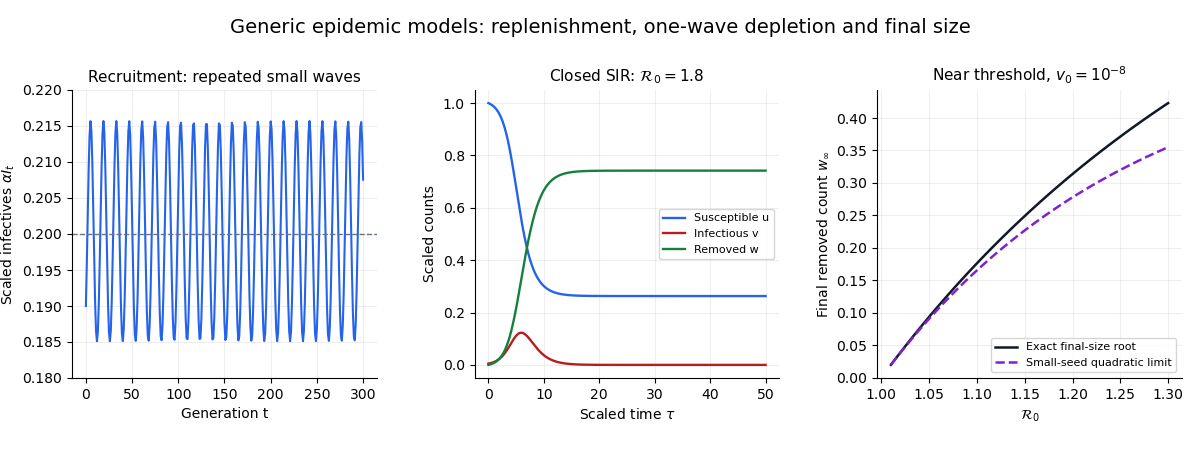
Yes, susceptible replenishment allows repeated outbreaks. While , the infection ratio isInfection grows above the susceptible threshold and declines below it. A wave depletes susceptibles; subsequent recruitment can restore the threshold and permit renewed growth. In the neutral linear regime, perturbations around the positive fixed point oscillate, so repeated small waves occur for sufficiently small perturbations over any fixed finite observation period.
For example, in scaled variables , , the choice , , produces the repeated positive waves illustrated below. This finite trajectory illustrates recurrence of outbreaks without claiming a nonlinearly attracting periodic orbit from the linearization alone. If exactly, the deterministic model has no infectious seed and stays zero.
Assume and scale by the initial susceptible count:Substitution into the SIR model equations givesThe initial data become , , . The conserved total is , since the scaling is by , not by . With this normalization, is the reproduction ratio at the initial susceptible level.
If the seed is positive, infection initially increases precisely whenIndeed, . Susceptibility is nonincreasing, so if , the infectious count never starts an increasing phase. When , it grows until , the SIR infection peak, and then declines.
The basic reproduction number compares transmission and removal: one infectious individual generates infections at initial rate and remains infectious for mean time . Their product is the expected number of secondary cases at that susceptible level. Above one, an infectious generation can replace itself with more cases. An exactly zero infectious seed remains zero regardless of this threshold.
Divide the susceptible equation by the removed equation, or differentiate the resulting invariant directly, to get . The initial data give the SIR susceptible-recovered identityPopulation conservation then gives . Since , the Taylor expansion for small yieldsAt the end of the outbreak, the infectious count approaches zero. The positive root of the quadratic approximation isFor and a seed satisfying , this reduces toThe truncation also requires , hence a near-threshold regime . The seed must be small but positive: setting it identically to zero gives no epidemic. This is the near-threshold SIR final-size expansion, and the physical removed count is .

Articles by others on the same topic
There are currently no matching articles.