Source paper: released examination archive, member
2016/T/a13752w1.pdf. The original cover dates this examination to 2017-06-19.An intact copy in the Mathematics Part A release, member
FOI-20210708-1 - Data/a13752w1 (2).pdf, restores printed pages 2–3. All nine questions, comprising 51 leaf subparts, are answered below. The earlier source provenance above is retained.For distinct odd primes , quadratic reciprocity statesHere the Legendre symbol records whether a nonzero congruence class is a quadratic residue. The first supplementary law for quadratic reciprocity and second supplementary law for quadratic reciprocity giveThus minus one is a square exactly when , and two is a square exactly when or .
To test the specified congruence class, factor . Since , multiplicativity of the Legendre symbol and quadratic reciprocity yieldThere is no sign change on swapping and because . Finally , so multiplicativity of the Legendre symbol gives , since . Therefore
For an odd prime , Euler's criterion statesFor , the Legendre symbol is for a quadratic residue and for a quadratic nonresidue; if , both sides are zero.
The product is a single power because the arithmetic progression of exponents has sum :Since , the second supplementary law for quadratic reciprocity gives . Hence Euler's criterion gives . Reduce the exponent using and :The least nonnegative remainder is therefore .
Euler's totient function counts the integers in a complete complete residue system that are coprime to the modulus:If the prime factorization is with distinct prime numbers , Euler's totient product formula isIn particular, . Adjoining the prime factor changes neither the odd factor nor its count of units, since . The product formula givesThis is a positive integer distinct from , as required.
The Chinese remainder theorem says that for pairwise coprime positive moduli and arbitrary integers , the simultaneous modular congruenceshave a solution, unique modulo .
Choose distinct prime numbers . Their prime powers are pairwise coprime. Apply the Chinese remainder theorem toFor the resulting integer , each is divisible by , the required power of an integer greater than one. Adding a sufficiently large multiple of makes positive without changing any modular congruence. Thus such a positive exists, indeed infinitely many do. This is the general construction of consecutive integers divisible by prescribed prime powers.
Use the fact that is a normal subgroup to move a factor of past a factor of . For and ,whileThe identity element belongs to . Hence is a subgroup, by the subgroup test. This proves the product of a subgroup with a normal subgroup construction; need not be a normal subgroup.
For each , conjugation maps to itself and respects its multiplication. The inverse of is , so both are group automorphisms of .
The printed formula requires a composition convention. For the printed , ordinary function composition givesIndeed, . Thus the displayed assignment is a group antihomomorphism with the usual multiplication in the automorphism group. It is a group homomorphism if the automorphisms are written as right operators and multiplied in the corresponding reverse order; this is precisely why right conjugation reverses composition.
With the usual left function composition, the corresponding group homomorphism is insteadDirect expansion gives . This states the intended conjugation action without silently reversing the order in the printed formula.
Write the group order as , where is a prime number and . A Sylow p-subgroup is a subgroup of group order , the largest power of dividing .
The three Sylow theorems assert:
- Existence: a Sylow p-subgroup exists, and every subgroup of prime power order a power of is contained in one.
- Conjugacy: any two Sylow p-subgroups are conjugate in .
- Counting: their number satisfies and .
In particular, a unique Sylow p-subgroup is a normal subgroup, since all its conjugates must equal it.
The Sylow theorems give and . Among the divisors , only satisfies the modular congruence. HenceUniqueness and the conjugacy assertion of the Sylow theorems make a normal subgroup.
The Sylow theorems also give and . Of , only is congruent to one modulo five. Thus is a normal subgroup of as well.
By Lagrange's theorem, , since its group order divides both and . For and , the group commutator lies in by the normal subgroup property of , and in by the normal subgroup property of . It is therefore the identity element, so all elements of commute with all elements of . This is the fact that normal subgroups of coprime order commute.
The subgroup consequently has elements: the expression is unique because . Since and have prime orders, they are cyclic groups. Write and . The product of commuting elements of coprime order has order , so generates . Finally, is a normal subgroup because both its factors are normal subgroups; equivalently, it has subgroup index two. Therefore
Put , the normal subgroup of order . By Cauchy's theorem for finite groups, contains an element of order two. Such an element cannot belong to the odd-order subgroup . Thus and , giving the semidirect productEvery automorphism of a finite cyclic group sends to for a unit modulo . The relation forces the conjugation action of to square to the identity:The Chinese remainder theorem identifies a congruence class modulo with its pair of classes modulo and . In each of these prime fields, the factorization forces or . The choices are independent, giving exactly four homomorphisms from a finite cyclic group . Explicitly,The factors and of are preserved by every automorphism, since each is its unique subgroup of that order. The four conjugation actions therefore give:
- : the action is trivial on both factors, so , by cyclicity of a product of two finite cyclic groups.
- : the action inverts both factors, so is the dihedral group .
- : it is the identity modulo and inversion modulo , so the factor commutes with the other factors and .
- : it is inversion modulo and the identity modulo , giving .
Here has group order , as in the paper. The center of a group distinguishes these four groups of order seventy: its orders are , respectively, so the four groups are pairwise nonisomorphic. Each construction is a semidirect product with elements, so every listed possibility occurs.
The real projective plane is the set of one-dimensional linear subspaces of . Equivalently,A projective point is written in homogeneous coordinates . A projective line is the set of projective points whose representatives belong to one fixed two-dimensional linear subspace of . Such a linear subspace is the kernel of a linear map of a nonzero linear functional, so its equation has the form with .
Two distinct projective points have linearly independent representatives . Their linear span has dimension two and hence defines a projective line containing both. Conversely, any two-dimensional linear subspace containing both representatives contains their entire linear span and therefore equals it. Thus exactly one projective line passes through two distinct projective points.
For representatives and , a point belongs to their projective line exactly when these three vectors are linearly dependent. The determinant criterion givesExpanding along the first row givesThe coefficient vector is the cross product . It is nonzero because the projective points are distinct. Rescaling either representative merely rescales all three coefficients, leaving the projective line unchanged. This is the join formula in projective joins and meets by cross products.
Two projective triangles are in perspectivity from a point when their three corresponding-vertex projective lines , , and all pass through .
Desargues's theorem: perspectivity from a point implies perspectivity from a line. More explicitly, if are concurrent, then the three corresponding-side intersectionsare collinear. The usual statement assumes nondegenerate projective triangles and well-defined, distinct corresponding-side intersections. The projective line containing is the axis of perspectivity from a line. All intersections are projective: parallel lines in an affine chart meet on its projective line at infinity.
The dual projective space is . A projective line with coefficients becomes a projective point in this dual plane; a projective point becomes the dual projective line .
The point-line duality reverses incidence:Thus the dual statement is that the dual point lies on the dual line . A join of projective points becomes an intersection of dual projective lines, and the converse holds too. In particular, collinear projective points correspond to concurrent dual projective lines.
The dual of Desargues's theorem is its converse: if the intersections of the three pairs of corresponding sides are collinear, then the three lines joining corresponding vertices are concurrent. In the same nondegenerate setting, perspectivity from a line therefore implies perspectivity from a point.
Apply projective joins and meets by cross products to each corresponding pair. The cross products of their representatives are proportional to , , and , respectively. HenceTheir common point isIt is a valid projective point, because its representative is nonzero. The three equations force , so this common projective point is unique. Thus the two projective triangles are in perspectivity from a point .
The corresponding side equations, computed using projective joins and meets by cross products, areSubtracting the two equations in each row and substituting back gives the three projective pointsFor example, the first pair forces and ; the second pair forces and ; the last pair forces . All three satisfysince , , and . The coefficient vector is nonzero, so this is a projective line. Thus the corresponding-side intersections are collinear, explicitly confirming Desargues's theorem.
The diagram uses the affine chart with coordinates and . Here the center is finite, the axis is , and lies on the projective line at infinity. The apparent parallelism of and records their common vertical point at infinity, which also belongs to the axis.
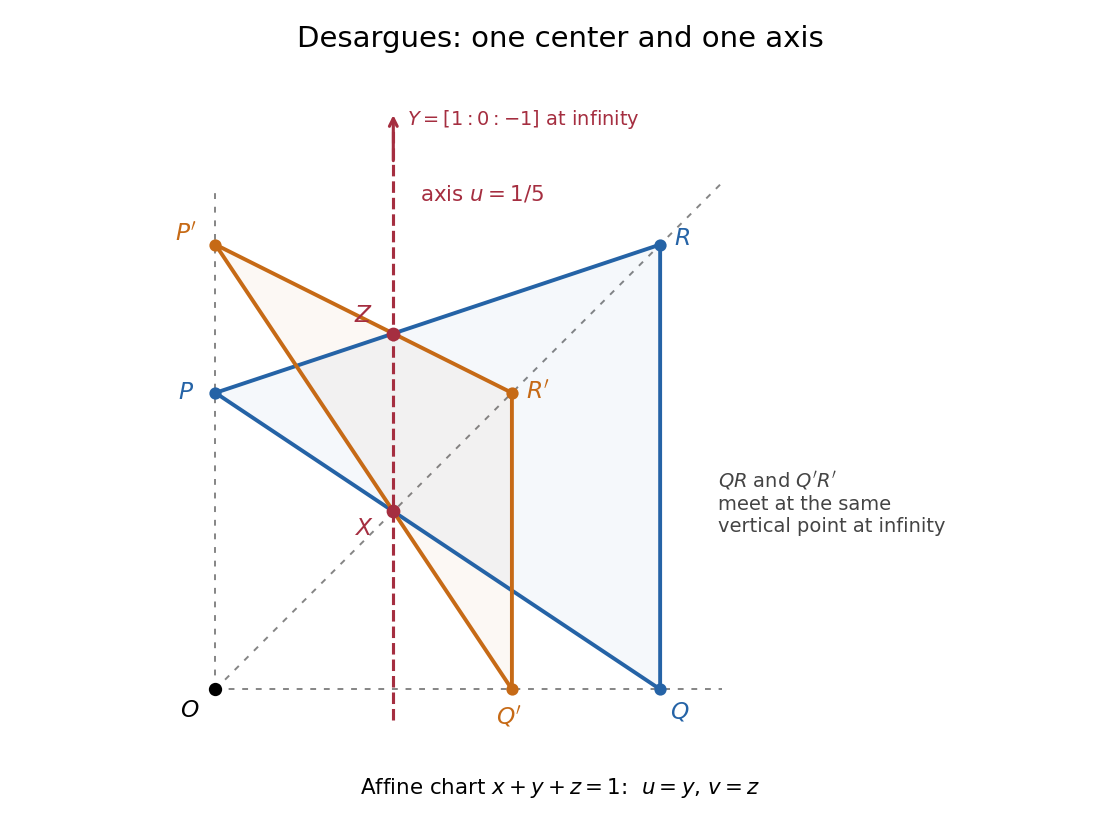
Desargues's theorem: three connectors meet at O and three side intersections lie on one projective line
. Original drawing in the affine chart x+y+z=1. Blue and orange triangles are in perspectivity from O. Two side intersections X and Z lie on the red vertical axis; the third intersection Y is its vertical point at infinity. Details.The map is differentiable at if there is a linear map such thatEquivalently, . This linear map is unique and is the Fréchet derivative . Its matrix in the standard bases is the Jacobian matrix, whose entry is at . A function is differentiable on its domain if this condition holds at every point.
A sufficient condition is that the derivative is surjective, equivalently that its Jacobian matrix has rank . Then the implicit function theorem makes the zero set near a embedded submanifold of dimensionThe rank condition persists nearby because the derivative is continuous. This is the local form of the regular level set theorem; only the rank at the specified point is needed for this local conclusion.
Expand the increment of the quadratic form, using :The last term obeys . Thus is differentiable andThis is the quadratic form gradient. The derivative is a linear functional of the increment , whereas the gradient is its representing vector under the Euclidean inner product.
Since is invertible, the quadratic form gradient vanishes exactly at the origin. At every nonzero point of , the scalar derivative is surjective, so the regular level set theorem gives a smooth submanifold of dimension .
If , the nontriviality assumption forces the form to be an indefinite quadratic form: an invertible definite form would have zero set consisting only of the origin. Every nonzero point is regular. To show that the origin really fails to be a manifold point, use Sylvester's law of inertia to reduce to . With positive and negative coordinate vectors , the null vectors and span . Each line in one of these directions lies in the cone.
If a relatively open manifold neighborhood of the origin existed, its tangent space would contain all these line directions, so would have dimension . Such an embedded manifold would be open in , impossible for the zero set of a nonzero quadratic form. ConsequentlyThis gives the smooth locus of a nondegenerate real quadratic level set, including maximality at the singular vertex.
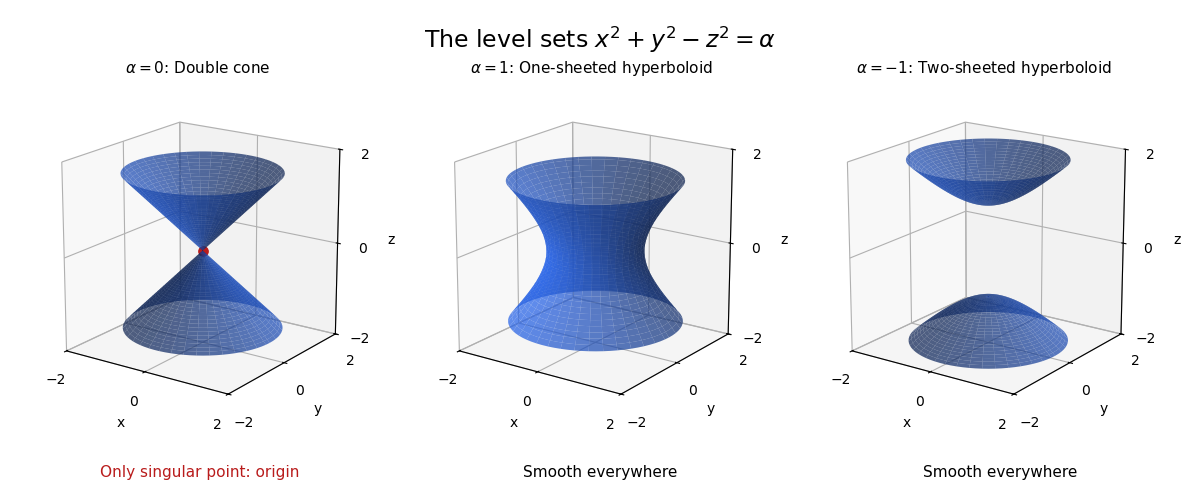
- : a circular double cone, . Its vertex at the origin is the sole singular point; every other point is a smooth surface point.
- : a one-sheeted hyperboloid, with horizontal radius . It is smooth everywhere.
- : a two-sheeted hyperboloid, . Both sheets are smooth everywhere, including their tips .
The cone vertex is an instance of the double cone singularity. The tips of the two-sheeted hyperboloid are regular because the gradient is nonzero there.
Use the angular-frequency Fourier transform conventionFor with the usual local absolute-continuity hypothesis, the Fourier transform of a derivative isFor example, this applies when is and both displayed functions are integrable. These assumptions make integration by parts valid and the endpoint terms vanish.
Split the integral at the origin and reflect the negative half:Thus the Fourier transform of a two-sided exponential is
With this convention, the Fourier inversion theorem states that if , thenalmost everywhere and at every continuity point of . Apply this to the continuous function in part (ii):The denominator is even. Replacing by and renaming the integration variable givesBoth integrable members of this transform pair satisfy the inversion hypotheses.
Complete the square: . In the Fourier transform, the substitution givesThe phase is important. Taking the real part at gives the cosine integral, since changing the sign in the exponential does not change its real part:
For integrable functions , the convolution theorem in the chosen convention isLet be the Fourier transform of in the horizontal coordinate. Transforming Laplace's equation givesFor , exclude the growing exponential and obtain . At , continuity in frequency gives ; a constant zero-frequency transform is compatible with spatial decay of .
By the transform pair in part (a), the inverse transform of is the Poisson kernel for the upper half-plane, . ThusThe Poisson extension of exponential boundary data is harmonic, approaches the continuous boundary data and decays at spatial infinity. For uniqueness, apply the maximum principle for harmonic functions to the difference of two solutions on increasingly large half-discs: it is zero on the real boundary and uniformly small on the distant semicircle.
Use the squaring map from a quadrant to the upper half-plane:By conformal invariance of harmonicity, the answer isOn the horizontal axis it gives , and on the vertical axis it gives . Also , so spatial infinity maps to spatial infinity and the required decay follows. The two boundary values agree at the origin.
Apply a constant Lagrange multiplier to the isoperimetric constraint, using the augmented functional . Its integrand isThe Euler-Lagrange equation gives , henceThe multiplier rule applies because the constraint derivative in direction is , so the constraint derivative is not zero. The prescribed endpoint values remove boundary variations.
Multiply the Sturm-Liouville equation by and integrate. The endpoint values and integration by parts giveSince ,Thus the multiplier equals the stationary value of at the extremal, as in stationary values of a quadratic functional with a quadratic constraint. It is also the corresponding Rayleigh quotient.
Multiply the equation for by and that for by , then subtract. Integrating the resulting identity yieldsAll endpoint terms vanish because both functions satisfy the zero Dirichlet boundary conditions. Since the multipliers differ,This is the weighted orthogonality of Sturm-Liouville eigenfunctions.
Part (a)(ii) now givesIf , continuity makes identically zero. Thus is constant, and the boundary condition forces , contradicting . Hence
The extremal equation is . For , its general solution is . The left endpoint forces , while the right endpoint and require . ThereforeIn particular, each extremal has the requested Fourier sine series form . More strongly, for an individual extremal only the coefficient at can be nonzero. An arbitrary combination of distinct modes is an admissible function, but does not solve this one-eigenvalue equation.
For , both the constraint and endpoint values hold, the extremal equation has , and direct integration gives .
For any admissible function, its derivative has Fourier cosine series coefficients and zero constant coefficient. This follows by integration by parts: , and . Thus the Parseval identity givesFor finite sums the same identity follows directly from the cosine product formula in the hint; the identity justifies the general case. Equality holds only if for all , and normalization then fixes . ThereforeThis is the minimum Dirichlet energy at fixed L2 norm on an interval, equivalently the sharp Wirtinger inequality for this interval.
A tree is a connected graph with no cycles. Equivalently, between any two of its vertices there is exactly one graph path. A single vertex with no edges is also a tree.
A shortest path from to is a graph path joining these endpoints such thatfor every other -path in , where is the sum of its edge weights. Here paths have no repeated vertices; minimizing over unrestricted walks is a different problem when negative edge weights occur.
A shortest-path tree rooted at is a spanning tree of for which the unique -path in is a -shortest -path in for every vertex . It simultaneously realizes all distances from the root. It need not be a minimum spanning tree, which minimizes total tree weight instead.
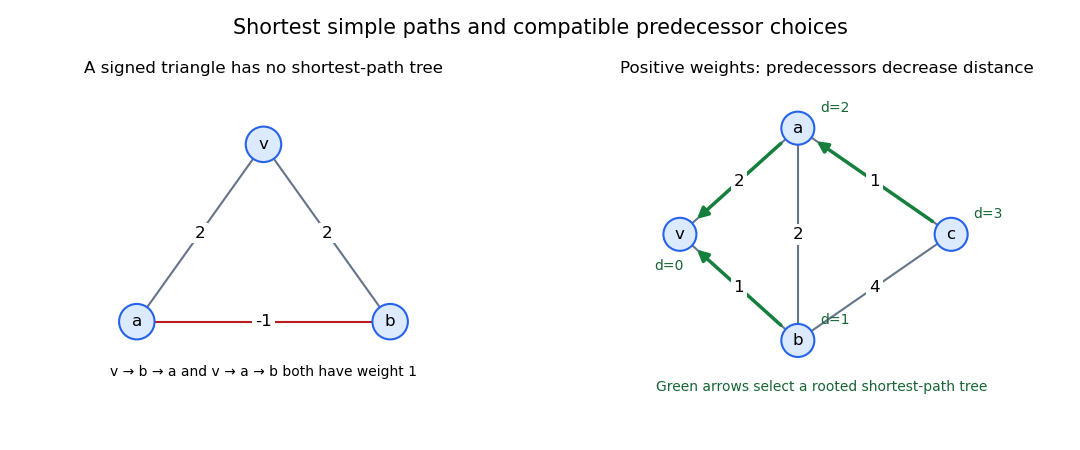
Use a triangle with vertices and weights , . The unique shortest -path is , of weight one, while the unique shortest -path is , also of weight one. A shortest-path tree would therefore need all three edges of the triangle. This is impossible for a tree.
Thus negative edge weights can prevent a shortest-path tree, even though the shortest simple path to each individual vertex exists. This is the example in signed edge weights can prevent a shortest-path tree.
Under the usual walk convention allowing repeated edges, the stated hypothesis is insufficient. Take the connected graph consisting of one zero-weight edge . It has no simple cycles, so the cycle condition holds. Nevertheless is a minimum-weight -walk of weight zero and is not a path.
If the course uses “walk” to mean an edge-nonrepeating trail, the intended argument is valid. If such a minimum trail repeats a vertex, take its first repeated-vertex segment. Its interior vertices are distinct and no edge repeats, so this segment is a simple cycle . Removing it leaves an -trail of weight , a contradiction. Hence is a path. Since every -path is a competing trail, it is a shortest path.
For unrestricted walks, the same proof works if every nontrivial closed subwalk has positive weight, in particular if every edge has positive weight. This is cycle erasure in minimum-weight walks. The exact 2017 course convention was not available to check; the counterexample and the trail interpretation distinguish the two meanings explicitly.
Let be the weight of a shortest -path, and let be the predecessor of on the chosen . Its prefix to must also be shortest: a cheaper prefix followed by the final edge would give a cheaper walk to , and cycle erasure in minimum-weight walks would produce a cheaper path because every edge weight is positive. ThereforeFollowing predecessor arrows strictly decreases , so cannot revisit a vertex. Since each nonroot vertex has a predecessor, finiteness forces every predecessor chain to end at . Thus is connected.
The edges are distinct: if two vertices selected the same undirected edge, each would be the other's predecessor, contradicting strict decrease. Hence has exactly edges. A finite connected graph with this edge count is a tree. This proves that positive-weight shortest-path predecessors form a tree, without requiring the initially chosen paths to be mutually consistent.
The unique root-to- path in is the reversal of its predecessor chain. Every edge satisfies . Summing along that chain telescopes tosince for positive weights. Thus the tree path is a shortest -path in for every , and is a shortest-path tree rooted at .


Articles were limited to the first 100 out of 126 total.
Articles by others on the same topic
There are currently no matching articles.