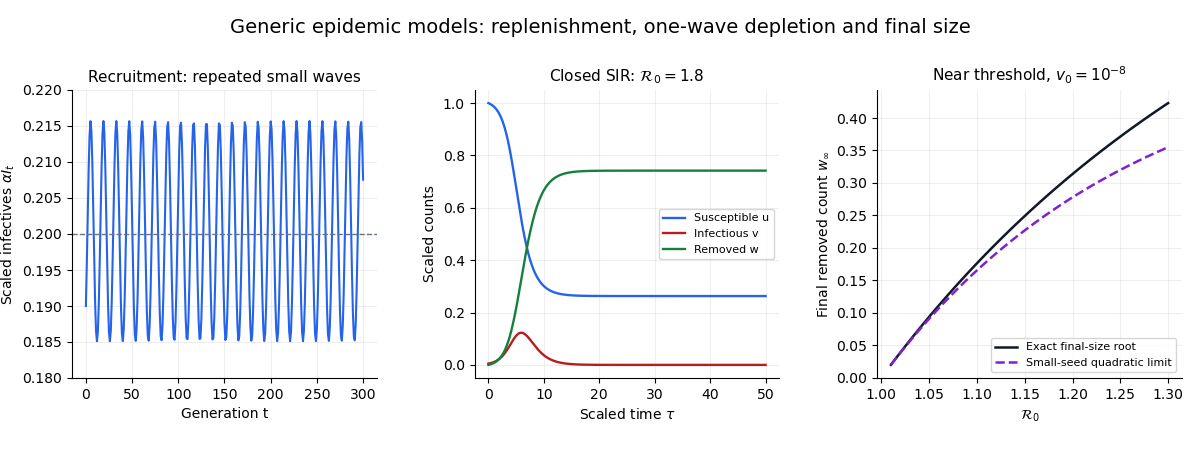
Assume and scale by the initial susceptible count:Substitution into the SIR model equations givesThe initial data become , , . The conserved total is , since the scaling is by , not by . With this normalization, is the reproduction ratio at the initial susceptible level.
If the seed is positive, infection initially increases precisely whenIndeed, . Susceptibility is nonincreasing, so if , the infectious count never starts an increasing phase. When , it grows until , the SIR infection peak, and then declines.
The basic reproduction number compares transmission and removal: one infectious individual generates infections at initial rate and remains infectious for mean time . Their product is the expected number of secondary cases at that susceptible level. Above one, an infectious generation can replace itself with more cases. An exactly zero infectious seed remains zero regardless of this threshold.
Divide the susceptible equation by the removed equation, or differentiate the resulting invariant directly, to get . The initial data give the SIR susceptible-recovered identityPopulation conservation then gives . Since , the Taylor expansion for small yieldsAt the end of the outbreak, the infectious count approaches zero. The positive root of the quadratic approximation isFor and a seed satisfying , this reduces toThe truncation also requires , hence a near-threshold regime . The seed must be small but positive: setting it identically to zero gives no epidemic. This is the near-threshold SIR final-size expansion, and the physical removed count is .

Articles by others on the same topic
There are currently no matching articles.