The four points form a projective frame: no three are collinear. By the allowed uniqueness theorem and cross-ratio invariance, useIntersecting the indicated projective lines givesA point of has coordinates . Intersecting with , whose equation is , gives . On that line use its first two homogeneous coordinates. The cross-ratio from (a)(ii) isThe characteristic of a field being zero ensures that . The construction is the diagonal-point property of a complete quadrangle, producing harmonic conjugate points.
Choose a point off , then a point on distinct from . PutThese four points form a projective frame: lie off , and meets at neither nor . Form, using only joins and intersections,Here the point called in (i) is , while is . Thus (i) gives . Interchanging the last two arguments reciprocates the cross-ratio, soAll auxiliary choices are possible over a field of characteristic zero, which is infinite. Uniqueness from (a)(ii) shows that the final point is independent of those choices. The picture uses an affine chart in which every relevant intersection is finite; parallel-line exceptions in another chart are ordinary intersections on the projective line at infinity.
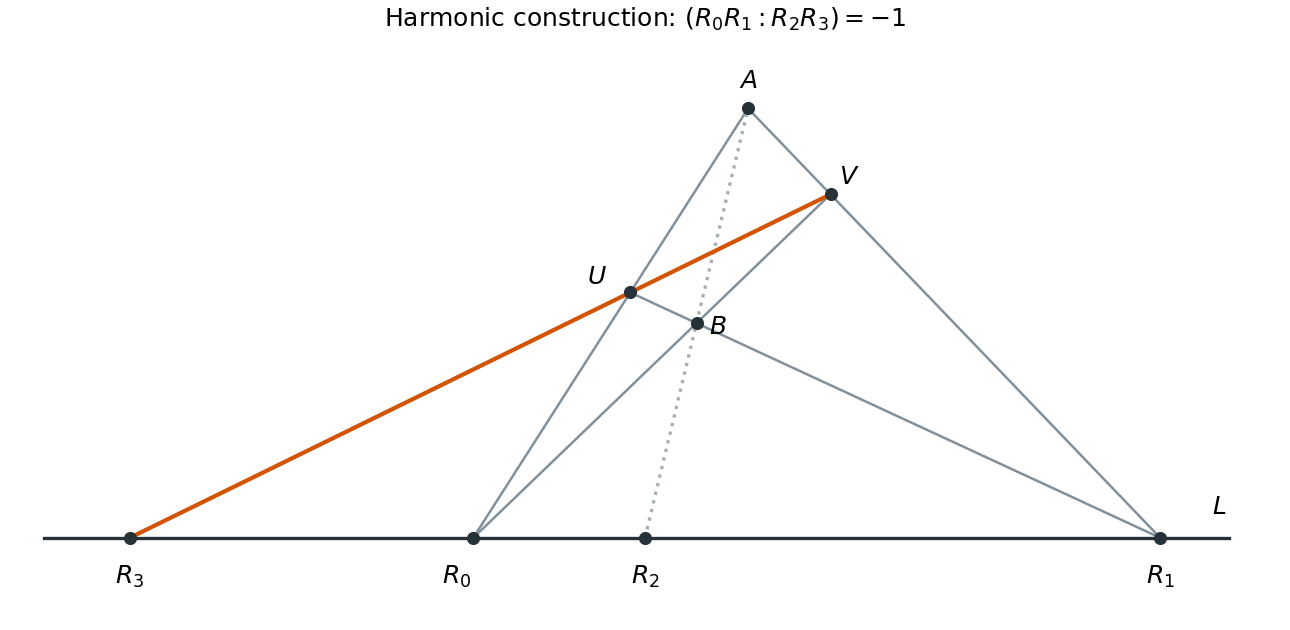
Construction of harmonic conjugate points by joins and intersections
. Details. 
Articles by others on the same topic
There are currently no matching articles.