A projective transformation of is induced by an invertible linear map :This is well defined because replacing by a nonzero scalar multiple does not change . Multiplying by a nonzero scalar also leaves unchanged. Conversely these are precisely the transformations in the projective linear group . No field automorphism is included in this definition.
Choose nonzero vectors representing , and write . Use the cross-ratio conventionDistinctness makes the denominator nonzero. Every rescaling of a representative occurs once in numerator and denominator, so the value depends only on the projective points. Swapping both pairs simply exchanges the numerator's factors and the denominator's factors:Under an invertible linear map , . Two factors of occur above and below the fraction, proving projective transformation invariance.
Finally choose homogeneous coordinates making , , . This normalization exists by the allowed theorem about a projective frame. A point distinct from is uniquely , and the displayed cross-ratio is . Thus equality of the two cross-ratios forces equal coordinates andThis also shows that for fixed first three distinct points the fourth point is determined by its cross-ratio.
Conjugate by a projective transformation sending to and to . A matrix representing the conjugated transformation must have zero diagonal, since its first column represents and its second represents . Therefore it has the formIts square is , a nonzero scalar matrix, which induces the identity on the projective line. Conjugating back provesFor the requested explicit involution, takeMore generally works whenever .
The four points form a projective frame: no three are collinear. By the allowed uniqueness theorem and cross-ratio invariance, useIntersecting the indicated projective lines givesA point of has coordinates . Intersecting with , whose equation is , gives . On that line use its first two homogeneous coordinates. The cross-ratio from (a)(ii) isThe characteristic of a field being zero ensures that . The construction is the diagonal-point property of a complete quadrangle, producing harmonic conjugate points.
Choose a point off , then a point on distinct from . PutThese four points form a projective frame: lie off , and meets at neither nor . Form, using only joins and intersections,Here the point called in (i) is , while is . Thus (i) gives . Interchanging the last two arguments reciprocates the cross-ratio, soAll auxiliary choices are possible over a field of characteristic zero, which is infinite. Uniqueness from (a)(ii) shows that the final point is independent of those choices. The picture uses an affine chart in which every relevant intersection is finite; parallel-line exceptions in another chart are ordinary intersections on the projective line at infinity.
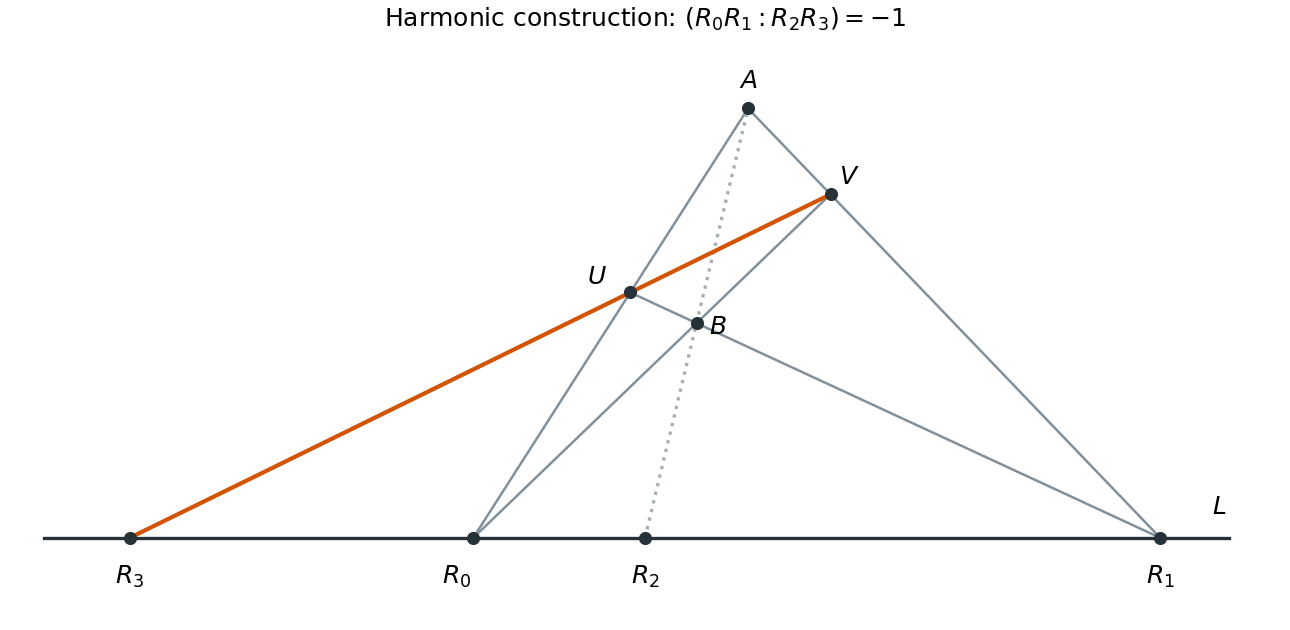
Construction of harmonic conjugate points by joins and intersections
. Details. 
Articles by others on the same topic
There are currently no matching articles.