Abbreviate , . The coordinate factors immediately give the three boundary equilibria . The Jacobian matrix isAt , the eigenvalues are , so it is a repelling equilibrium. At the other two points, triangularity givesTherefore is asymptotically stable for and a saddle point for ; is asymptotically stable for and a saddle point for . Equality gives a zero eigenvalue, so linearization alone is inconclusive there.
For later use, the coexistence point is physically positive exactly when if , or if . Its stability is as supplied in the question. If the displayed formula for does not apply: when also , the coincident non-axis nullclines give a whole segment of equilibria.
The non-axis nullclines are and . For , , the first has intercepts and the second has . Their axis intercept order rules out a positive intersection. Below the first line increases and above it decreases; below the second increases and above it decreases. Thus is a saddle point and is stable.
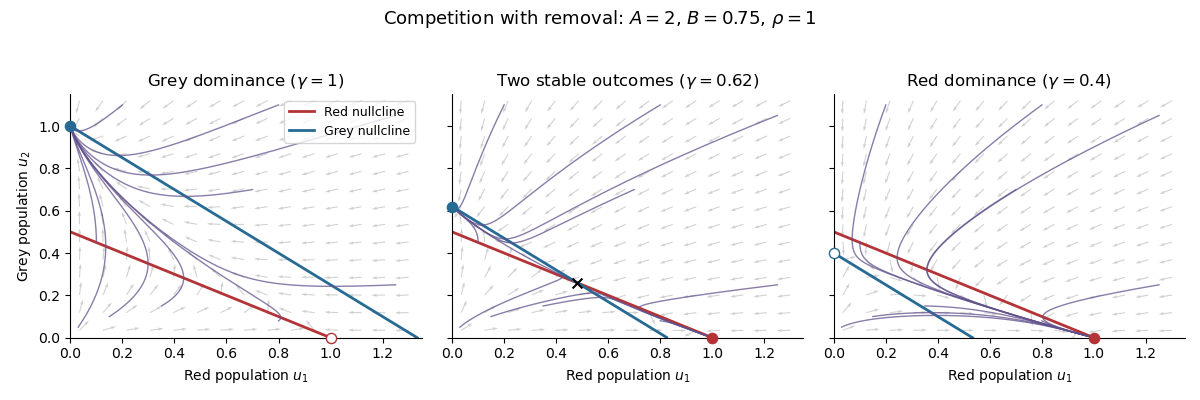

For strictly positive initial populations, both coordinates stay positive and are bounded above by their individual logistic equations. There are no interior periodic orbits: the Dulac function makes the divergence of the multiplied vector field , so the Bendixson-Dulac theorem applies. The stable manifold of is the invariant red-only axis, and is repelling. The phase portrait, or the Poincaré-Bendixson theorem with these boundary directions, therefore givesThe qualification matters: a grey population identically absent cannot drive extinction. In dimensional variables, positive grey presence leads to , in this no-hunting case.
Under , , , the thresholds are ordered . As decreases from one, first becomes stable atFor , both boundary equilibria are stable, and the positive coexistence point is a saddle point. Its stable manifold is the separatrix between their basins of attraction. For every fixed , a sufficiently small positive lies in the red-survival basin. To justify the quantifier beyond a neighborhood of , start on the red-only axis: its logistic equation approaches . Continuous dependence over the finite time needed to enter a stable neighborhood shows that sufficiently small positive initial grey populations do so as well.
At the second threshold, meets . For , is a saddle point, its stable manifold is the grey-only axis, and there is no positive coexistence equilibrium. Boundedness and the same Bendixson-Dulac theorem argument rule out an interior cycle. Consequently every initial state with and approaches . This is the removal regime that eliminates grey squirrels regardless of their initial abundance. At threshold equality linearization is nonhyperbolic; the strict parameter intervals above avoid inferring stability from a zero eigenvalue.
Articles by others on the same topic
There are currently no matching articles.