The terms give intrinsic per-capita population growth. The terms model intraspecific crowding in a logistic equation, while model interspecific competition. Here is the single-species carrying capacity, and measures the competitive effect of one unit of species relative to one unit of species in that species' crowding term. The last term is per-capita removal of grey squirrels: constant effort, rather than a constant number removed per unit time.
The intrinsic rates and removal rate have units of inverse time. The capacities have the same density units as the respective ; with both densities expressed in the same units, are dimensionless. The two equations form a Competitive Lotka-Volterra model with density regulation and harvesting.
Since , division of the equations by givesThus the dimensionless parameters areEach is a ratio of quantities with matching units. In particular can be negative even though every original model parameter is positive.
The nonnegative quadrant is invariant because both right-hand sides have the corresponding population as a factor. There . The differential inequality, or the Gronwall inequality, givesBiologically means : per-capita removal exceeds even the grey squirrels' maximum uncrowded growth rate. Competition can only strengthen the decline.
Abbreviate , . The coordinate factors immediately give the three boundary equilibria . The Jacobian matrix isAt , the eigenvalues are , so it is a repelling equilibrium. At the other two points, triangularity givesTherefore is asymptotically stable for and a saddle point for ; is asymptotically stable for and a saddle point for . Equality gives a zero eigenvalue, so linearization alone is inconclusive there.
For later use, the coexistence point is physically positive exactly when if , or if . Its stability is as supplied in the question. If the displayed formula for does not apply: when also , the coincident non-axis nullclines give a whole segment of equilibria.
The non-axis nullclines are and . For , , the first has intercepts and the second has . Their axis intercept order rules out a positive intersection. Below the first line increases and above it decreases; below the second increases and above it decreases. Thus is a saddle point and is stable.
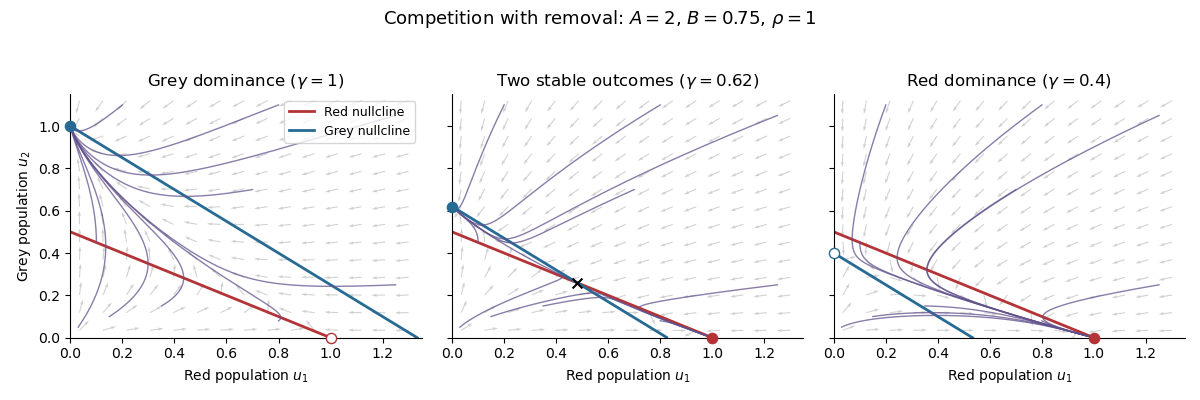

For strictly positive initial populations, both coordinates stay positive and are bounded above by their individual logistic equations. There are no interior periodic orbits: the Dulac function makes the divergence of the multiplied vector field , so the Bendixson-Dulac theorem applies. The stable manifold of is the invariant red-only axis, and is repelling. The phase portrait, or the Poincaré-Bendixson theorem with these boundary directions, therefore givesThe qualification matters: a grey population identically absent cannot drive extinction. In dimensional variables, positive grey presence leads to , in this no-hunting case.
Under , , , the thresholds are ordered . As decreases from one, first becomes stable atFor , both boundary equilibria are stable, and the positive coexistence point is a saddle point. Its stable manifold is the separatrix between their basins of attraction. For every fixed , a sufficiently small positive lies in the red-survival basin. To justify the quantifier beyond a neighborhood of , start on the red-only axis: its logistic equation approaches . Continuous dependence over the finite time needed to enter a stable neighborhood shows that sufficiently small positive initial grey populations do so as well.
At the second threshold, meets . For , is a saddle point, its stable manifold is the grey-only axis, and there is no positive coexistence equilibrium. Boundedness and the same Bendixson-Dulac theorem argument rule out an interior cycle. Consequently every initial state with and approaches . This is the removal regime that eliminates grey squirrels regardless of their initial abundance. At threshold equality linearization is nonhyperbolic; the strict parameter intervals above avoid inferring stability from a zero eigenvalue.
Write . The physically nonnegative branches, omitting , areOn both bifurcation diagrams, draw solid for and dashed for ; draw dashed for and solid for . The coexistence branch is dashed throughout its interior because it is a saddle point. It connects at to at , through two transcritical bifurcations when the branches are continued mathematically beyond the nonnegative quadrant.
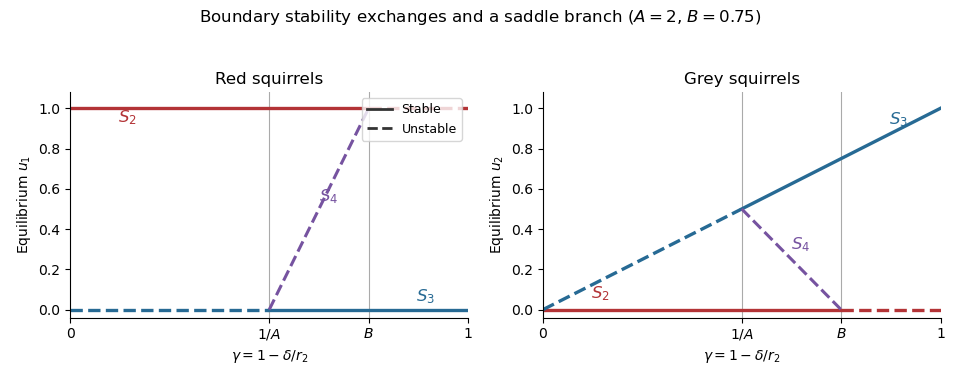
Stable boundary populations and the unstable coexistence threshold
. Original bifurcation diagrams for , . Solid branches are asymptotically stable, dashed branches unstable. The physically admissible coexistence branch joins the grey-only branch at to the red-only branch at . Details.
Since , increasing hunting effort moves leftward on these diagrams. The first stability threshold corresponds toAbove this removal rate, a sufficiently small grey population can be eliminated while reds recover. Until the second threshold, however, the system is bistable: an initially large grey population can still win, so the history and initial abundances matter. The second threshold isAbove it, any positive red population recovers and the grey population tends to zero, regardless of its initial abundance in this deterministic model. This threshold is smaller than , so competition from surviving reds can make eradication possible with less removal than would be necessary to suppress grey growth without competitors. If , part (a)(iii) supplies the simpler competitor-independent extinction bound. These are model predictions about long-term dynamics; neither finite-time extinction nor uncertainty in ecological parameters is encoded in the equations.
Articles by others on the same topic
There are currently no matching articles.