Landau damping is the collisionless decay of a plasma wave through resonant energy exchange with particles whose velocity is close to the wave's phase velocity vϕ=ω/k. Particles slightly slower than the wave tend to gain energy from it; particles slightly faster can give energy to it. For the decreasing resonant part of a Maxwell-Boltzmann distribution, the net transfer is from the wave to the electrons, so the wave amplitude decays.
In the linear Vlasov equation description this is collisionless phase mixing, not a requirement for frequent particle collisions. Fine-scale structure develops in the velocity dependence of the perturbation even while the macroscopic electric field decreases. The resonant contribution to the growth rate has the sign of ∂f/∂v at a positive wave phase velocity: a negative slope produces damping, whereas a sufficiently positive slope can drive an instability. A population comparison must be local to the resonance; merely counting all particles faster and slower than the wave is not the criterion.
Define the one-dimensional thermal widths σp=kBTp/me and σb=kBTb/me. Normalize each velocity distribution to its electron number density:The total is f=fp+fb. It consists of a broad peak centred at zero and a much narrower displaced beam near V, with V≫σp≫σb. Their areas, rather than their peak heights, are np and nb. A weak narrow beam can make a positive-slope region on its low-velocity side even while contributing little to the total density.
fp(v)=2πσpnpe−v2/(2σp2),fb(v)=2πσbnbe−(v−V)2/(2σb2).
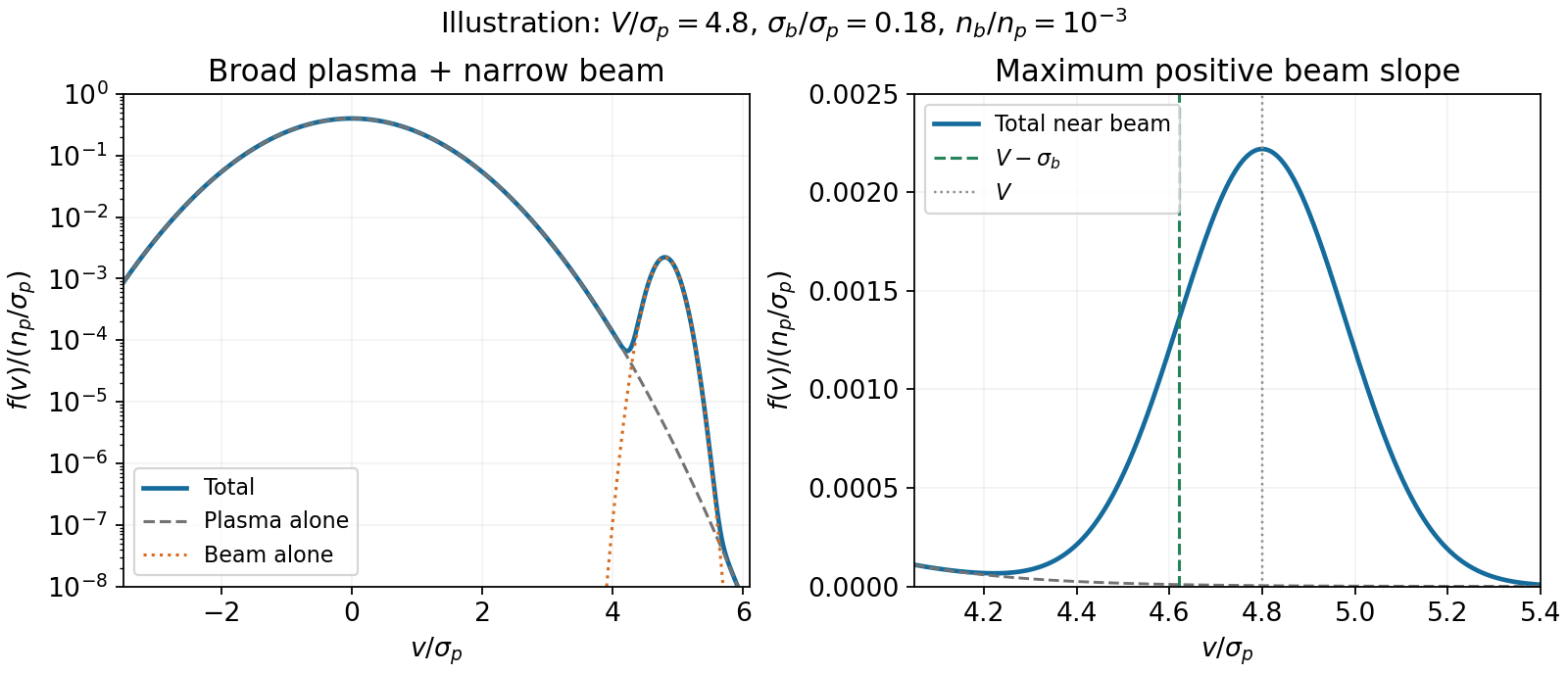

For the shifted beam Maxwell-Boltzmann distribution,On the rising flank put u=(V−v)/σb>0. The positive slope is proportional to ue−u2/2, whose derivative is (1−u2)e−u2/2. Its unique positive maximum is at u=1, givingThis is the region where beam drive can most readily overcome the negative plasma slope when that background changes little over the narrow beam width. It is an estimate for the first resonant unstable wave, not a proof that every beam-plasma dispersion relation has its exact marginal phase velocity at this value. Both the total slope and the real dispersion relation determine the exact marginal mode.
fb′(v)=2πσb3nb(V−v)e−(v−V)2/(2σb2).
vϕ≃V−σb=V−mekBTb.
At v∗=V−σb, the beam's positive slope is nbe−1/2/(2πσb2), while the background slope has magnitude npv∗e−v∗2/(2σp2)/(2πσp3). Thus a nonnegative total slope at this velocity requiresApproximating the background slope by its value at V yieldsEquality is the local marginal-slope condition; strict inequality gives positive resonant drive in this approximation. The numerical C is of order unity and can change when the resonant velocity is optimized or the full wave dispersion is retained.
npnb≥eσp3v∗σb2e−v∗2/(2σp2).
npnb>CkBTpmeTpVTbexp(−2kBTpmeV2),C=e.
Replacing v∗ by V in the exponential is controlled only if Vσb/σp2≪1, in addition to σb≪σp. The two width inequalities alone do not guarantee that extra condition far out on a Maxwellian tail. The preceding unapproximated slope inequality remains available when it is not satisfied.
Use kBTp=1000 eV and kBTb=100 eV. The nonrelativistic beam speed and cross-sectional area areHere V/σp=20, σb2/σp2=0.1, and the exponential in the requested threshold is e−10. With C=e,Converting beam density to the magnitude of its electric current givesThis is an order-of-magnitude estimate from the source's asymptotic formula. The numerical hierarchy is only moderate: Vσb/σp2=2. Retaining the background slope at V−σb instead gives about 9.1×10⁴ A as a sufficient positive-slope current at that chosen velocity. The difference quantifies the sensitivity of the exponential-tail approximation; an exact kinetic instability threshold requires the dispersion relation. The requested estimate is therefore on the scale of tens of kiloamperes, rather than a precisely determined current.
V=me2(10keV)≃5.93×10⁷ms−1,Ab=π(0.5mm)2.
(npnb)est=e(20)(0.1)e−10≃3.35×10⁻⁵.
Imin,est=enbVAb≃2.5×10⁴A.
Ancestors (10)
- S16
- 2012
- Past exam of the short options paper shared by Prelims and Parts A and B of the physics course of the University of Oxford
- Short options paper shared by Prelims and Parts A and B of the physics course of the University of Oxford
- Physics course of the University of Oxford
- Undergraduate course of the University of Oxford
- Course of the University of Oxford
- University of Oxford
- List of universities
- Home
Discussion (0)
New discussionThere are no discussions about this article yet.
Articles by others on the same topic (0)
There are currently no matching articles.