Far from a short-range potential, the particle is locally free. The imposed incoming boundary condition is a unit-amplitude plane wave travelling along +z, while an outgoing free spherical wave has radial dependence eikr/r. The scattering coefficient can depend on direction, givingFor the Schrödinger probability current, j=(ℏ/m)Im(ψ∗∇ψ), the incident flux is jin=ℏk/m. The outgoing scattered radial flux, separated from the incident beam, is jsc,r∼(ℏk/m)∣fk∣2/r2. Thus the outgoing rate through r2dΩ, divided by incident flux, givesThis elastic-scattering result uses the same incoming and outgoing wavenumber and the usual outgoing-wave boundary condition.
ψ∼eikz+fk(θ,ϕ)reikr.
dΩdσ=jinjsc,rr2=∣fk(θ,ϕ)∣2.
The spherical potential has a rotationally symmetric Fourier transform, so choose the polar axis of the integration along q. With q=∣kf−ki∣=2ksin(θ/2),The first Born approximation therefore givesThere is no azimuthal dependence. At q=0, the bracket is (qr0)3/3+O(q5), so fk(0)=−2mV0r03/(3ℏ2) is finite, not zero. The approximation assumes scattering weak enough for the incident plane wave to replace the distorted wave inside the interaction integral.
∫r′≤r0d3r′V0e−iq⋅r′=4πV0∫0r0r′2qr′sin(qr′)dr′=4πV0q3sin(qr0)−qr0cos(qr0).
fk(θ)=−ℏ2q32mV0[sin(qr0)−qr0cos(qr0)],q=2ksin2θ.
Apart from the finite forward limit, amplitude zeros obey sinx−xcosx=0, or tanx=x, where x=qr0. The first positive root is x1≃4.49341. Since the accessible range is 0≤x≤2kr0,Thus there are no zeros for k<kc; the first enters at the largest momentum transfer, θ=π, when k=kc.
kc=2r0x1≃r02.247.
For larger roots, xn lies just below an=π(n+21), n=1,2,…. Expanding tan(an−ε)≃1/ε gives xn=an−1/an+O(an−3). Keeping its leading term yields the requested diffraction estimateExactly, replace the numerator π(n+21) by the corresponding root xn. The displayed approximation is a large-qr0 root approximation: taking k large at fixed low order does not make x1 equal to 3π/2. For example, the exact first angle at high k is approximately 4.49341/(kr0), not 4.71239/(kr0).
θn≃2arcsin[2kr0π(n+21)],π(n+21)≤2kr0.
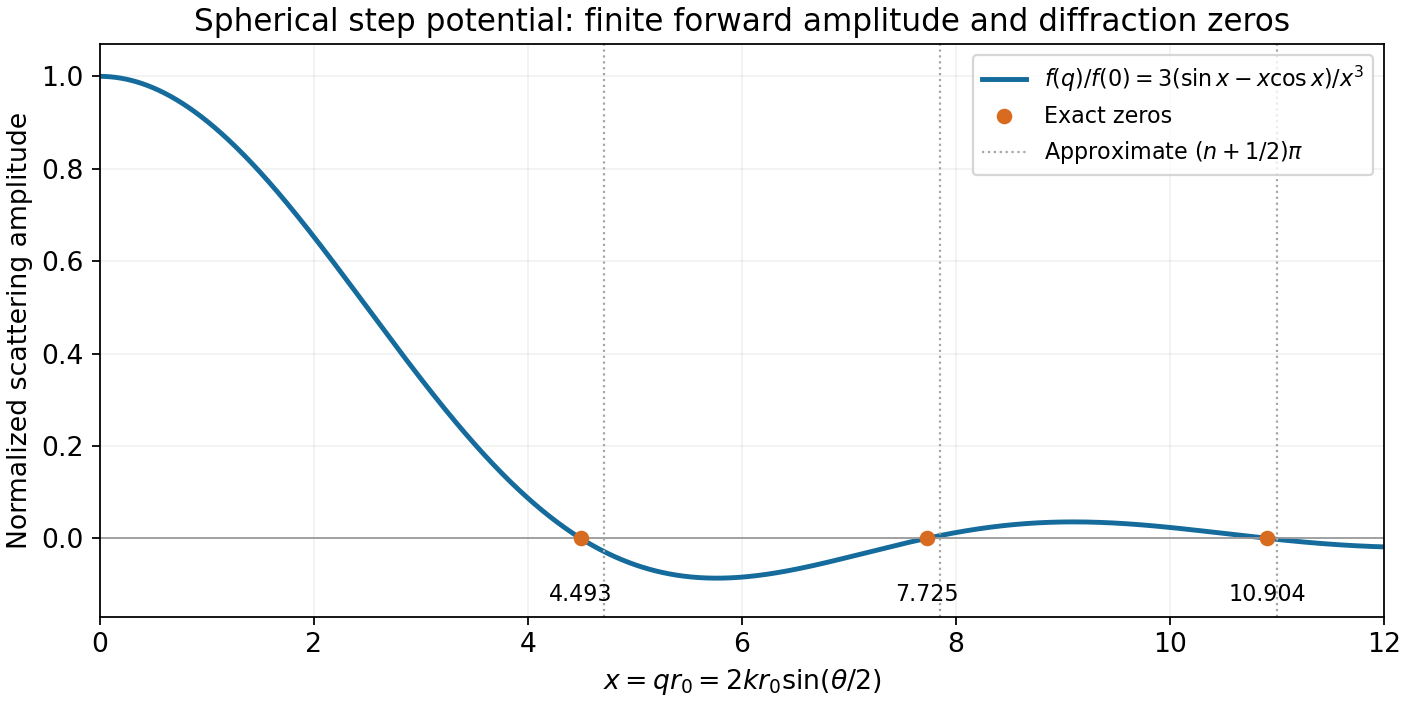
Born scattering form factor of a spherical constant potential
. The exact normalized amplitude and its first three zeros are shown. The asymptotic half-integer-pi locations are close estimates, with a visible low-order correction. Details.
Ancestors (10)
- S18
- 2012
- Past exam of the short options paper shared by Prelims and Parts A and B of the physics course of the University of Oxford
- Short options paper shared by Prelims and Parts A and B of the physics course of the University of Oxford
- Physics course of the University of Oxford
- Undergraduate course of the University of Oxford
- Course of the University of Oxford
- University of Oxford
- List of universities
- Home
Discussion (0)
New discussionThere are no discussions about this article yet.
Articles by others on the same topic (0)
There are currently no matching articles.