Work with η=diag(1,−1,−1,−1) and ∂=γμ∂μ. Multiplying the free Dirac equation by the operator with the opposite mass sign givesThe ordinary derivatives commute, so only the symmetric part of γμγν contributes. Requiring this operator to factor the Klein-Gordon equation, (∂μ∂μ+m2)ψ=0, for arbitrary free momenta givesThus the Dirac matrices represent the corresponding Clifford algebra. The inference uses factorization for the general free equation; the fact that one specially chosen wavefunction happens to solve both equations would not alone determine every matrix anticommutator.
(i∂+m)(i∂−m)ψ=[−γμγν∂μ∂ν−m2]ψ=0.
{γμ,γν}=2ημνI,{γμ,γν}=2ημνI.
Let U(x)=eieα(x), ψ′=Uψ, and Aμ′=Aμ+∂μα. Direct differentiation in the gauge covariant derivative givesThe gradient of the local phase is exactly cancelled by the potential transformation. Since U is scalar in spinor space and commutes with the Dirac matrices,Consequently a solution is mapped into a solution: the minimally coupled Dirac equation is covariant under the local U(1) gauge symmetry. The operator and wavefunction both transform; ordinary differentiation of the transformed wavefunction alone would leave an extra phase-gradient term.
Dμ′ψ′=(∂μ−ieAμ′)(Uψ)=U[∂μ+ie∂μα−ieAμ−ie∂μα]ψ=UDμψ.
(iγμDμ′−m)ψ′=U(iγμDμ−m)ψ.
Use Fμν=∂μAν−∂νAμ. The stated derivative convention gives [Dμ,Dν]=−ieFμν. Also [γμ,γν]=−2iσμν. Splitting products into symmetric and antisymmetric parts therefore yieldsMultiplying the first-order equation by iγμDμ+m now givesThe antisymmetric derivative commutator is the electromagnetic field strength. It is the extra term absent when squaring an uncoupled Dirac operator with commuting derivatives, and it generates the spin–magnetic-field interaction in the nonrelativistic limit.
(γμDμ)2=DμDμ+41[γμ,γν][Dμ,Dν]=D⋅D−2eσμνFμν.
[−D⋅D+2eσμνFμν−m2]ψ=0.
With Aμ=(0,A), the lowered components are Aμ=(0,−A). Define π=−i∇+eA and B=∇×A. This convention describes physical charge q=−e. Since Fij=−ϵijkBk,Writing ψ=e−i(m+E)tϕ makes the squared equationDrop E2 relative to 2mE and write ϕ=(φ,χ)T. Both two-component blocks obey the Pauli equationThe gauge-covariant kinetic term contains p2/(2m), e(A⋅p+p⋅A)/(2m), and e2A2/(2m): free kinetic, orbital magnetic, and diamagnetic contributions. The spin term is −μ⋅B with μ=−eσ/(2m), giving spin gyromagnetic factor g=2 at this order. In uniform B and symmetric gauge, the orbital term is eB⋅L/(2m).
σμνFμν=−2(σ⋅B00σ⋅B).
[(m+E)2−m2−π2−eΣ⋅B]ϕ=0.
Eφ=[2m(p+eA)2+2meσ⋅B]φ,Eχ=[2m(p+eA)2+2meσ⋅B]χ.
Squaring introduces extra formal solutions unless the original first-order equation is retained. In the usual positive-energy Dirac basis it relates the small lower component to the upper one by χ=(σ⋅π)φ/(2m+E)≃(σ⋅π)φ/(2m). Thus these are not two independent nonrelativistic particles. Restoring units places ℏ in the spin term, eℏσ⋅B/(2m).
Far from a short-range potential, the particle is locally free. The imposed incoming boundary condition is a unit-amplitude plane wave travelling along +z, while an outgoing free spherical wave has radial dependence eikr/r. The scattering coefficient can depend on direction, givingFor the Schrödinger probability current, j=(ℏ/m)Im(ψ∗∇ψ), the incident flux is jin=ℏk/m. The outgoing scattered radial flux, separated from the incident beam, is jsc,r∼(ℏk/m)∣fk∣2/r2. Thus the outgoing rate through r2dΩ, divided by incident flux, givesThis elastic-scattering result uses the same incoming and outgoing wavenumber and the usual outgoing-wave boundary condition.
ψ∼eikz+fk(θ,ϕ)reikr.
dΩdσ=jinjsc,rr2=∣fk(θ,ϕ)∣2.
The spherical potential has a rotationally symmetric Fourier transform, so choose the polar axis of the integration along q. With q=∣kf−ki∣=2ksin(θ/2),The first Born approximation therefore givesThere is no azimuthal dependence. At q=0, the bracket is (qr0)3/3+O(q5), so fk(0)=−2mV0r03/(3ℏ2) is finite, not zero. The approximation assumes scattering weak enough for the incident plane wave to replace the distorted wave inside the interaction integral.
∫r′≤r0d3r′V0e−iq⋅r′=4πV0∫0r0r′2qr′sin(qr′)dr′=4πV0q3sin(qr0)−qr0cos(qr0).
fk(θ)=−ℏ2q32mV0[sin(qr0)−qr0cos(qr0)],q=2ksin2θ.
Apart from the finite forward limit, amplitude zeros obey sinx−xcosx=0, or tanx=x, where x=qr0. The first positive root is x1≃4.49341. Since the accessible range is 0≤x≤2kr0,Thus there are no zeros for k<kc; the first enters at the largest momentum transfer, θ=π, when k=kc.
kc=2r0x1≃r02.247.
For larger roots, xn lies just below an=π(n+21), n=1,2,…. Expanding tan(an−ε)≃1/ε gives xn=an−1/an+O(an−3). Keeping its leading term yields the requested diffraction estimateExactly, replace the numerator π(n+21) by the corresponding root xn. The displayed approximation is a large-qr0 root approximation: taking k large at fixed low order does not make x1 equal to 3π/2. For example, the exact first angle at high k is approximately 4.49341/(kr0), not 4.71239/(kr0).
θn≃2arcsin[2kr0π(n+21)],π(n+21)≤2kr0.
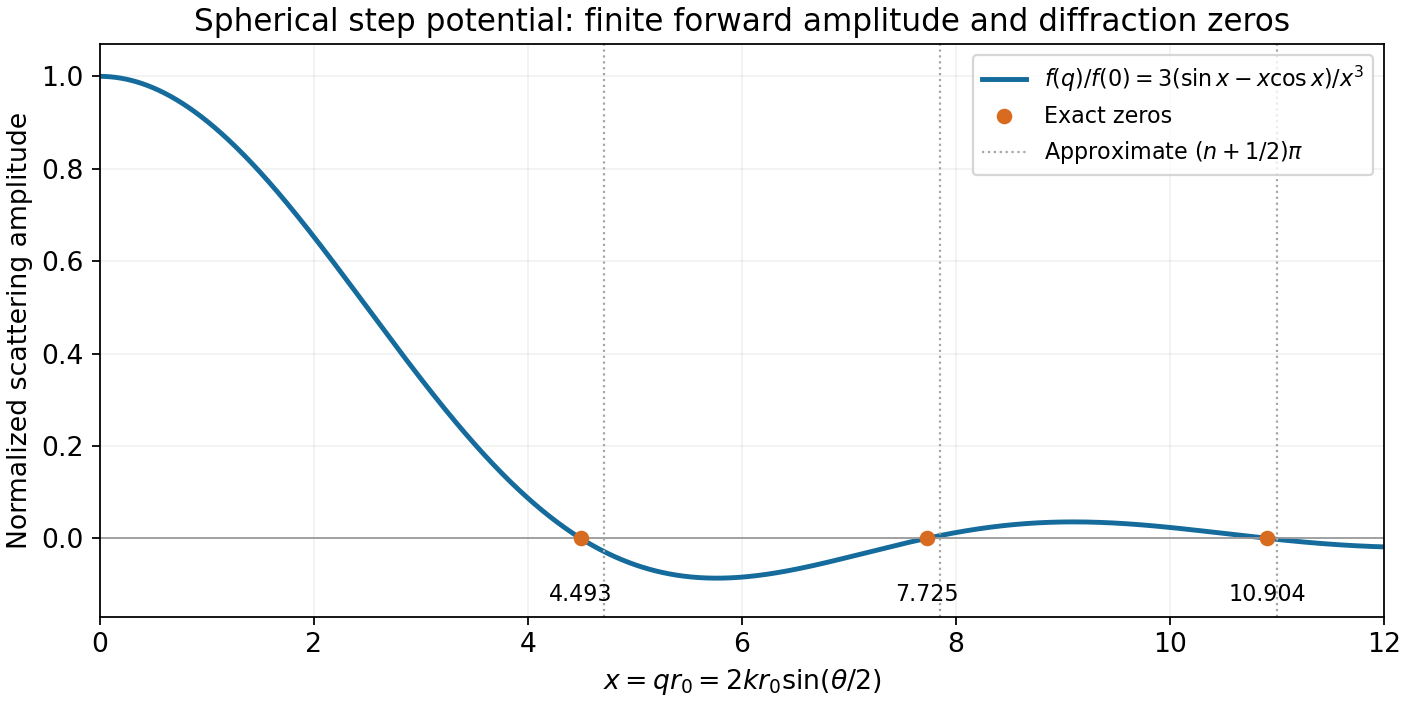
Born scattering form factor of a spherical constant potential
. The exact normalized amplitude and its first three zeros are shown. The asymptotic half-integer-pi locations are close estimates, with a visible low-order correction. Details.
Assume the scalar potential is real, so the Weyl equation has a Hermitian Hamiltonian H=σ⋅p+V. Multiplying the equation and its adjoint by ψ† and ψ respectively givesThus with ρ=ψ†ψ and J=ψ†σψ, the lower-index four-current jμ=(ρ,−J) obeys ∂μjμ=0.
∂t(ψ†ψ)=−∇⋅(ψ†σψ).
For K=σ⋅p,Consequently K is conserved for spatially constant V; a spatially uniform time-dependent scalar offset would also commute with it. For general nonuniform V it is not conserved. At nonzero momentum, (σ⋅p^)2=I, so the helicity eigenvalues are +1,−1. In the chosen constant-potential Weyl Hamiltonian, the positive E−V branch has helicity +1; the negative branch has −1. An expectation value in a superposition need not itself be an eigenvalue.
[K,H]=[K,V]=−iσ⋅∇V.
For dependence on z alone and constant V0, remove the common phase by ψ=e−iV0tψ. Then ∂tψ=−σz∂zψ. The normalized eigenvectorsobey σzu±=±u±. The corresponding first-order transport equations have characteristics t−z and t+z, respectively, givingHere η propagates toward +z and ρ toward −z, both at unit speed.
u+=(10),u−=(01)
ψ(z,t)=e−iV0t[η(t−z)u++ρ(t+z)u−].
For a fixed unit vector n^, replace z by n^⋅x and choose orthonormal spinors satisfying (σ⋅n^)u±(n^)=±u±(n^). If n^=(sinϑcosφ,sinϑsinφ,cosϑ), one choice isIndependent constant phases on the spinors can be absorbed into the two arbitrary envelope functions.
u+(n^)=(cos(ϑ/2)eiφsin(ϑ/2)),u−(n^)=(−e−iφsin(ϑ/2)cos(ϑ/2)).
Evaluate the envelopes at their displayed arguments and set a=η∗ρ. The common phase e−iV0t cancels from every bilinear. Direct use of the Pauli matrices givesThe physical longitudinal current is Jz=∣η∣2−∣ρ∣2: the two density profiles move in opposite directions. Their separate transport identities give ∂t(∣η∣2+∣ρ∣2)+∂z(∣η∣2−∣ρ∣2)=0.
jμ=(∣η∣2+∣ρ∣2,−2Rea,−2Ima,∣ρ∣2−∣η∣2).
For a coherent superposition, the transverse currents Jx=2Re(η∗ρ) and Jy=2Im(η∗ρ) generally do not vanish. They are independent of x,y, so they contribute no divergence in this one-dimensional construction. Omitting them would give an incorrect local four-current. Pointwise, ∣J∣2=(∣η∣2+∣ρ∣2)2, so the pure two-component Weyl current is future null wherever the density is nonzero. If only one envelope is present, the current points entirely along its propagation direction; an incoherent average can remove the transverse interference terms.
Ancestors (9)
- 2012
- Past exam of the short options paper shared by Prelims and Parts A and B of the physics course of the University of Oxford
- Short options paper shared by Prelims and Parts A and B of the physics course of the University of Oxford
- Physics course of the University of Oxford
- Undergraduate course of the University of Oxford
- Course of the University of Oxford
- University of Oxford
- List of universities
- Home
Discussion (0)
New discussionThere are no discussions about this article yet.
Articles by others on the same topic (0)
There are currently no matching articles.