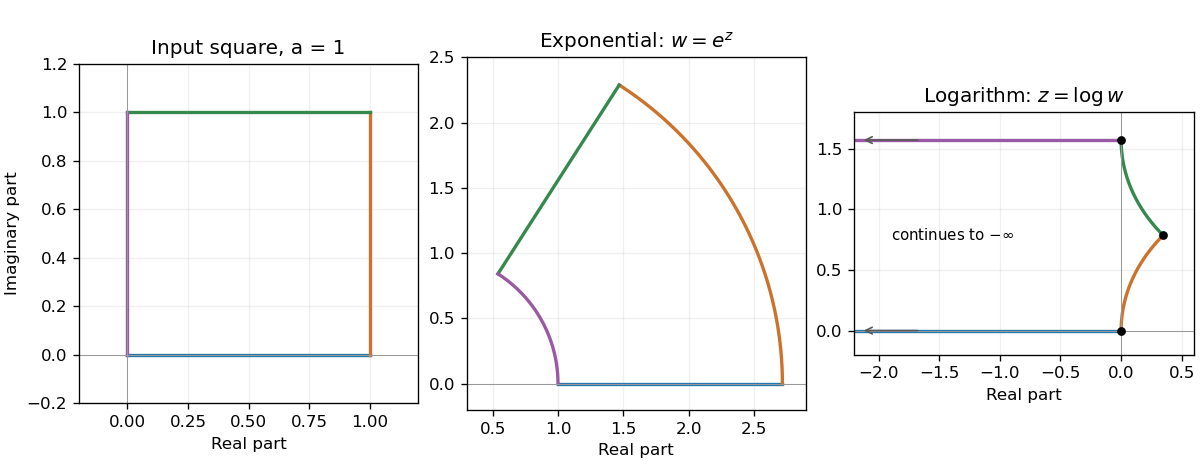
Use the complex logarithm with 0≤argw≤π/2 on the nonzero points of the first-quadrant square. Put z=x+iy=log∣w∣+iargw. The square bounds Rew,Imw≤a give
The two edges meeting at w=0map to the horizontal half-lines y=0 and y=π/2, extending indefinitely to the left. The other edges map to x=loga−logcosy for 0≤y≤π/4 and x=loga−logsiny for π/4≤y≤π/2. They meet at log(a2)+iπ/4.
The angles are preserved at a, a(1+i) and ia. There dlogw/dw=1/w is finite and nonzero. The origin is a branch point, has no finite logarithmic image, and supplies no fourth finite vertex at which angle preservation could be asserted.