Choose the principal logarithm, so L(z)=Log(1−z) has branch cut [1,∞). Near zero its Taylor series givesThus zero is a simple pole of residue one, and one is a logarithmic branch point. The function is holomorphic on C∖({0}∪[1,∞)) with this branch. Infinity is also a branch point in the extended-plane description; the function's decay there along the cut plane does not make it a single-valued holomorphic function through infinity.
L(z)=−z−2z2−3z3+O(z4),z3L(z)2=z1+1+O(z).
Use the positive orientation shown in the source: the upper bank runs outwards and the lower bank returns towards one. On those banks the logarithm branch has values ℓ−iπ and ℓ+iπ, respectively, with ℓ=log(x−1). Their squared difference is −4iπℓ. The residue theorem therefore givesand henceThe large-circle contribution is O(R−2log2R) and the small circle about one contributes O(ε∣logε∣2), both tending to zero. These estimates justify replacing the closed contour integral by its two cut-bank integrals.
2πi=lim∮Γz3L(z)2dz=−4πi∫1∞x3log(x−1)dx,
∫1∞x3log(x−1)dx=−21.
Take g(z)=L(z)3/z3 on the same logarithm branch. At zero, L(z)3=−z3+O(z4), so the apparent singularity is removable and the closed contour integral is zero. The bank difference isThe circular contributions vanish by the previous estimates with the third power of the logarithm. ConsequentlyThe last integral is 1/2, givingIncreasing the logarithm power has converted the desired real integral into a jump across a branch cut, while removing the pole inside the contour.
(ℓ−iπ)3−(ℓ+iπ)3=−6iπℓ2+2iπ3.
0=−6iπ∫1∞x3log2(x−1)dx+2iπ3∫1∞x3dx.
∫1∞x3log2(x−1)dx=6π2.
A conformal map preserves the magnitude and orientation of angles between intersecting smooth curves locally. For a complex holomorphic function, the condition at z0 is f′(z0)=0: the first-order change δw=f′(z0)δz rotates and uniformly scales every tangent vector by the same complex factor. This local statement does not require a globally one-to-one map.
No region maps onto the entire finite complex plane: ez is never zero. Its image on C is C∖{0}. A fundamental strip such asmaps bijectively onto that punctured plane, because ex+iy=exeiy. The half-open strip supplies one representative of each angle; it is not an open domain. An open strip of height 2π omits a ray as well. The missing zero is approached only in the limit x→−∞.
{x+iy:x∈R, −π<y≤π}
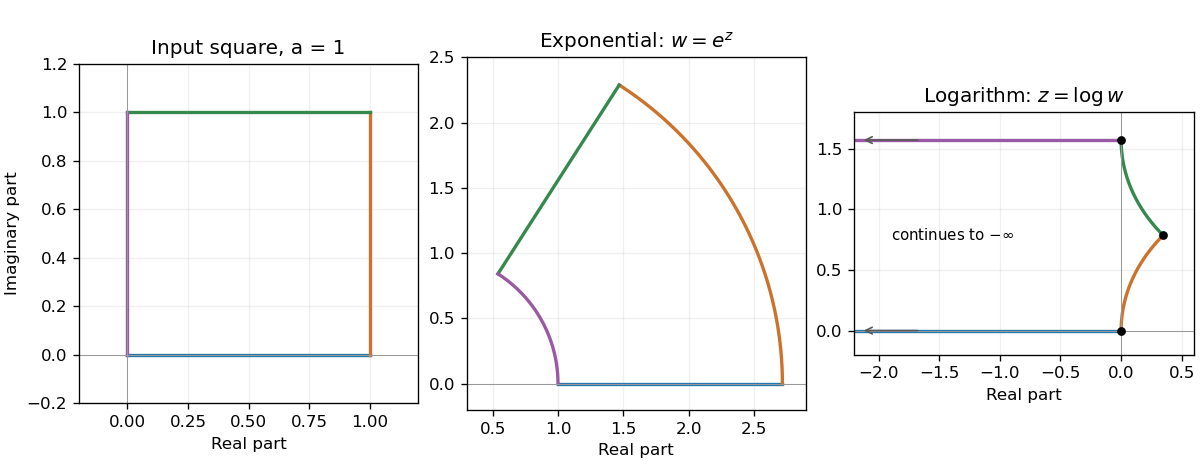
Writing z=x+iy gives ∣w∣=ex and argw=y. Thus the closed square maps to the annular sectorIts horizontal edges become radial segments and its vertical edges become circular arcs. Each radial tangent is perpendicular to the tangent of its adjoining circle, so the four interior angles remain π/2. Equivalently, the complex derivative ez is nonzero at every vertex and the map is conformal there.
1≤∣w∣≤ea,0≤argw≤a.
Use the complex logarithm with 0≤argw≤π/2 on the nonzero points of the first-quadrant square. Put z=x+iy=log∣w∣+iargw. The square bounds Rew,Imw≤a giveThe two edges meeting at w=0 map to the horizontal half-lines y=0 and y=π/2, extending indefinitely to the left. The other edges map to x=loga−logcosy for 0≤y≤π/4 and x=loga−logsiny for π/4≤y≤π/2. They meet at log(a2)+iπ/4.
0≤y≤2π,x≤loga−logmax(cosy,siny).
The angles are preserved at a, a(1+i) and ia. There dlogw/dw=1/w is finite and nonzero. The origin is a branch point, has no finite logarithmic image, and supplies no fourth finite vertex at which angle preservation could be asserted.

For t>0, close the real-axis contour in the upper half-plane: ∣eizt∣=e−tImz supplies decay. The only enclosed simple pole is z=i, with residue e−t/(2i). Thus h(t)=2πie−t/(2i)=πe−t.
For t<0, close downwards. The clockwise orientation contributes −2πi times the residue et/(−2i) at z=−i, givingAt t=0, direct integration of 1/(1+p2) gives π, consistent with the continuous extension. The large arc tends to zero by Jordan's lemma for nonzero t, or the denominator estimate when t=0.
h(t)=πe−∣t∣.
Let I denote the requested integral. Symmetry and the period of sin2θ make the corresponding integral over 0≤θ≤2π equal to 4I. With z=eiθ, this becomesThe denominator factors as −2(z2−1/2)(z2−2). The two poles inside the unit circle are z=±1/2. Each residue is 1/(6i), because the derivative of the polynomial denominator there is 6z. The residue theorem gives 4I=2π/3, so
4I=∮∣z∣=1i(−2z4+5z2−2)zdz.
I=6π.
Ancestors (9)
- 2015
- Past exam of the short options paper shared by Prelims and Parts A and B of the physics course of the University of Oxford
- Short options paper shared by Prelims and Parts A and B of the physics course of the University of Oxford
- Physics course of the University of Oxford
- Undergraduate course of the University of Oxford
- Course of the University of Oxford
- University of Oxford
- List of universities
- Home
Discussion (0)
New discussionThere are no discussions about this article yet.
Articles by others on the same topic (0)
There are currently no matching articles.