A conformal map preserves the magnitude and orientation of angles between intersecting smooth curves locally. For a complex holomorphic function, the condition at z0 is f′(z0)=0: the first-order change δw=f′(z0)δz rotates and uniformly scales every tangent vector by the same complex factor. This local statement does not require a globally one-to-one map.
No region maps onto the entire finite complex plane: ez is never zero. Its image on C is C∖{0}. A fundamental strip such asmaps bijectively onto that punctured plane, because ex+iy=exeiy. The half-open strip supplies one representative of each angle; it is not an open domain. An open strip of height 2π omits a ray as well. The missing zero is approached only in the limit x→−∞.
{x+iy:x∈R, −π<y≤π}
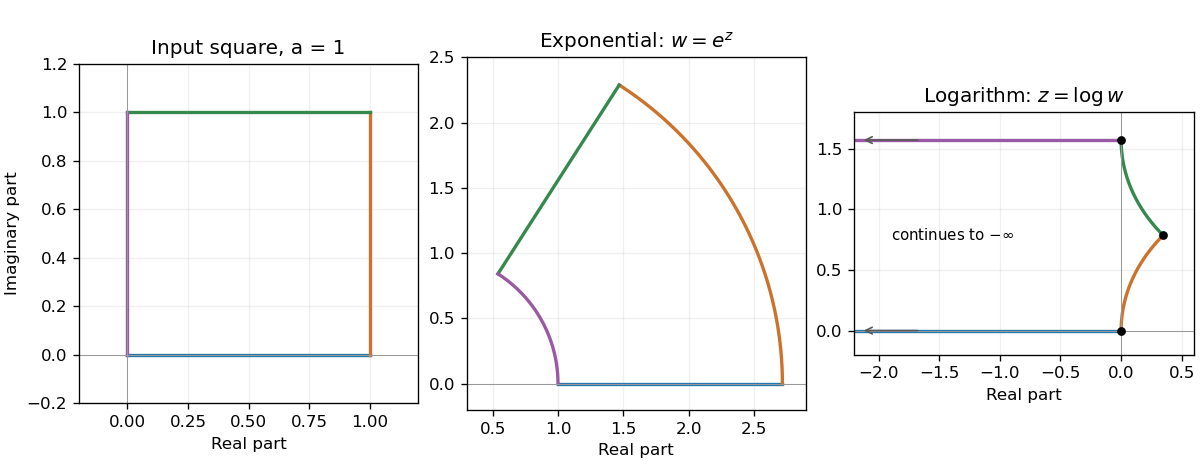
Writing z=x+iy gives ∣w∣=ex and argw=y. Thus the closed square maps to the annular sectorIts horizontal edges become radial segments and its vertical edges become circular arcs. Each radial tangent is perpendicular to the tangent of its adjoining circle, so the four interior angles remain π/2. Equivalently, the complex derivative ez is nonzero at every vertex and the map is conformal there.
1≤∣w∣≤ea,0≤argw≤a.
Use the complex logarithm with 0≤argw≤π/2 on the nonzero points of the first-quadrant square. Put z=x+iy=log∣w∣+iargw. The square bounds Rew,Imw≤a giveThe two edges meeting at w=0 map to the horizontal half-lines y=0 and y=π/2, extending indefinitely to the left. The other edges map to x=loga−logcosy for 0≤y≤π/4 and x=loga−logsiny for π/4≤y≤π/2. They meet at log(a2)+iπ/4.
0≤y≤2π,x≤loga−logmax(cosy,siny).

Ancestors (10)
- S1
- 2015
- Past exam of the short options paper shared by Prelims and Parts A and B of the physics course of the University of Oxford
- Short options paper shared by Prelims and Parts A and B of the physics course of the University of Oxford
- Physics course of the University of Oxford
- Undergraduate course of the University of Oxford
- Course of the University of Oxford
- University of Oxford
- List of universities
- Home
Discussion (0)
New discussionThere are no discussions about this article yet.
Articles by others on the same topic (0)
There are currently no matching articles.