Worked notes are available in Advanced Quantum Mechanics: S18 Exam 2015 Solutions. The requested Q1 amplitude sketch is supplemented below; the analytic worked parts remain available in those notes.
Alternate S18 question extract: www-thphys.physics.ox.ac.uk/people/AndreiStarinets/short_options_exam_2015.pdf. It carries the printed identifiers 2S98/2S99 and matches this option's three question cores, with wording and footer variations.
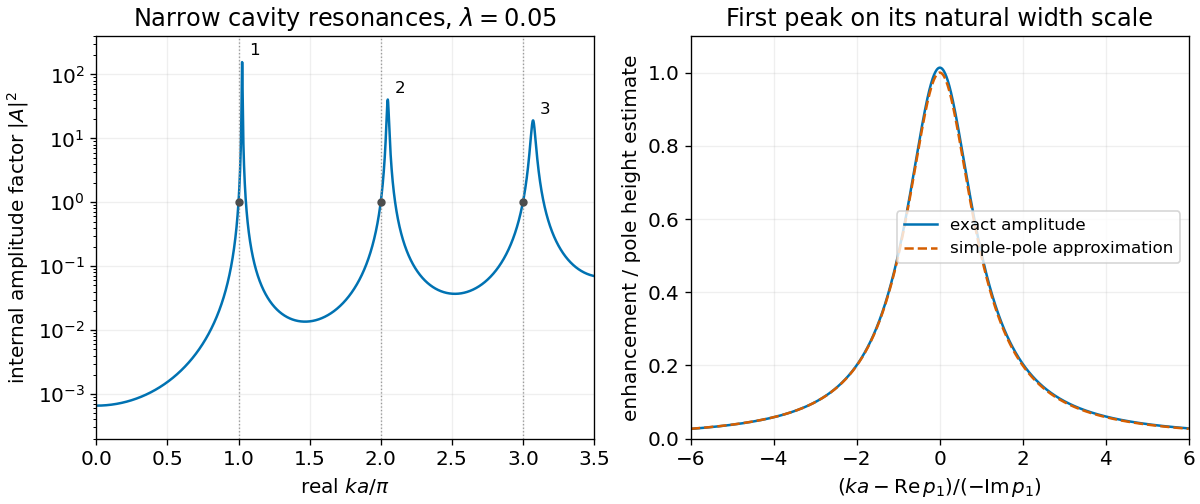
For real x=ka, taking the modulus squared of the amplitude gives the half-line delta-well amplitude enhancementThe supplied resonance poles have real parts xn≃nπ(1+λ/2+λ2/4) and negative imaginary parts −γn≃−(λnπ/2)2 for fixed low n at λ≪1.[ref] Linearizing the denominator at a simple pole givesThus the sketch has narrow, tall peaks with a locally Lorentzian line shape, just above positive integer multiples of π. Their half-widths are γn, and the leading peak heights are 4/(λ2n2π2). In this fixed-low-mode approximation, increasing n broadens and lowers the peaks. Exactly at x=nπ=0, the value is one. At zero it has the finite limit λ2/(2−λ)2 for λ=2.
∣A(x)∣2=(1−cos2x)2+(λx−sin2x)2λ2x2.
∣A(x)∣2≃∣D′(pn)∣2[(x−xn)2+γn2]λ2xn2,D(x)=1−e2ix+iλx.
The peaks represent long-lived standing waves between the wall and the attractive delta potential. Despite the source's transmission-coefficient terminology, ∣A∣2 is an internal amplitude factor and can exceed one. The interior probability current is zero, and the reflected probability current equals the incident magnitude; the hard wall passes no transmitted flux.

Ancestors (9)
- 2015
- Past exam of the short options paper shared by Prelims and Parts A and B of the physics course of the University of Oxford
- Short options paper shared by Prelims and Parts A and B of the physics course of the University of Oxford
- Physics course of the University of Oxford
- Undergraduate course of the University of Oxford
- Course of the University of Oxford
- University of Oxford
- List of universities
- Home
Discussion (0)
New discussionThere are no discussions about this article yet.
Articles by others on the same topic (0)
There are currently no matching articles.