ATP synthase combines a membrane Fo proton-conducting rotor with an F1 catalytic head. The c-ring and central gamma shaft rotate relative to a stator and the alpha/beta head. Proton flow down its electrochemical potential can drive conformational changes in three beta catalytic sites to bind substrates, form and release ATP. Reverse operation uses ATP hydrolysis to turn the shaft and pump protons. The immobilized F1 assay isolates this latter rotation; it does not require the membrane proton motor to be present.
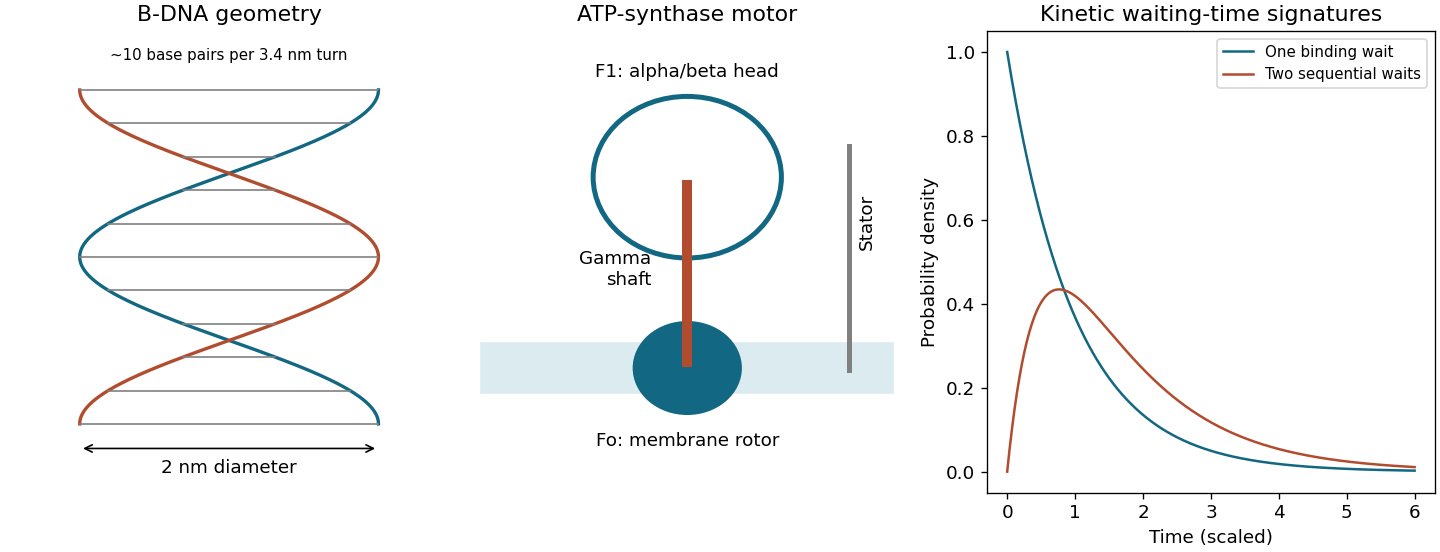

An ATP-binding step with pseudo-first-order rate k1c has survival probability S1=e−k1ct and waiting density P1=−S1′=k1ce−k1ct. It decreases from a finite value at zero, integrates to one and has mean 1/(k1c). Its concentration dependence suggests binding-limited waiting before the large 80-degree substep.
Two independent sequential exponential steps of rates ka,kb give the convolutionIt begins at zero, rises to a maximum at log(ka/kb)/(ka−kb) and decays; its mean is ka−1+kb−1. At equal rates it becomes k2te−kt. This supports at least two kinetic events during the waiting associated with the 40-degree substep, plausibly chemical transformation/product release and conformational changes. It does not uniquely identify which rate belongs to hydrolysis or a particular product: different hidden-state networks can have the same waiting distribution. Three 120-degree catalytic cycles per revolution, partitioned into 80 and 40 degrees in the assay, are consistent with three catalytic sites.
P2(t)=∫0tkae−kaskbe−kb(t−s)ds=ka−kbkakb(e−kbt−e−kat).
Ancestors (10)
- S12
- 2016
- Past exam of the short options paper shared by Prelims and Parts A and B of the physics course of the University of Oxford
- Short options paper shared by Prelims and Parts A and B of the physics course of the University of Oxford
- Physics course of the University of Oxford
- Undergraduate course of the University of Oxford
- Course of the University of Oxford
- University of Oxford
- List of universities
- Home
Discussion (0)
New discussionThere are no discussions about this article yet.
Articles by others on the same topic (0)
There are currently no matching articles.