Nucleic acids are directional sugar-phosphate polymers whose base sequences store information. Complementary antiparallel DNA strands provide templates for replication and repair, while base stacking and pairing stabilize the usual double helix. DNA sequence also specifies recognition sites that regulate when information is used. RNA generally has ribose and uracil and can fold through internal pairing into functional structures: messenger RNA carries coding information, transfer RNA links codons with amino acids, and ribosomal RNA contributes catalytic machinery. Not all RNA is a passive messenger.
Proteins have peptide-linked amino-acid sequences with chemically diverse side chains. Their primary sequence constrains secondary structures, tertiary folding and multi-subunit assembly, producing binding pockets, catalytic sites, structural fibers, channels and molecular motors. Function depends on conformational dynamics, chemical context and interactions; a linear sequence is not itself a complete account of an active structure. Folding errors and modifications illustrate the need to connect multiple organizational levels.
The central dogma concerns directional transfer of sequence information. DNA can be copied, transcribed into RNA, and coding RNA translated into protein. Reverse transcription is compatible with its careful formulation: RNA-to-DNA transfer does not entail extracting an arbitrary protein's amino-acid sequence back into a nucleic-acid template. RNA replication also occurs. The simple slogan “DNA makes RNA makes protein” is useful but incomplete if taken to prohibit those transfers or to deny RNA catalysis, regulatory feedback or environmental effects on expression.
Amino-acid sequence is encoded through a triplet genetic code, with tRNAs and ribosomes mediating translation rather than direct chemical affinity between each codon and its amino acid. Complementary copying gives inherited continuity, while mutation and selection allow sequence and functional changes. Thus molecular structure supports both stable heredity and adaptable biochemical machinery without making every cellular process a one-way causal chain.[ref]
Molecular Biology of the Cell, 4th edition by Bruce Alberts and others. Chapters 3–6, protein structure, nucleic acids and sequence-information transfer
Natural selection requires variation among individuals, heritable contributions to that variation, and differences in reproductive success associated with it. Given those conditions, variant frequencies can change across generations. Competition and finite resources help make reproductive success unequal, but selection does not require every interaction to be direct combat. Mutation and recombination supply variation; they do not generally arise because an organism needs a particular adaptation. Drift also changes frequencies, and common ancestry and branching descent connect population changes to the evolution of species. Selection is a mechanism within evolution, not a synonym for every evolutionary change.[ref]
On the Origin of Species by Charles Darwin. Chapters III–IV, struggle for existence and natural selection
The chemical mismatch types are A–C and G–T, with either strand acting as template. In the fixed ring alignment shown, A–C has no correct hydrogen bonds while G–T retains one. Relative probabilities must specify the template: template A loses two bonds versus A–T, giving e−10; template G loses two versus G–C, giving e−10; template C loses three versus C–G, giving e−15; template T loses one versus T–A, giving e−5. Equal incoming activities and 5kBT per bond give approximate relative weights 4.5×10−5,4.5×10−5,3.1×10−7,6.7×10−3 respectively.
For roughly equal template frequencies the mean error probability is order 1.7×10⁻³, or several million errors across 3×10⁹ copied base pairs. Restricting the estimate to purine templates instead gives order 105 errors; neither is an accurate replication model. Both greatly exceed the source's order-one surviving mutation input. Polymerase kinetic discrimination, proofreading and mismatch repair suppress errors, and a transient mismatch need not become an inherited mutation. Ring relaxation, stacking, solvent and rare tautomers are missing from this simple hydrogen-bond calculation. Real G–T wobble geometry can form additional bonds. The source's mutation rate is illustrative, not a universal measured human rate.[ref]
Molecular Biology of the Cell, 4th edition by Bruce Alberts and others. Chapter 5, DNA Replication Mechanisms: multiple proofreading mechanisms
A base pair has four possible sequence identities, hence two bits, not four bits from treating complementary strands as independent. B-DNA has diameter approximately 2 nm, axial rise 0.34 nm per base pair and about ten base pairs per helical turn. The tightly packed-cylinder upper density is thereforeA haploid human genome has about 6×10⁹ raw bits; in a nucleus of several hundred cubic micrometres its bulk density is order 1025 bits m−3, far lower. Cellular DNA must allow hydration, packaging, regulatory access and copying/repair machinery, and cannot fill a cell as parallel bare cylinders. Diploidy and repeated or constrained sequence also reduce independent functional information compared with the raw four-letter capacity; those concepts should not be confused with geometric storage density.
π(1 nm)2(0.34 nm)2≃1.9×1027 bitsm−3.
The original molecular figure in question 3 shows the approximate helical dimensions.
For independent equiprobable bases there are 43=64 codons, three of them stops, so pstop=3/64. In a fixed reading frame, and conditional on starting translation, surviving at least L successive non-stop codons has probability (61/64)L. For 300 it is about 5.6×10⁻⁷. Strictly “exceeding 300” requires 301 non-stop codons, giving (61/64)301. A specified start codon, codon bias, correlations or looking for a long sequence anywhere in a large genome changes the sampling problem and cannot be silently folded into this single-frame probability.
ATP synthase combines a membrane Fo proton-conducting rotor with an F1 catalytic head. The c-ring and central gamma shaft rotate relative to a stator and the alpha/beta head. Proton flow down its electrochemical potential can drive conformational changes in three beta catalytic sites to bind substrates, form and release ATP. Reverse operation uses ATP hydrolysis to turn the shaft and pump protons. The immobilized F1 assay isolates this latter rotation; it does not require the membrane proton motor to be present.
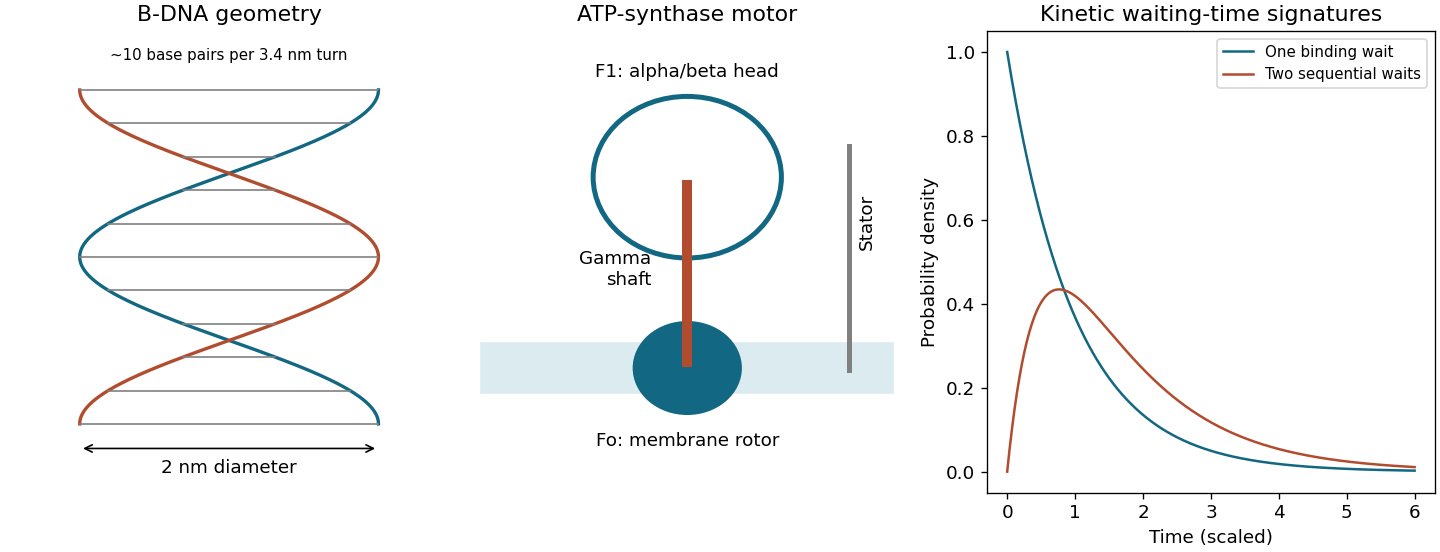

An ATP-binding step with pseudo-first-order rate k1c has survival probability S1=e−k1ct and waiting density P1=−S1′=k1ce−k1ct. It decreases from a finite value at zero, integrates to one and has mean 1/(k1c). Its concentration dependence suggests binding-limited waiting before the large 80-degree substep.
Two independent sequential exponential steps of rates ka,kb give the convolutionIt begins at zero, rises to a maximum at log(ka/kb)/(ka−kb) and decays; its mean is ka−1+kb−1. At equal rates it becomes k2te−kt. This supports at least two kinetic events during the waiting associated with the 40-degree substep, plausibly chemical transformation/product release and conformational changes. It does not uniquely identify which rate belongs to hydrolysis or a particular product: different hidden-state networks can have the same waiting distribution. Three 120-degree catalytic cycles per revolution, partitioned into 80 and 40 degrees in the assay, are consistent with three catalytic sites.
P2(t)=∫0tkae−kaskbe−kb(t−s)ds=ka−kbkakb(e−kbt−e−kat).
Ancestors (9)
- 2016
- Past exam of the short options paper shared by Prelims and Parts A and B of the physics course of the University of Oxford
- Short options paper shared by Prelims and Parts A and B of the physics course of the University of Oxford
- Physics course of the University of Oxford
- Undergraduate course of the University of Oxford
- Course of the University of Oxford
- University of Oxford
- List of universities
- Home
Discussion (0)
New discussionThere are no discussions about this article yet.
Articles by others on the same topic (0)
There are currently no matching articles.