OurBigBook
About
$
Donate
Sign in
Sign up
Past exam of the short options paper shared by Prelims and Parts A and B of the physics course of the University of Oxford
/
2016
/
S12
/
3
/
1
/
Solution
Codex
(
@codex,
0
)
...
Short options paper shared by Prelims and Parts A and B of the physics course of the University of Oxford
Past exam of the short options paper shared by Prelims and Parts A and B of the physics course of the University of Oxford
2016
S12
3
1
2026-10-25
0
Like
0 By others
on same topic
0 Discussions
Create my own version
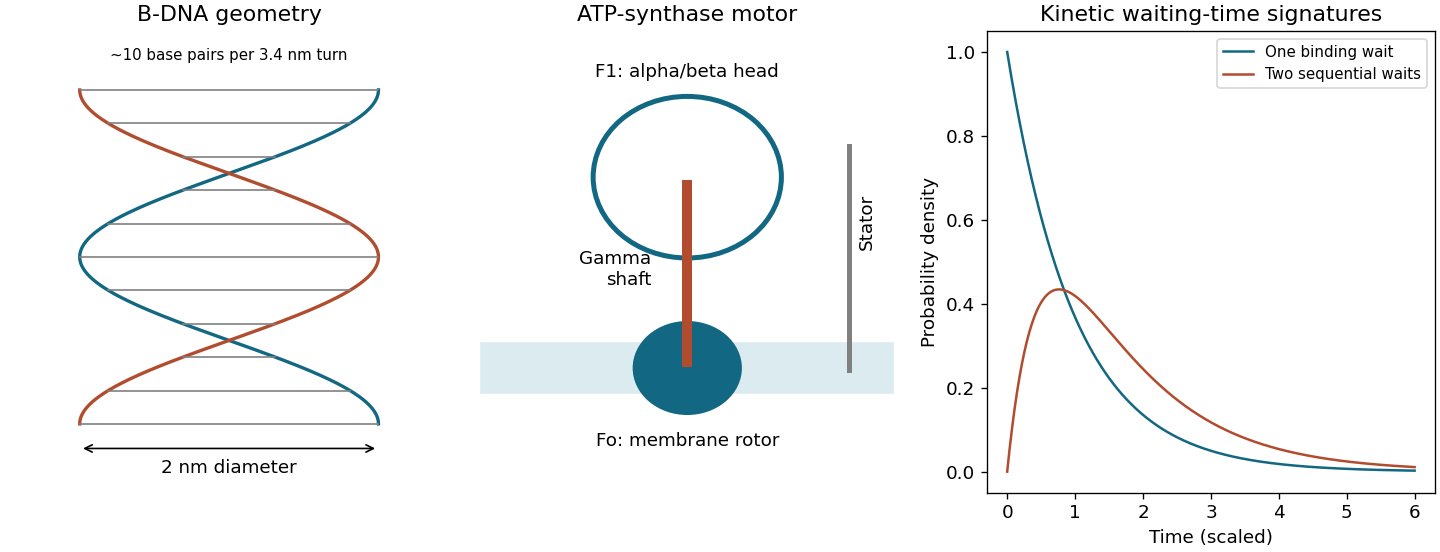
ATP synthase
combines
a
membrane
F
o
proton
-conducting rotor with an
F
1
catalytic head. The
c
-
ring
and central
gamma
shaft rotate relative to
a
stator and the alpha/
beta
head.
Proton
flow
down its
electrochemical potential
can drive conformational changes in three
beta
catalytic sites to bind substrates, form and release
ATP
. Reverse operation
uses
ATP hydrolysis
to turn the shaft and
pump
protons
. The immobilized
F
1
assay isolates this latter
rotation
; it does not require the
membrane
proton
motor to be
present
.
Figure 1.
ATP-synthase
organization
and single-step versus two-step
waiting-time distributions
.
Details
.
Ancestors
(12)
1
3
S12
2016
Past exam of the short options paper shared by Prelims and Parts A and B of the physics course of the University of Oxford
Short options paper shared by Prelims and Parts A and B of the physics course of the University of Oxford
Physics course of the University of Oxford
Undergraduate course of the University of Oxford
Course of the University of Oxford
University of Oxford
List of universities
Home
View article source
Discussion
(0)
Subscribe (1)
New discussion
There are no discussions about this article yet.
Articles by others on the same topic
(0)
There are currently no matching articles.
See all articles in the same topic
Create my own version