Let xi=L/fi, with positive f focusing in the first transverse plane. The doublet matrix is M=Q2D(L)Q1, with Qi=(1−1/fi01). Its lower-left entry is Cx=−(x1+x2−x1x2)/L. In the other plane both quadrupole signs reverse, giving Cy=−(−x1−x2−x1x2)/L. Thus positive effective focusing power in both planes requiresFor a parallel incident ray bundle, actual downstream focal distances are ℓx=L(1−x1)/(x1+x2−x1x2) and ℓy=L(1+x1)/(−x1−x2−x1x2). Requiring both foci downstream adds ∣x1∣<1. Positive effective power alone need not imply a real image after the final element. The original schematic below distinguishes these conditions.
x1x2<−∣x1+x2∣.
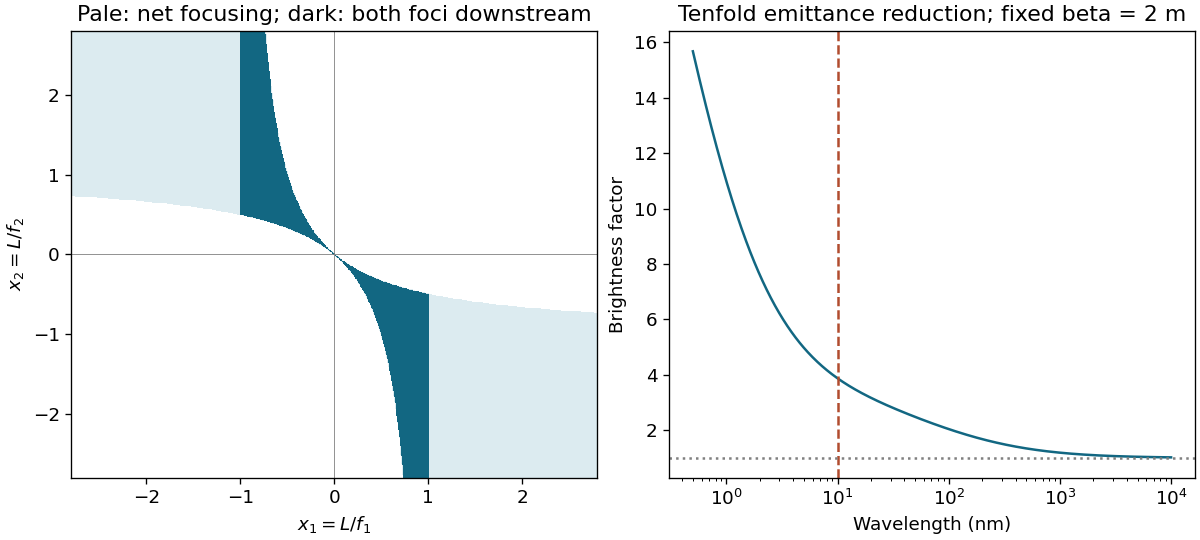
Doublet focusing region and wavelength-dependent emittance benefit under fixed source optics
. Details. 
The beam rigidity is Bρ≃p/(0.2998 GeV/(cTm))≃1.67×105 T m. Equal opposing strengths have f=Bρ/(GLq), and weak separated-doublet net power is 1/F≃L/f2. Taking F∼L∗=50 m gives the design familyThere is not a unique pair (Lq,L) without a spacing/layout choice. A compact estimate L∼Lq gives about 18 m for each, showing immediately that neither is extremely small compared with 50 m and the advertised asymptotic approximation is only rough. For example L=30 m gives Lq∼14 m in the same estimate.
Lq2L∼L∗(Bρ/G)2≃6.2×103 m3.
An equal-strength doublet also has exact parallel-input focal distances f2/L−f and f2/L+f: it is astigmatic, so a single exact common 50 m focus cannot be imposed without specifying incoming optical functions or allowing unequal strengths. The family above is a scale estimate of net focusing, not a complete collider final-focus design.
A uniform nonrelativistic electron column has radial electric field Er=−neer/(2ϵ0) inside its radius. A relativistic proton therefore has focusing strength K=e2ne/(2ϵ0pv) per unit length. Electron-current magnetic effects are small under the stated nonrelativistic assumption. To change the nominal doublet strength 1/L∗ by 10−4 requiresOne illustrative choice is a one-metre lens with ne≃1.1×10¹⁶ m−3; other density-length combinations work. The electron beam must cover the proton beam and have a sufficiently uniform profile. Its placement changes the detailed transfer-map correction; the estimate treats the required additional integrated focusing at the entrance and does not claim a uniquely specified electron-lens engineering design.
neLe=e22ϵ0pvL∗10−4≃1.1×10¹⁶ m−2.
Ancestors (10)
- S19
- 2016
- Past exam of the short options paper shared by Prelims and Parts A and B of the physics course of the University of Oxford
- Short options paper shared by Prelims and Parts A and B of the physics course of the University of Oxford
- Physics course of the University of Oxford
- Undergraduate course of the University of Oxford
- Course of the University of Oxford
- University of Oxford
- List of universities
- Home
Discussion (0)
New discussionThere are no discussions about this article yet.
Articles by others on the same topic (0)
There are currently no matching articles.