Let xi=L/fi, with positive f focusing in the first transverse plane. The doublet matrix is M=Q2D(L)Q1, with Qi=(1−1/fi01). Its lower-left entry is Cx=−(x1+x2−x1x2)/L. In the other plane both quadrupole signs reverse, giving Cy=−(−x1−x2−x1x2)/L. Thus positive effective focusing power in both planes requiresFor a parallel incident ray bundle, actual downstream focal distances are ℓx=L(1−x1)/(x1+x2−x1x2) and ℓy=L(1+x1)/(−x1−x2−x1x2). Requiring both foci downstream adds ∣x1∣<1. Positive effective power alone need not imply a real image after the final element. The original schematic below distinguishes these conditions.
x1x2<−∣x1+x2∣.
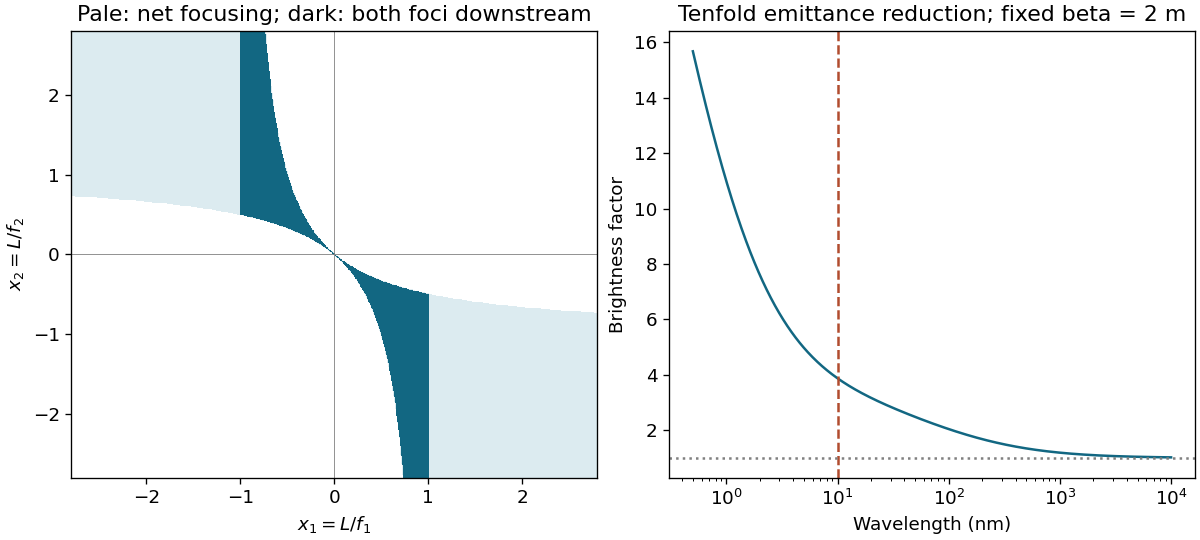
Doublet focusing region and wavelength-dependent emittance benefit under fixed source optics
. Details. 
The beam rigidity is Bρ≃p/(0.2998 GeV/(cTm))≃1.67×105 T m. Equal opposing strengths have f=Bρ/(GLq), and weak separated-doublet net power is 1/F≃L/f2. Taking F∼L∗=50 m gives the design familyThere is not a unique pair (Lq,L) without a spacing/layout choice. A compact estimate L∼Lq gives about 18 m for each, showing immediately that neither is extremely small compared with 50 m and the advertised asymptotic approximation is only rough. For example L=30 m gives Lq∼14 m in the same estimate.
Lq2L∼L∗(Bρ/G)2≃6.2×103 m3.
An equal-strength doublet also has exact parallel-input focal distances f2/L−f and f2/L+f: it is astigmatic, so a single exact common 50 m focus cannot be imposed without specifying incoming optical functions or allowing unequal strengths. The family above is a scale estimate of net focusing, not a complete collider final-focus design.
A uniform nonrelativistic electron column has radial electric field Er=−neer/(2ϵ0) inside its radius. A relativistic proton therefore has focusing strength K=e2ne/(2ϵ0pv) per unit length. Electron-current magnetic effects are small under the stated nonrelativistic assumption. To change the nominal doublet strength 1/L∗ by 10−4 requiresOne illustrative choice is a one-metre lens with ne≃1.1×10¹⁶ m−3; other density-length combinations work. The electron beam must cover the proton beam and have a sufficiently uniform profile. Its placement changes the detailed transfer-map correction; the estimate treats the required additional integrated focusing at the entrance and does not claim a uniquely specified electron-lens engineering design.
neLe=e22ϵ0pvL∗10−4≃1.1×10¹⁶ m−2.
At zero dispersion and α=0, σ=ϵβ and σ′=ϵ/β. The results areThe repeated Dx,Dy entries in the source are interpreted as intended vanishing dispersion and its slope. If dispersion slopes were not zero, energy spread would contribute to divergence and further data would be needed.
σx=77.5 μm,σx′=38.7 μrad,σy=7.75 μm,σy′=3.87 μrad.
State a radiation-width convention. For rms Gaussian-equivalent single-electron undulator radiation take σr=λL/(4π) and σr′=λ/L, so the diffraction emittance is λ/(4π). These give 11.3 micrometres and 70.7 microradians. Convolve independent electron and radiation widths in quadrature. The total photon source is thenSome approximate undulator width conventions differ by order-one factors; these must be kept consistent in the following brightness comparison.
Σx≃78.3 μm,Σx′≃80.6 μrad,Σy≃13.7 μm,Σy′≃70.8 μrad.
At fixed flux and bandwidth, brightness is inversely proportional to ΣxΣx′ΣyΣy′. Lowering both geometric emittances by ten makes the electron rms widths and divergences smaller by 10. Add the unchanged radiation widths in quadrature again and divide the old phase-space product by the new one. The resulting brightness factor is approximately 3.87, an increase of about 287%, rather than the factor 100 that would follow if diffraction were negligible in both planes. The exact value under the adopted width convention is given by the accompanying check and plot.
Emittance reduction has little effect when radiation dominates every source width and divergence. At fixed β=L=2 m, the strongest condition is λL/(16π2)≫ϵxβ, or λ≫4.7×10⁻⁷ m. The divergence condition only requires λ≫ϵxL/β=3 nm. There is no sharp “negligible” cutoff without an allowed percentage. If the optics were reoptimized to match diffraction instead, the weaker comparison λ/(4π)≫ϵx would set the relevant scale; it is not the same fixed-beta problem.
For the same lattice radiation-integral ratio, natural geometric emittance scales as γ2. A factor-ten decrease therefore requires E′=3/10≃0.949 GeV. Keeping coupling ratio fixed reduces the vertical emittance by the same factor, within that ideal scaling model.
Lower energy changes the source spectrum as well as emittance. At fixed bending geometry, bending-radiation critical energy scales as γ3, so it falls by 103/2; for fixed undulator period and deflection parameter the fundamental wavelength grows as γ−2, by ten. A smaller electron emittance therefore does not automatically improve brightness at the original 10 nm wavelength: the device may no longer radiate there on its fundamental, flux and harmonic operation change, and diffraction remains. Lattice redesign can retain beam energy and target spectrum while reducing emittance, which is why energy reduction alone is not a generally satisfactory substitute.
TODO — the source does not supply the longitudinal position-energy correlation, imposed chirp, or chicane dispersion/geometry needed for a unique compressed bunch length. A four-bend drawing and an uncorrelated energy spread are insufficient. In linear optics,If the given spread is uncorrelated, the minimum is the unchanged 0.2 m, not a compressed submillimetre bunch. If a chirp is supplied, optimal R56 depends on it and on the uncorrelated residual spread.
σzf2=σz2+2R56Cov(z,δ)+R562σδ2.
A sometimes intended phase-space lower-bound estimate conserves longitudinal emittance and permits final relative energy spread of order unity, giving σzf≳σzσδ∼20 μm. This is an additional extreme energy-spread allowance, not a consequence of an unspecified magnetic chicane. If one illustratively matches a plasma scale kpσzf∼1, then ne∼ϵ0mec2/(e2σzf2)≃7×1022 m−3. Matching to a whole wavelength instead changes this by 4π2. The parametric density relation is valid; the unique requested numerical compression is not established by the source.
The required energy increment is 9.9 TeV. If the usable longitudinal gradient is ηE0, with E0=mecωp/e, the channel length isUnder the illustrative preceding σzf=20 μm and kpσzf=1 choices, E0≃25.6 GV m−1 and Lp≃390/η m. TODO — a unique numerical length inherits the missing compression/density specification and additionally requires a usable wake amplitude/loading factor η or driver information. A driver energy per proton alone does not fix its bunch population or accelerating gradient.
Lp=ηmecωp9.9 TeV.
Propagation through an already formed cold plasma requires ωL>ωp, hence λL<λp=2πc/ωp. For the illustrative density above, that is a cutoff near 126 micrometres. It is a propagation ceiling, not a sufficient condition for producing ionization.
TODO — the unique cutoff inherits the unspecified density, and a literal maximum wavelength for gas ionization also needs gas species, laser intensity and the ionization mechanism. A single-photon threshold would impose hc/λ≥Iion; strong-field or multiphoton ionization is a different criterion. None of those data is supplied. The density-dependent propagation condition is the part determined symbolically.
For a 1 micrometre laser, nc≃1.1×1027 m−3 and a cold underdense wave has γϕ2≃nc/ne. At peak wave scale E0, optimal passage through an accelerating half-cycle gives ideal stage gain ΔE∼4(nc/ne)mec2; crest-to-zero injection gives half that. With the illustrative ne≃7×10²² m−3, the optimal ideal gain is about 32 GeV and a 9.9 TeV increment needs order 300 stages, or order 600 with the crest convention.
TODO — no unique stage count follows without the missing density and laser/wake amplitude assumptions. Depletion, diffraction, guiding, beam loading, injection, energy spread, driver evolution and interstage losses can all increase or otherwise alter the requirement. The parametric count is N≳ΔEtotal/[4η(nc/ne)mec2], with the phase and field conventions explicitly retained.
Ancestors (9)
- 2016
- Past exam of the short options paper shared by Prelims and Parts A and B of the physics course of the University of Oxford
- Short options paper shared by Prelims and Parts A and B of the physics course of the University of Oxford
- Physics course of the University of Oxford
- Undergraduate course of the University of Oxford
- Course of the University of Oxford
- University of Oxford
- List of universities
- Home
Discussion (0)
New discussionThere are no discussions about this article yet.
Articles by others on the same topic (0)
There are currently no matching articles.