Use polymer volume fraction horizontally and the Flory interaction parameter vertically. Lower gives better solvent quality. The simplest Flory–Huggins solution theory assigns the dimensionless mixing free energy per lattice siteThus gives positive excluded volume and a good-solvent coil, is the long-chain theta condition, and is the poor-solvent side. It is the net two-segment interaction that vanishes at theta, not every molecular force.
At fixed good-solvent quality, the polymer overlap volume fraction separates isolated coils from a semidilute polymer solution. Above overlap, many chains interpenetrate, but there is still solvent on the segment scale. As approaches order unity the solution is concentrated; these concentration-regime boundaries are crossovers, not first-order phase transitions. The overlap fraction increases from order in a strong good solvent toward order at theta. The crossover can be expressed as while ; it saturates at the theta scaling when that condition fails.
On the poor-solvent side there can instead be coexistence of polymer-poor and polymer-rich phases. The binodal follows a common tangent of ; the spinodal followsThe critical point of a Flory–Huggins polymer solution isFor finite , lies above . Therefore poor solvent does not automatically mean demixing at every concentration, and an overlap line must not be mistaken for a coexistence boundary. The original figure uses the stated ideal model for an illustrative chain length; it does not assert a measured phase boundary. A vertical temperature axis would additionally require a material-specific relation .
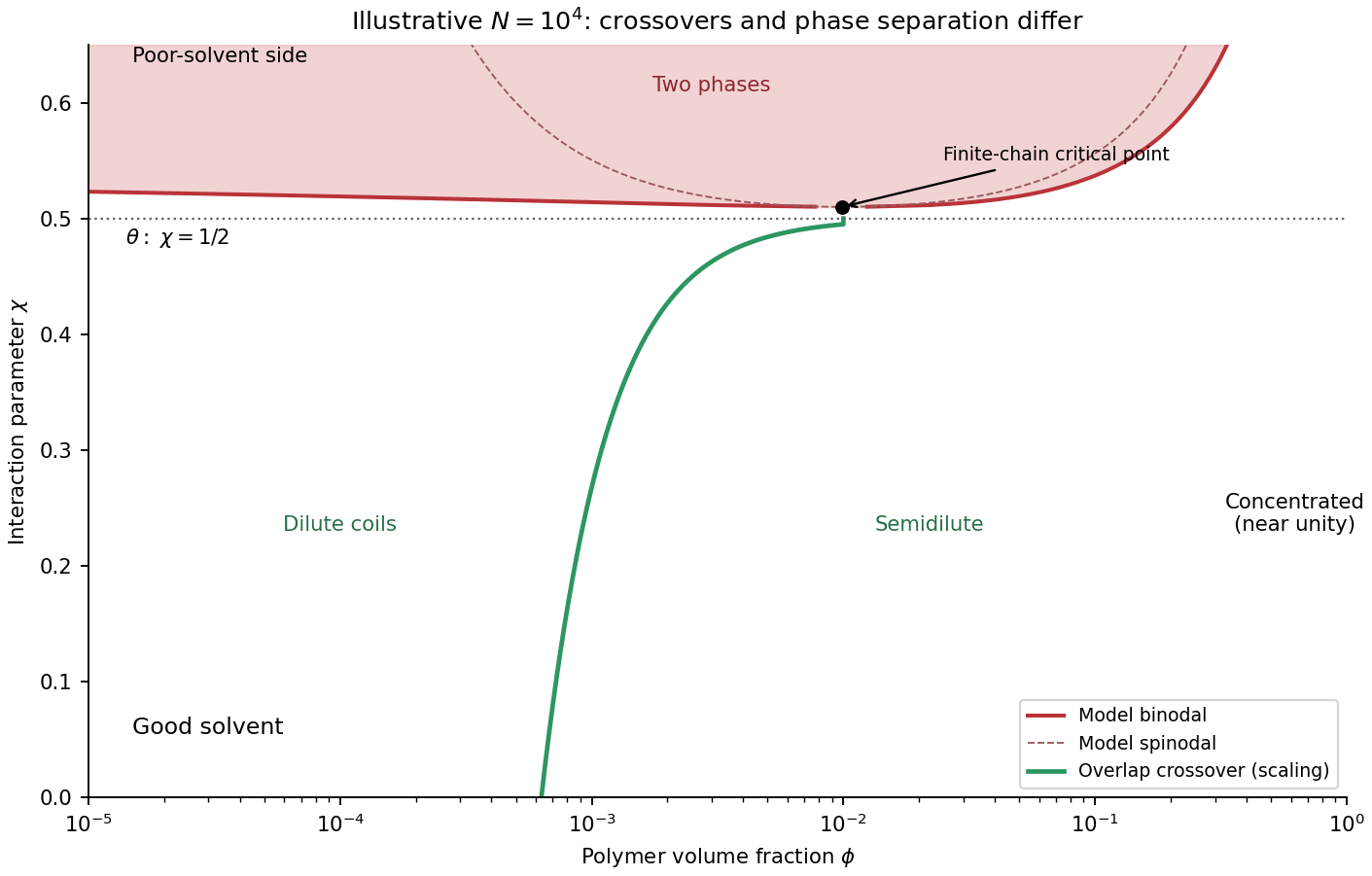
Polymer solution regimes
. Details. 
Articles by others on the same topic
There are currently no matching articles.