The three solvent conditions describe effective interactions between segments of a generic polymer. In a good solvent, solvent contacts favor a swollen, self-avoiding coil with positive excluded volume. At a theta solvent condition, leading pair repulsion and attraction cancel; the chain has approximately ideal random-walk statistics. In a poor solvent, effective attraction contracts the chain, eventually producing a dense polymer globule for a sufficiently long chain.
For statistical segments of length , the radius of gyration has the scalingThe good-solvent power is the Flory approximation; the asymptotic three-dimensional exponent is closer to . In the ideal freely jointed chain, the more precise result is , whereas the end-to-end mean square is . Scaling notation suppresses those geometry-dependent factors. The globule power follows from a volume proportional to , and presumes a dense collapsed state away from the theta crossover. The dilute condition excludes overlap with other chains; it does not eliminate contacts between distant segments of the same chain.
Use polymer volume fraction horizontally and the Flory interaction parameter vertically. Lower gives better solvent quality. The simplest Flory–Huggins solution theory assigns the dimensionless mixing free energy per lattice siteThus gives positive excluded volume and a good-solvent coil, is the long-chain theta condition, and is the poor-solvent side. It is the net two-segment interaction that vanishes at theta, not every molecular force.
At fixed good-solvent quality, the polymer overlap volume fraction separates isolated coils from a semidilute polymer solution. Above overlap, many chains interpenetrate, but there is still solvent on the segment scale. As approaches order unity the solution is concentrated; these concentration-regime boundaries are crossovers, not first-order phase transitions. The overlap fraction increases from order in a strong good solvent toward order at theta. The crossover can be expressed as while ; it saturates at the theta scaling when that condition fails.
On the poor-solvent side there can instead be coexistence of polymer-poor and polymer-rich phases. The binodal follows a common tangent of ; the spinodal followsThe critical point of a Flory–Huggins polymer solution isFor finite , lies above . Therefore poor solvent does not automatically mean demixing at every concentration, and an overlap line must not be mistaken for a coexistence boundary. The original figure uses the stated ideal model for an illustrative chain length; it does not assert a measured phase boundary. A vertical temperature axis would additionally require a material-specific relation .
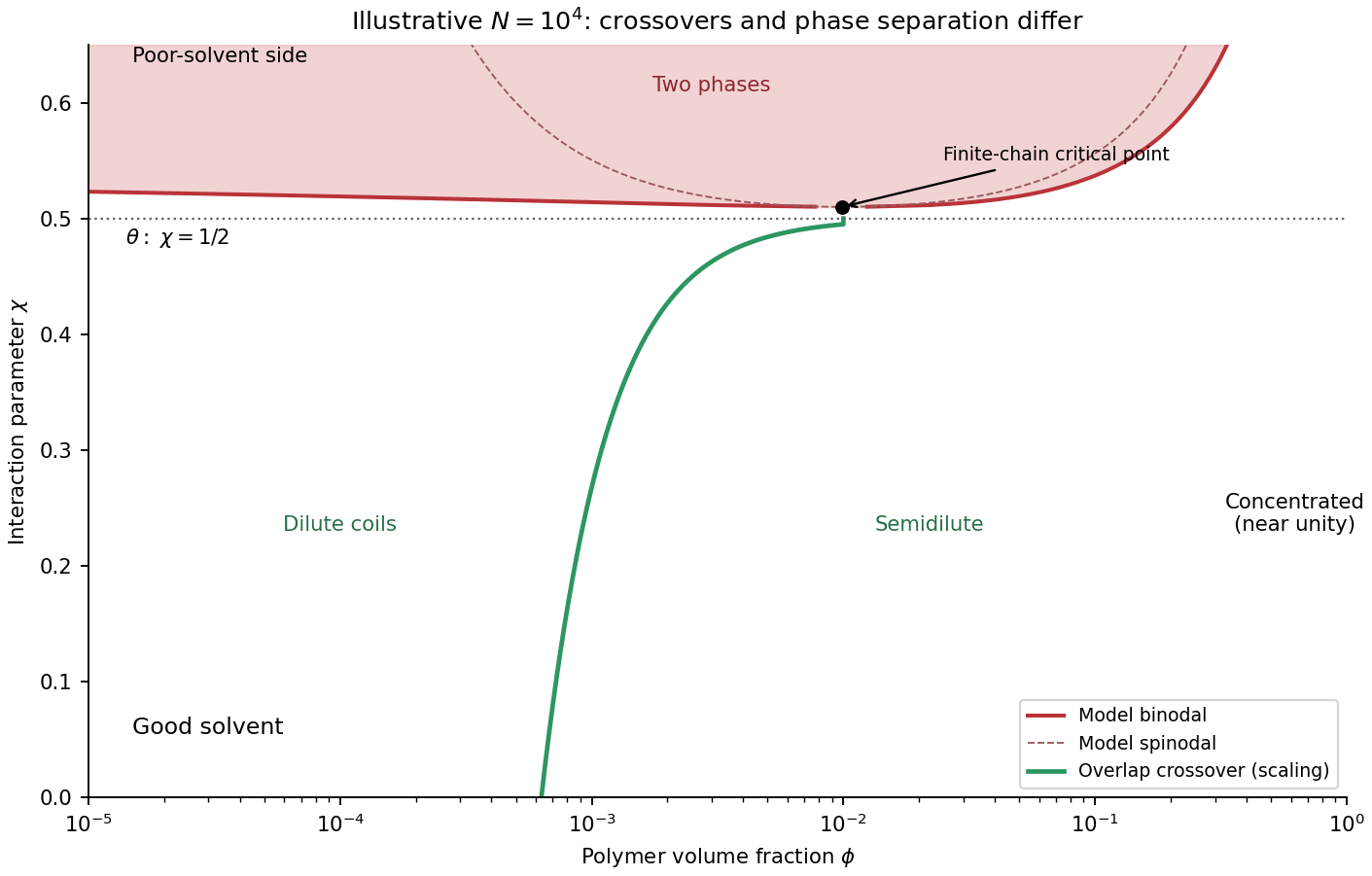
Polymer solution regimes
. Details. 
Overlap means roughly one coil per coil volume. With segment volume , the corresponding polymer overlap volume fraction isFor a strong good solvent, , and henceor about 0.063% by volume in the unit-prefactor scaling convention. The segment length cancels. A coil has no sharply defined boundary, so using or retaining a size amplitude changes an order-one prefactor. This calculation is a scaling estimate, not an exact volume-fraction measurement.
The correlation length in a semidilute solution is the concentration blob size. Below it a chain retains isolated good-solvent statistics; beyond it concentration fluctuations are screened and many chains interpenetrate. It is a local scale, not the total chain radius. If a blob contains segments,Eliminating gives the good-solvent concentration-blob scalingUsing the supplied segment size and concentration,Here and , so there are many segments within each blob and several dozen blobs per chain. Also , consistent with a semidilute estimate rather than isolated coils. The cancellation of from is physical: once chains are long enough, the local concentration sets the mesh scale. As throughout the scaling argument, numerical amplitudes are not determined by the given data.
In a dilute solution, separate coils diffuse through solvent with long-ranged hydrodynamic coupling among their segments. The Zimm model gives whole-chain diffusionwhere is a hydrodynamic radius and the solvent viscosity. The coil continually changes shape while its centre of mass performs long-time Brownian motion; treating it as a rigid sphere is only a scaling analogy.
At high concentration, solvent-mediated hydrodynamic interactions are screened on sufficiently large scales and times. If chains are not entangled, additive local or blob friction gives Rouse model behaviour, at fixed concentration. For long entangled chains, neighboring chains prevent rapid transverse escape. In the reptation tube picture the chain moves mainly along its contour until it renews the surrounding tube. Contour diffusion scales as , the tube-renewal time as , and the random-coil size squared as . ThereforeBoth cases ultimately give diffusive centre-of-mass motion, but entangled concentrated chains move much more slowly and retain constraints for longer. The inequality establishes strong overlap, not by itself entanglement: the latter also requires sufficiently many segments relative to an entanglement length. No numerical entanglement scale or concentrated-solution diffusion coefficient is supplied, so only the conditional regimes and scaling exponents can be fixed here.
Articles by others on the same topic
There are currently no matching articles.