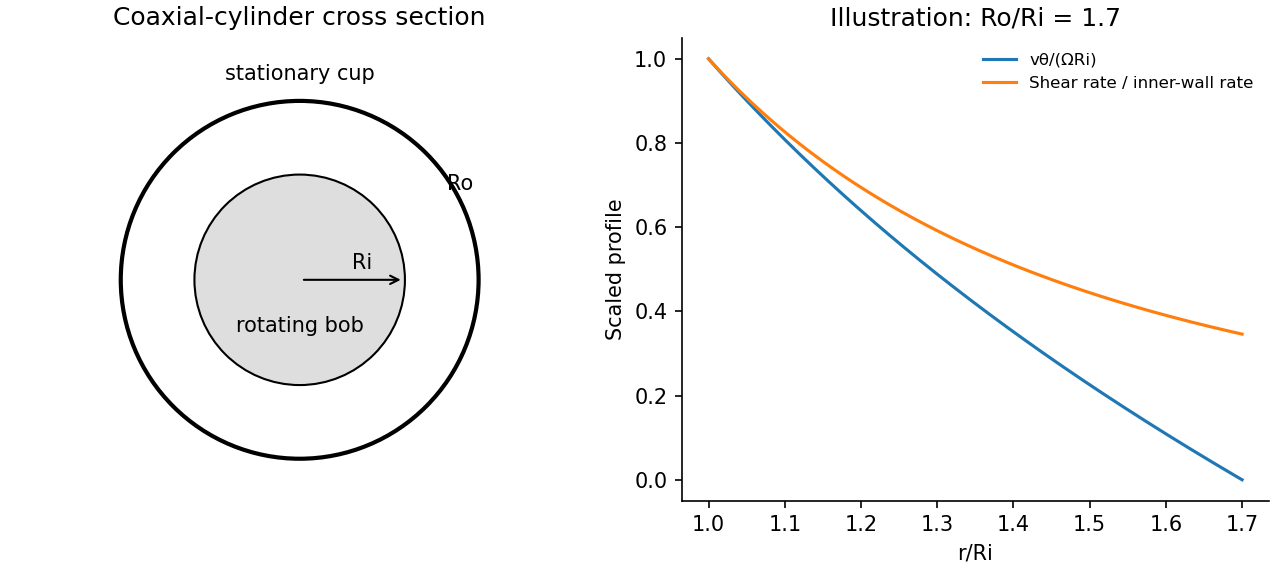
A Couette rheometer measures the torque required to rotate one coaxial cylinder relative to another. With inner radius , outer radius , wetted length , inner angular velocity and stationary outer wall, laminar Newtonian flow hasThe shear stress at the inner wall is . In a narrow gap , , so .
Measuring torque over a range of speeds gives a flow curve: constant viscosity identifies a Newtonian regime; decreasing or increasing apparent viscosity indicates shear thinning or thickening. A yield-stress fit needs a genuine low-rate regime and must not be confused with bearing drag or wall slip. Small oscillatory strain also probes viscoelasticity, with for imposed .
Control temperature, calibrate instrument torque and end effects, and check gap dependence or roughened surfaces for slip. Keep inertia small enough to avoid Taylor vortices. The exact Newtonian profile is a calibration model; a non-Newtonian material needs its own stress–rate relation.

Articles by others on the same topic
There are currently no matching articles.