Original paper: 31 May 2014, physical PDF pages 316–319.
Young's equation gives . The interfacial-energy difference from two contact angles follows by subtracting the two equilibrium contact-angle equations, which eliminates the common solid–air energy:The water–solid interface has the larger energy. This assumes the same clean solid surface and equilibrium angles, without swelling or strong contact-angle hysteresis.
Use a freely rotating chain: fixed bond length , fixed angle between forward bond vectors, and independently random torsion angles. Then , giving the orientational persistence length of a freely rotating chainThe equivalent long-chain Kuhn length divided by two, , is nearly equal here but is a distinct discrete-chain convention. A chemical internal bond angle is supplementary to the forward-vector angle used above.
Synthetic examples are relatively stiff poly(p-phenylene terephthalamide) and flexible polydimethylsiloxane. Light scattering and viscometry established rodlike solution conformations for the former; single-chain mechanical measurements support the latter's flexibility. Persistence is solvent- and model-dependent, so no universal numerical value is inferred for either example.[ref]
Properties of some rodlike polymers in solution by C.-P. Wong and others. publisher abstract, dilute-solution light scattering and viscometry
[ref]Understanding the Extraordinary Flexibility of Polydimethylsiloxane through Single-Molecule Mechanics by Song Lu and others. abstract, single-chain atomic-force measurements and flexibility
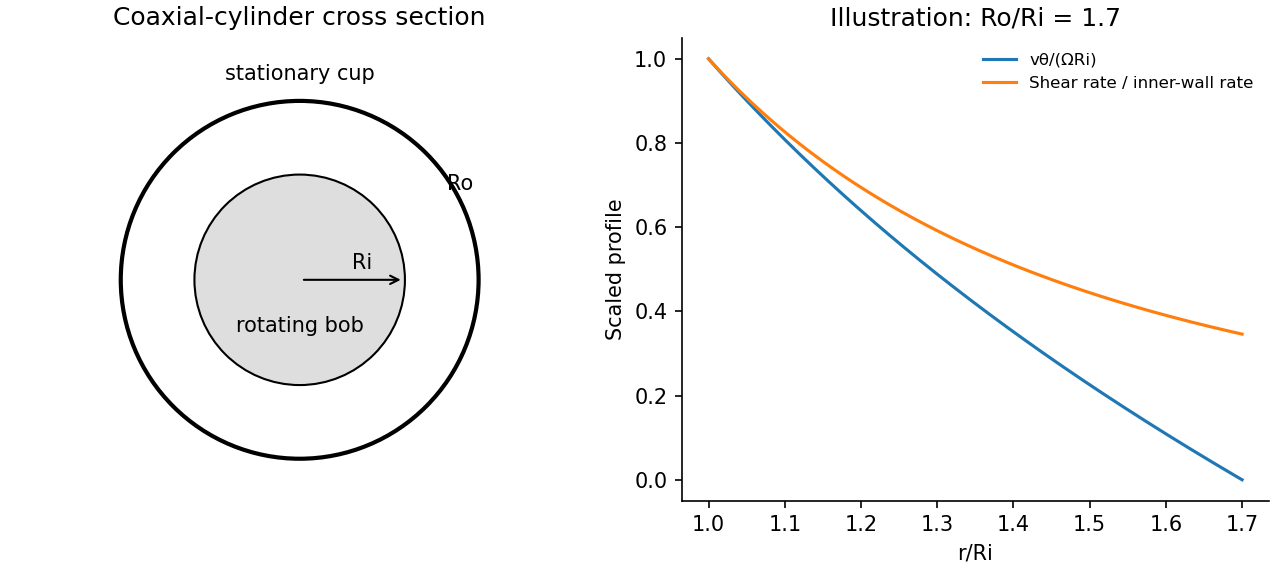
A Couette rheometer measures the torque required to rotate one coaxial cylinder relative to another. With inner radius , outer radius , wetted length , inner angular velocity and stationary outer wall, laminar Newtonian flow hasThe shear stress at the inner wall is . In a narrow gap , , so .
Measuring torque over a range of speeds gives a flow curve: constant viscosity identifies a Newtonian regime; decreasing or increasing apparent viscosity indicates shear thinning or thickening. A yield-stress fit needs a genuine low-rate regime and must not be confused with bearing drag or wall slip. Small oscillatory strain also probes viscoelasticity, with for imposed .
Control temperature, calibrate instrument torque and end effects, and check gap dependence or roughened surfaces for slip. Keep inertia small enough to avoid Taylor vortices. The exact Newtonian profile is a calibration model; a non-Newtonian material needs its own stress–rate relation.
An amphiphile contains a solvent-compatible head and a solvent-avoiding tail. In water, aggregation hides hydrocarbon tails while leaving heads exposed. This reduces the free-energy cost of tail–water contact, competing with loss of translational entropy, headgroup repulsion and chain packing. A micelle is a finite equilibrium aggregate, not necessarily a permanently bound particle.
Equality of molecular chemical potentials controls aggregation. For a large preferred aggregation number, approaches an aggregate value , givingAbove the critical micelle concentration, added surfactant mainly increases aggregate population while monomer activity changes relatively little. Finite aggregation numbers give a smooth crossover rather than an exact bulk phase transition. The amphiphile packing parameter compares tail volume, preferred head area and chain length; small favours spherical micelles, while larger values favour less curved aggregates. These geometric criteria are approximate, not universal shape phase boundaries.[ref]
Theory of self-assembly of hydrocarbon amphiphiles by Jacob N. Israelachvili and others. 1976, packing/free-energy model of generic hydrocarbon surfactant aggregates
Surface-tension or conductivity changes with concentration locate an operational CMC; scattering probes size and aggregation number. temperature, impurities and salt must be controlled, and independent methods help distinguish aggregation from precipitation. In an ionic surfactant, salt screens headgroup repulsion and can change both the CMC and aggregate shape. This discussion concerns generic synthetic surfactants only.
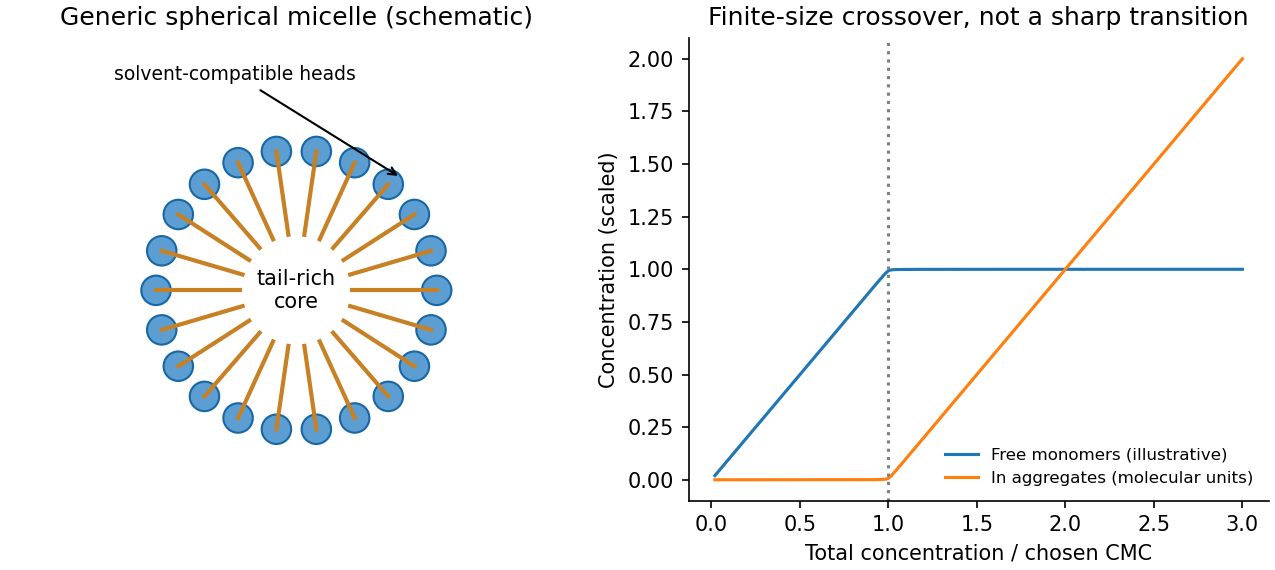
Original generic micelle schematic and an explicitly illustrative aggregation crossover
. Details. Interpret the stated free energy as per lattice site of volume . Flory–Huggins solution theory counts polymer chains, giving the entropy term , and solvent molecules, giving . The interaction term penalizes unlike contacts when ; a simple contact model has . Connectivity reduces polymer translational entropy relative to independent monomers. This is an incompressible mean-field model with composition-independent for the calculations below.[ref]
Thermodynamics of High Polymer Solutions by Paul J. Flory. 1942, connected-chain combinatorial entropy and mixing free energy
Expanding the dilute osmotic pressure identifies the effective second virial coefficient. A good solvent has and positive excluded volume, promoting swollen chains. A poor solvent has , favouring contraction and potentially phase separation. The theta-solvent condition is in this long-chain mean-field description: the second virial term vanishes, but higher terms remain. For finite , this condition is not the exact critical point, which instead has .
Let . The osmotic pressure in Flory-Huggins solution theory isThus . For mass concentration and chain molar mass ,osmometry uses a membrane permeable to solvent but retaining every polymer chain, at known uniform temperature. Extrapolate to zero concentration to remove interactions; the intercept gives the number-average molar mass. Aggregation, leakage of small chains, ions with a Donnan contribution, or a poor-solvent two-phase sample invalidate the simple molecular-weight interpretation.
The measured ratios give an exactly linear reduced-pressure fit:The reduced osmotic-pressure intercept is . TODO: the osmometry temperature is not stated in Question 3, so its absolute numerical molar mass is undetermined. The data establish . If is additionally assumed, the conditional result is . temperatures stated in other questions are not silently imported.
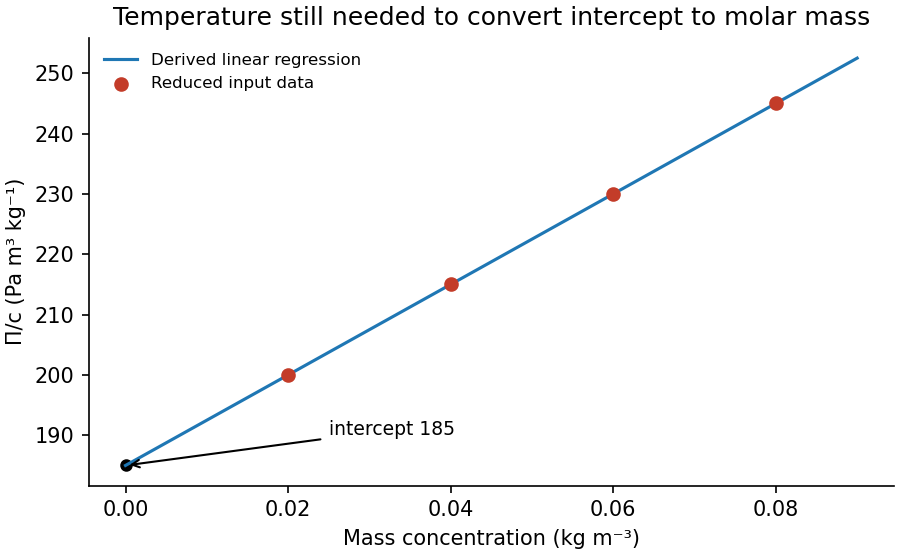
Original reduced-osmotic-pressure regression and its zero-concentration intercept
. Details. Balancing buoyant weight with Stokes drag givesThis needs isolated spherical particles, low Reynolds number and negligible wall corrections. The supplied settling measurement gives , hence . Its Reynolds number is about , consistent with the approximation.
Compare gravitational work over one radius with thermal energy, or use with . The gravitational Peclet number givesBelow this sedimentation-Brownian crossover radius Brownian motion dominates settling on the particle-size scale. It does not eliminate gravity: the sedimentation scale height is . For negligible concentration gradients across a sample height , the stronger condition is . No universal permanently nonsedimenting size follows without a length/time criterion.
Brownian encounters bring small particles into contact; van der Waals attraction can then bind them. Surface charge can create a repulsive barrier through Debye screening of colloid repulsion. For a monovalent salt reservoir with number density of each ionic species, Poisson–Boltzmann theory hasFor , linearization gives , with . If instead means total ion density, the factor two is absent. The planar potential decays as ; a sphere has an additional factor. This mean-field approximation neglects specific adsorption, ion correlations and finite ion size.
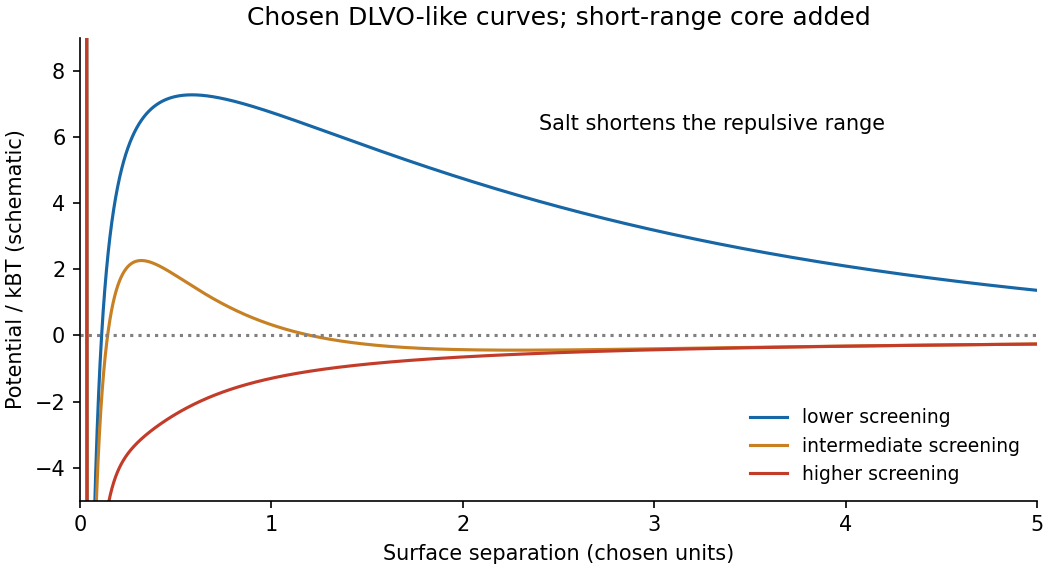
DLVO theory adds screened repulsion to dispersion attraction. At small surface separation for equal spheres of radius , a useful schematic form iswith a short-range repulsive core needed outside the continuum model. Low salt can leave a barrier many times , giving kinetic stability. Higher salt shortens the repulsion and can lower or remove the barrier, allowing coagulation into a deep primary minimum. The primary and secondary DLVO minima have different consequences: a shallow secondary minimum permits looser, sometimes reversible aggregation. The surface boundary condition affects ; screening length alone is not a complete measured interaction law. Non-DLVO hydration or steric forces can matter at contact.


Articles by others on the same topic
There are currently no matching articles.