First take the intended annulus configuration with . The first stopping time is finite by the allowed fact, and continuity gives . After , the annulus exit time is bounded by the exit time of the outer disc, which is almost surely finite; use the Strong Markov property at . Thus almost surely.
The function is harmonic on this annulus. Its stopped value is a bounded martingale, so optional stopping theorem and continuity give, if is the probability of hitting the inner circle first,ConsequentlyFor fixed , one may take and let . The probability of hitting the inner circle before the outer one tends to one. The probability of ever hitting that inner circle is at least each of these probabilities, hence is one. Taking the countable intersection for , , proves visits to balls of arbitrarily small radius almost surely.
The source permits as well. Then and the actual starting radius for the next exit is one, rather than . More generally put . If , the answer for the literal definition is . If , the infimum defining the next exit is already almost surely and the inner-circle probability is zero. Positive is implicit in an annulus and is necessary for the logarithmic calculation.
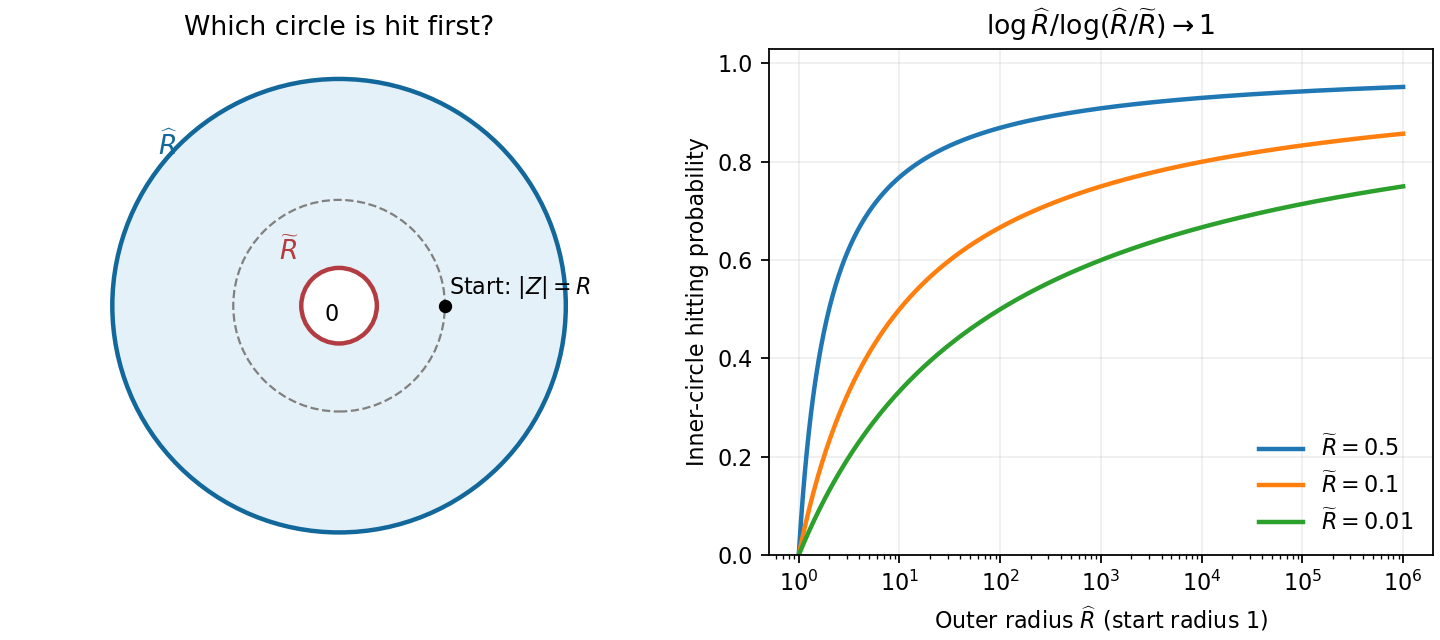
Logarithmic annulus hitting probabilities and visits to arbitrarily small discs
. Details. 
If , apply translation, rotation and Brownian scaling toThis is standard planar Brownian motion started at one. Its almost-sure visits to arbitrarily small discs about zero translate to visits of to discs about , with radii multiplied by . Therefore the same neighborhood recurrence holds for every pair . If , every such disc is already hit at time zero. If positive hitting times are requested, continuity gives positive times within every fixed disc as well. A countable sequence of shrinking radii suffices to obtain one probability-one event for this assertion.
Articles by others on the same topic
There are currently no matching articles.