Maintaining a fixed separation in one inertial laboratory frame is not the same as maintaining a fixed separation measured locally with the accelerating rockets. The attached string is prevented from undergoing the laboratory contraction that an unstrained comoving string would have. It is therefore stretched and develops tensile stress: this is Bell's spaceship paradox, not a failure of Lorentz contraction.
For sufficiently prolonged acceleration and a finite elastic breaking strain, the string breaks. If an acceleration history produces only a small bounded increase in speed, whether it actually breaks depends on its material strength; the kinematic conclusion is stretching, not an unconditional assertion that every arbitrarily weak acceleration must snap every string. Stress also propagates through a real string at a finite speed. The construction enforcing Born rigidity in the following parts is a different set of trajectories chosen to keep the comoving separation fixed.
Let on the rear rocket and on the front rocket. The instantaneous inertial rest frame of the rear rocket at moves at relative to S. Transform the time difference of these two events:Setting givesThe velocity belongs to the rear event . It is not to be evaluated at laboratory time , nor does the simultaneity condition mean in S. At nonzero velocity the front event on the same instantaneous-rest slice is at a different laboratory time.
Use the same event pair already made simultaneous in the rear instantaneous rest frame. Its proper spatial separation is the Minkowski interval length, soThe inequality selects the front rocket rather than the equally long backward extension. Equivalently the Lorentz-transformed spatial difference obeys . This is not the condition at equal laboratory times, which would describe the stretching arrangement in a.
Write . Substituting into ii gives . The positive-separation branch therefore hasThe Born-rigid front trajectory from a rear worldline follows by setting :Every and in this formula is evaluated at the rear event with laboratory time , not at the shifted argument of .
For completeness, a smooth future-directed front trajectory requires this time mapping to be locally invertible. If the signed laboratory acceleration is and the rear proper acceleration is , thenWhen , their ratio gives , so the two simultaneous points indeed share their instantaneous velocity. If that factor reaches zero, an acceleration-horizon obstruction appears; an arbitrary rear trajectory cannot be extended to an arbitrary rigid length while retaining both rockets future-directed. The positive-acceleration example below satisfies the condition.
Take as a length. For the rear hyperbola,The implicit front event from iii has and . Eliminate the rear time to obtainThe rear proper acceleration is , while the front proper acceleration is . Thus Born rigidity in the acceleration requires the front rocket to accelerate less strongly. Their constant separation is measured on the tilted instantaneous-rest slices; their equal-laboratory-time coordinate separation decreases from rather than staying constant. At both rockets are at rest, at and .
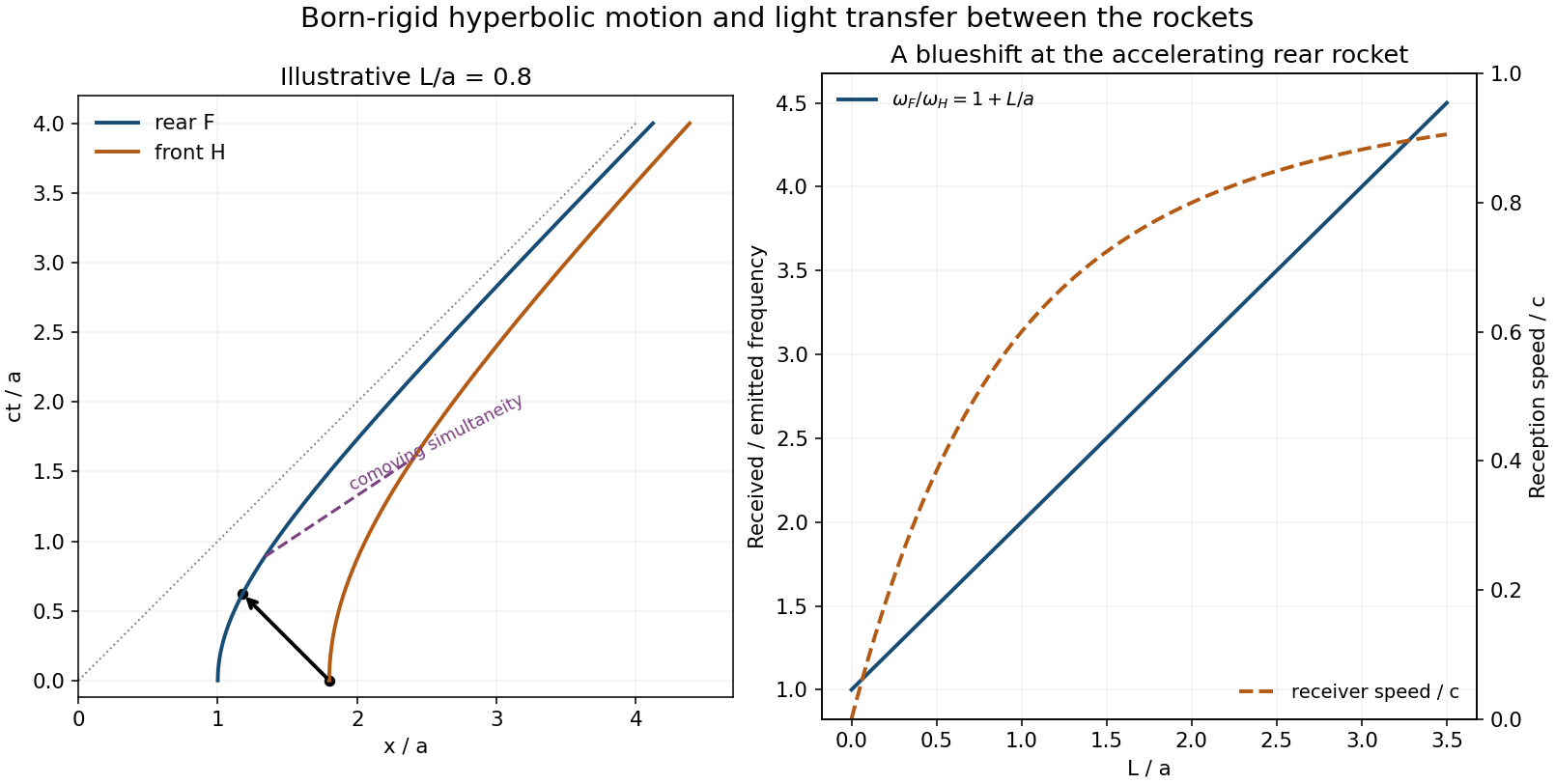

The photon leaves the front rocket at and moves toward decreasing , so its laboratory path is . Intersect it with the rear hyperbola, keeping the future root. Squaring and cancelling givesThe rear rocket's speed there isAt emission the front rocket is instantaneously at rest in S, so the photon laboratory frequency is . At reception the rear rocket moves in while the photon travels in . The Doppler factor for this head-on reception isThe receiver sees a blueshift. It is essential to use the front velocity at emission and the rear velocity at reception; comparing the two velocities at one laboratory time would describe the wrong pair of measurements. The result also agrees with the Rindler light-transfer frequency ratio for static accelerated observers at radii and . In the weak-acceleration limit , the shift is , and the arrival time approaches , providing useful checks.
Articles by others on the same topic
There are currently no matching articles.