For a Lorentz boost of speed along , the velocity-addition formula formulas areSubstitute , and take the ratio. The common time-transformation denominator cancels, yieldingTo specify the direction rather than just its tangent, use . This keeps the correct quadrant when the boost reverses the sign of the longitudinal velocity. For physical subluminal speeds the canceled denominator is positive. At and nonzero , the transformed direction is perpendicular to the boost; if the particle is exactly comoving, its transformed velocity vanishes and the angle is undefined.
The initial momentum magnitude satisfies . Equality of longitudinal and transverse magnitudes therefore givesAn electric field along changes , while the magnetic Lorentz force only rotates the transverse momentum. Its magnitude remains fixed. At the longitudinal turning point , henceFor an electron initially moving toward positive , the decelerating field points toward positive because its charge is . The electric work over givesThe radius is determined by transverse momentum rather than total energy:so the requested radius plot is horizontal. The cyclotron angular frequency changes as and the helix pitch shrinks to zero. These statements neglect radiation, as stipulated.
Each photon has energy . Their total four-momentum isIts squared invariant is . Therefore the system's rest energy isTwo individually massless particles can thus have positive total invariant mass. Back-to-back photons give rest energy , whereas exactly parallel photons have zero invariant mass and no massive-system rest frame.
The center-of-momentum frame moves with velocity . Using the total four-momentum in solution givesFor , its direction bisects the two photon directions, and its speed decreases from the limiting value to zero. At , the lab already is the center-of-momentum frame. At , the formal speed is and no inertial rest frame exists; this endpoint is a limit, not an allowable boost.
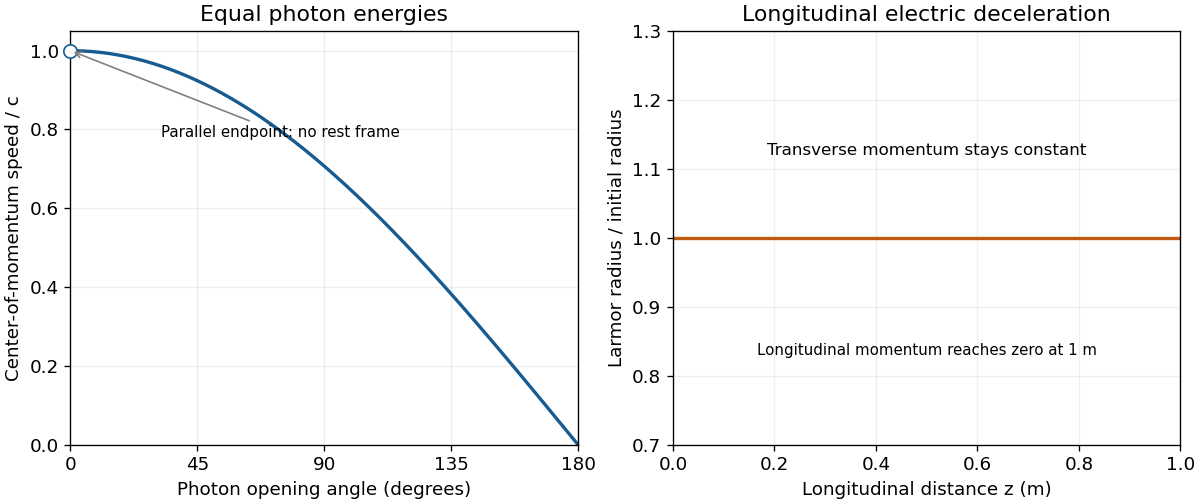
Center-of-momentum speed for equal-energy photons, with the parallel endpoint excluded, and the unchanged electron Larmor radius under longitudinal deceleration
. Details. 
Let be the incident laser-photon energy and . The maximum in the usual soft-laser geometry occurs for a head-on encounter followed by a forward outgoing photon along the electron beam. Boost into the initial electron rest frame: the incident energy becomes . Backscattering there gives the Compton scattering recoil relation . Boosting this outgoing photon forward to the lab givesThe familiar limit additionally requires and . The denominator is the recoil correction, not an optional factor at arbitrary incident energy.
For completeness, if the incidence direction is prescribed rather than optimized, let its unit vector be and the outgoing direction . Squaring the residual electron four-momentum on its mass shell gives the more general kinematic relationThus an unspecified crossing angle must not silently be identified with head-on incidence; the boxed result is the maximum for the stated head-on soft-photon arrangement.
Numerically gives , and a photon has energy . The maximum scattered energy is , givingThe rest-frame incident photon is only about one electronvolt, so the small recoil correction is consistent with the amplification estimate.
Articles by others on the same topic
There are currently no matching articles.