There is no nonzero, literally constant four-force that is a pure force throughout this motion. Initially , so purity forces . If the full four-vector were constant, ; its square would be , which cannot remain for a nonzero initially spatial . This is a genuine ambiguity in the source wording.
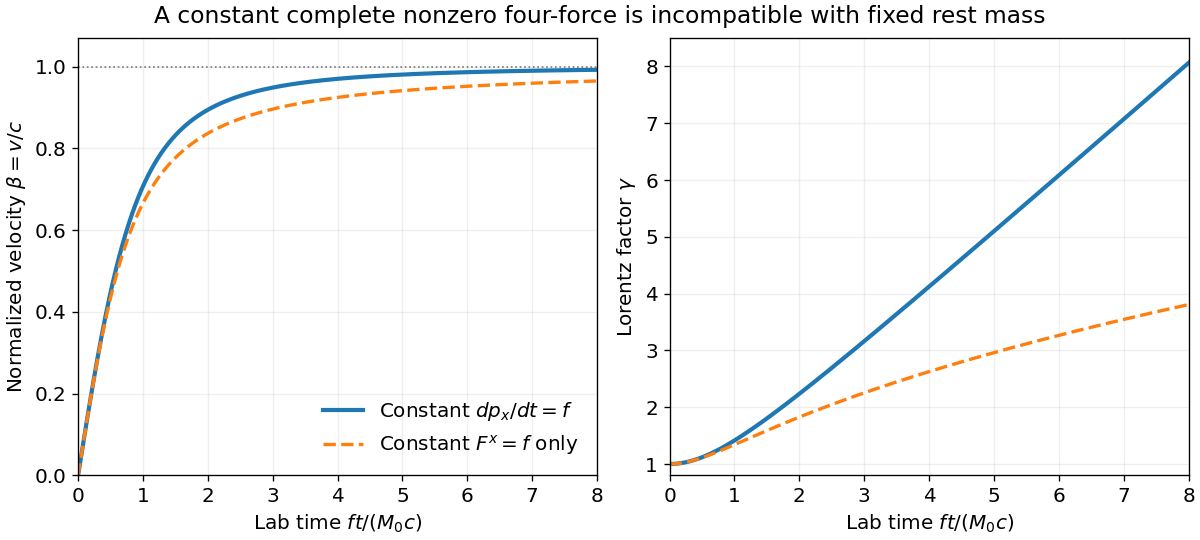
The usual consistent interpretation is constant laboratory relativistic force , equivalently constant one-dimensional proper acceleration . Take and let . Integrating momentum conservation with the applied impulse gives , soThe corresponding four-force has components , which are not constant, although its invariant magnitude is . Its temporal component is indeed . The speed rises from zero and approaches asymptotically; starts at one, initially rises quadratically and becomes linear in at late times.
If instead only the spatial four-force component is held constant, the distinct consistent answer is most simply parametrized by :This follows by integrating and . The temporal component must still vary. These two interpretations must not be conflated with a constant four-vector.

Articles by others on the same topic
There are currently no matching articles.