For a massive particle on a timelike world line, the four-velocity is , with . Its four-momentum is and its four-force is . Here is proper time. A massless trajectory does not admit this massive-particle proper-time parametrization.
The asserted classification of arbitrary orthogonal vectors is false. With the chosen Minkowski metric, and are nonzero, orthogonal and both spacelike vectors. Also and are orthogonal null vectors. The valid statement is that a nonzero vector orthogonal to a timelike vector is spacelike. To prove it, choose the rest frame of the timelike vector, ; then forces , so .
The relativistic energy-momentum relation givesTherefore . A photon is an example: . A collection of photons need not itself have zero invariant mass.
Along a massive particle's world line, proper time satisfies . A pure force preserves its rest mass. Differentiating and givesso for a pure force. This is a restriction on rest-mass transfer, not a statement that its work in every frame vanishes.
Write . Since , the four-acceleration isIf , this reduces to , whenceHere is the proper acceleration. The positive expression printed in the source is in the opposite metric signature, or the squared acceleration magnitude in ours. For example, at rest with nonzero acceleration, has in our convention. Thus one must not combine the printed positive sign with a mostly-minus norm.
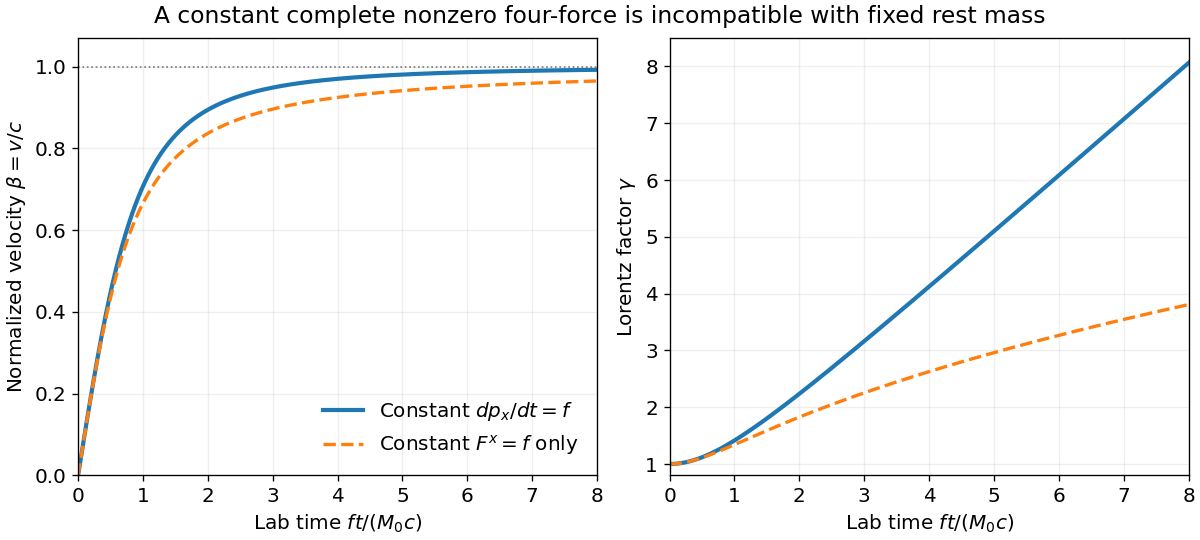
There is no nonzero, literally constant four-force that is a pure force throughout this motion. Initially , so purity forces . If the full four-vector were constant, ; its square would be , which cannot remain for a nonzero initially spatial . This is a genuine ambiguity in the source wording.
The usual consistent interpretation is constant laboratory relativistic force , equivalently constant one-dimensional proper acceleration . Take and let . Integrating momentum conservation with the applied impulse gives , soThe corresponding four-force has components , which are not constant, although its invariant magnitude is . Its temporal component is indeed . The speed rises from zero and approaches asymptotically; starts at one, initially rises quadratically and becomes linear in at late times.
If instead only the spatial four-force component is held constant, the distinct consistent answer is most simply parametrized by :This follows by integrating and . The temporal component must still vary. These two interpretations must not be conflated with a constant four-vector.

The equal and opposite incoming momenta make the laboratory the centre-of-mass frame. The initial total four-momentum is timelike. One outgoing photon would have null four-momentum, so an isolated two-body annihilation cannot produce exactly one photon. Two photons are kinematically possible and must have opposite momenta and equal energies:The quoted is the rest energy , not a mass in SI units. The energy balance includes both rest energies as well as the total kinetic energy.
This minimum concerns the complete final state. A detector with incomplete acceptance could register only one of the two photons, or none; conservation laws do not impose a minimum detected count without an ideal-detection assumption. Additional outgoing photons are also possible.
The electron moves in the direction for which the electric field does positive work. Its kinetic energy gain is the magnitude . HenceThis uses the relativistic energy-momentum relation, rather than the nonrelativistic kinetic-energy formula. Acceleration is opposite the field direction for a negatively charged electron, although the energy gain is positive along its actual displacement.
Articles by others on the same topic
There are currently no matching articles.