Source paper: Oxford public bundle, pages 67–71. The bundle filename says 2016; the held B2 cover is dated 14 June 2017. Letters identify successive unlettered marked paragraphs; subsidiary source labels are retained. Use and the Minkowski metric throughout. Official partial notes are explicitly limited to questions 1 and 2; they do not constitute answers to the whole paper.[ref]
B2 Symmetry and Relativity 2017 solution notes, problems 1 and 2 by Andrei Starinets. Cover identifies the year and the restriction to problems 1 and 2; the advertising page uses the same restriction
For a massive particle on a timelike world line, the four-velocity is , with . Its four-momentum is and its four-force is . Here is proper time. A massless trajectory does not admit this massive-particle proper-time parametrization.
The asserted classification of arbitrary orthogonal vectors is false. With the chosen Minkowski metric, and are nonzero, orthogonal and both spacelike vectors. Also and are orthogonal null vectors. The valid statement is that a nonzero vector orthogonal to a timelike vector is spacelike. To prove it, choose the rest frame of the timelike vector, ; then forces , so .
The relativistic energy-momentum relation givesTherefore . A photon is an example: . A collection of photons need not itself have zero invariant mass.
Along a massive particle's world line, proper time satisfies . A pure force preserves its rest mass. Differentiating and givesso for a pure force. This is a restriction on rest-mass transfer, not a statement that its work in every frame vanishes.
Write . Since , the four-acceleration isIf , this reduces to , whenceHere is the proper acceleration. The positive expression printed in the source is in the opposite metric signature, or the squared acceleration magnitude in ours. For example, at rest with nonzero acceleration, has in our convention. Thus one must not combine the printed positive sign with a mostly-minus norm.
There is no nonzero, literally constant four-force that is a pure force throughout this motion. Initially , so purity forces . If the full four-vector were constant, ; its square would be , which cannot remain for a nonzero initially spatial . This is a genuine ambiguity in the source wording.
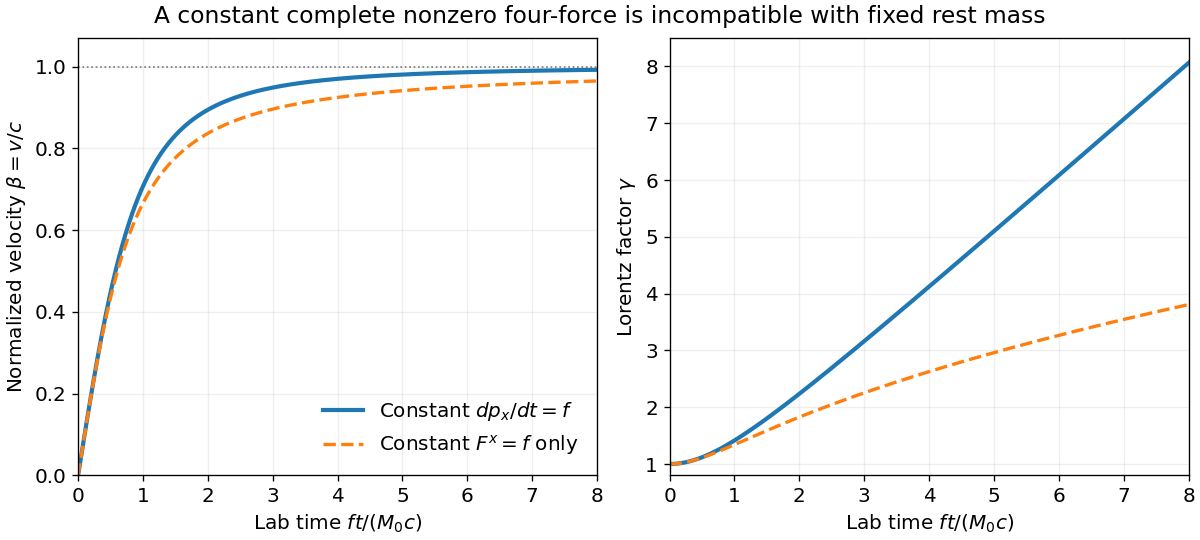
The usual consistent interpretation is constant laboratory relativistic force , equivalently constant one-dimensional proper acceleration . Take and let . Integrating momentum conservation with the applied impulse gives , soThe corresponding four-force has components , which are not constant, although its invariant magnitude is . Its temporal component is indeed . The speed rises from zero and approaches asymptotically; starts at one, initially rises quadratically and becomes linear in at late times.
If instead only the spatial four-force component is held constant, the distinct consistent answer is most simply parametrized by :This follows by integrating and . The temporal component must still vary. These two interpretations must not be conflated with a constant four-vector.

The equal and opposite incoming momenta make the laboratory the centre-of-mass frame. The initial total four-momentum is timelike. One outgoing photon would have null four-momentum, so an isolated two-body annihilation cannot produce exactly one photon. Two photons are kinematically possible and must have opposite momenta and equal energies:The quoted is the rest energy , not a mass in SI units. The energy balance includes both rest energies as well as the total kinetic energy.
This minimum concerns the complete final state. A detector with incomplete acceptance could register only one of the two photons, or none; conservation laws do not impose a minimum detected count without an ideal-detection assumption. Additional outgoing photons are also possible.
The electron moves in the direction for which the electric field does positive work. Its kinetic energy gain is the magnitude . HenceThis uses the relativistic energy-momentum relation, rather than the nonrelativistic kinetic-energy formula. Acceleration is opposite the field direction for a negatively charged electron, although the energy gain is positive along its actual displacement.
For a vacuum electromagnetic wave, the four-wavevector is with and . Its phase can be writtenBecause and transform as Lorentz four-vectors, their contraction is a Lorentz scalar. This proves phase invariance, with the same phase convention in both frames.
For a hypothetical free emission , four-momentum conservation gives . The initial and final electrons have , and . Squaring gives . In the final electron's rest frame, however, for a nonzero future-directed photon. ThusAn external field, another body or a medium can exchange momentum and change this conclusion; those are different systems.
Let and . A spacelike separation obeysUnder a boost with velocity , the time separation is . ChooseThen , while follows from the spacelike inequality. Therefore an inertial simultaneity frame exists. This choice has no transverse boost component and is not claimed to be the unique such frame. If the events are already simultaneous, suffices.
Put . The total four-momentum of the perpendicular photons isAlthough each constituent is massless, the sum has . Its invariant mass is thereforeThe rest energy is the total energy in the frame where the two photon momenta cancel, not the sum of individual photon rest energies.
The centre-of-mass velocity follows from the total energy and momentum:A boost in this direction with gives zero total spatial momentum and total energy . The constituent photons remain moving at in that frame.
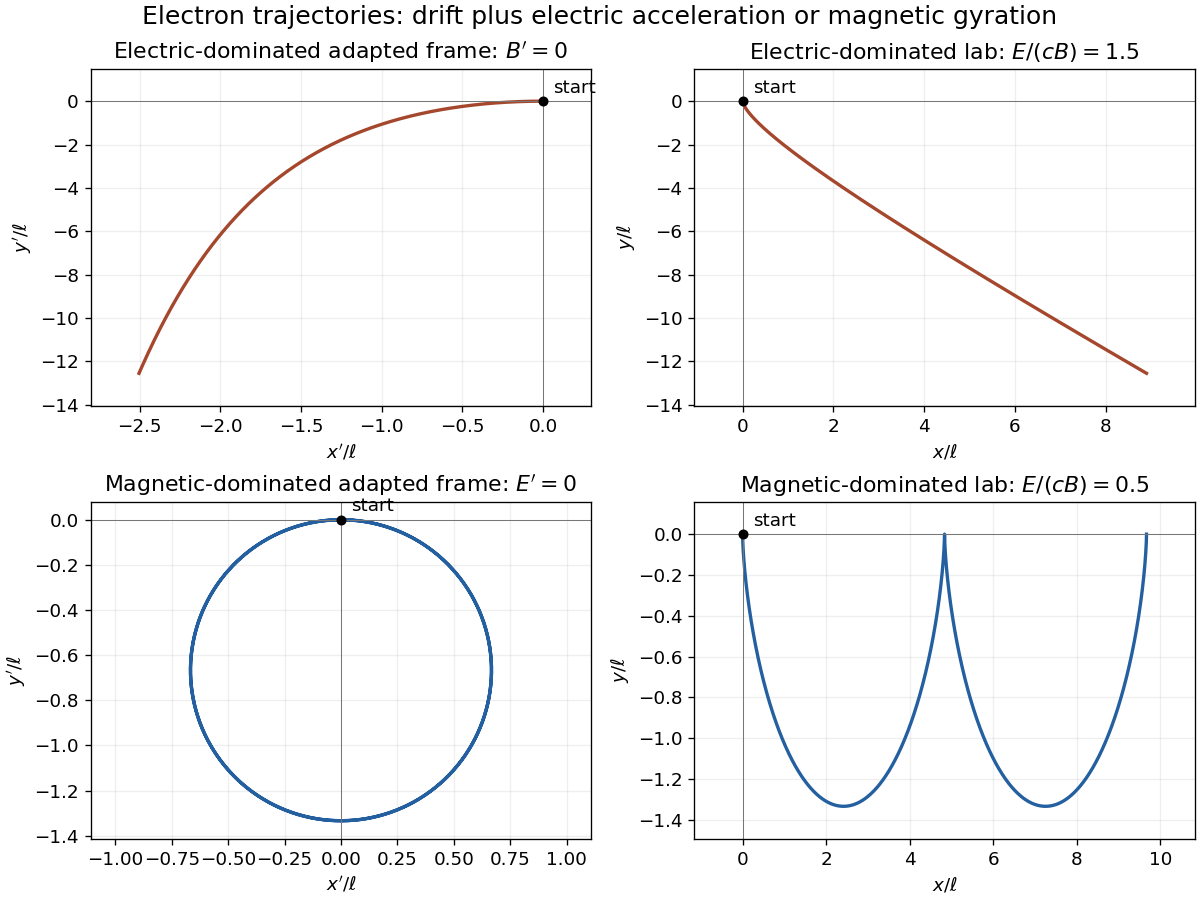
For the electric-dominated crossed-field orbit, choose a boost along . Since , it is subluminal. The Lorentz transformation of electromagnetic fields gives and , where . The initially stationary electron has , not zero velocity in this frame.
Let , and . Neglect radiation reaction, as in the prescribed external-field model. Integrating the relativistic Lorentz force in this purely electric frame gives the exact trajectoryIndeed , , and satisfy both the force equation and . The constant transverse momentum must be retained.
The inverse boost gives a useful exact laboratory parametrization as well:For , the lab electron starts accelerating toward negative and bends toward positive , the direction of . It never acquires a cyclotron orbit in this electric-dominated case. At late times, and , so its speed approaches along an oblique asymptote. Reversing field signs reverses the appropriate directions. The zero- limit is the ordinary electric-field hyperbolic motion.
For the magnetic-dominated crossed-field orbit, choose along , which is subluminal when . Then and . The initial velocity in this frame is , and the constant particle Lorentz factor is because a magnetic field does no work.
Define the signed relativistic cyclotron frequency , retaining . With as parameter, the exact primed trajectory isIt is a circle of radius with centre ; its initial velocity is as required. Transforming back givesIn the laboratory this is a stretched cycloidal trajectory with cusps where the electron is instantaneously at rest. Its average drift is , along for the positive field orientation. Its energy oscillates as the electric field exchanges energy with it; it does not accelerate without bound. If , the initially stationary electron remains stationary. At , neither of these finite boosts exists; that separate null-field limit is not one of the two strict cases requested.

With , the total four-momentum is . A sum of Lorentz four-vectors transforms as a four-vector, sois a Lorentz invariant. Its value is the squared invariant mass of the complete system, irrespective of whether its constituents interact. Isolation makes the total four-momentum constant in time.
For a photon gas, write with . Its individual null norms do not make the total norm vanish:For an isotropic gas in its momentum rest frame, and . Zero is possible only when all nonzero photons propagate in the same direction. Two equal-energy photons at right angles, for example, give , rather than zero. Without an angular distribution, the pairwise expression is the general answer; isotropy is an additional assumption.
Three relevant observable effects are the relativistic Doppler effect in spectral-line shifts, including the transverse time-dilation contribution; relativistic aberration, observable as a change of apparent light direction with observer motion; and relativistic beaming of moving emitters, associated with strongly asymmetric jet brightness. Apparent superluminal motion supplies a related light-travel-time test: can exceed one without a material speed exceeding . These interpretations require an emission and source-motion model; a cosmological or gravitational redshift by itself is not a direct test of special-relativistic kinematics.
For Compton scattering from an initially stationary electron, let incoming and outgoing photon energies be and and their mutual angle be . Four-momentum conservation gives . Squaring and using both electron mass shells and both photon null norms givesConsequently the outgoing angular frequency and shift areEquivalently, the Compton wavelength shift is . The electron recoil is essential; treating its energy as unchanged would suppress the effect.
A boost into a frame moving with velocity transforms the temporal component of the four-wavevector as . Therefore the general relativistic Doppler effect iswhere is the laboratory angle between the boost and propagation directions. This is also the frequency measured from the phase rate along the observer's world line, . The frequency is an observer-dependent contraction of the invariant wave phase.
Take the wave along positive , so . A longitudinal boost givesA receiver moving in the propagation direction measures a redshift. The same signed expression gives a blueshift when . If the original wave propagates along negative instead, retain in the general formula.
For , the laboratory wavevector is perpendicular to the boost. The dot product vanishes, soThis transverse-observer transformation is a blueshift. It must not be confused with the inverse factor often quoted when transverse refers to a ray perpendicular to the source velocity in the receiver's frame. The angle condition is specified in different frames in those two statements; relativistic aberration relates them.
The asserted necessity of equal masses is false. Equal unsigned outgoing angles imply equal longitudinal momenta when the transverse momenta cancel; they do not imply equal final speeds or energies for unequal masses.
An explicit counterexample uses , masses and , initial projectile energy , and a stationary target. The initial total energy is and momentum is . Choose final four-momentaThey sum to the incoming four-momentum. Their squared norms are respectively and , so the collision is elastic. Both trajectories make the same acute angle with positive :Thus no proof of the printed claim is possible.
The general centre-of-mass frame construction shows why. Let be the outgoing momentum magnitude there, the projectile scattering angle, and the two energies. After a boost along , the equal-angle condition for two forward nonzero trajectories isWith the initial projectile energy, its solution isprovided the right side lies between minus and plus one and both final longitudinal momenta are positive. Equal masses are one allowed case, giving ; they are not necessary. For the counterexample the right side is . Even equal masses do not force equal angles for every scattering direction: the symmetric outgoing configuration is an additional choice.
Take the stated static vector potential with zero scalar potential. In the laboratory,Let move along at the electron's reference velocity . The inverse transformation is . The Lorentz transformation of electromagnetic fields giveswith all other components zero. The sign follows from .
Although an observer fixed in sees an oscillating field, this is not an exact source-free propagating electromagnetic wave. The phase covector has , , so its squared norm isIt is the boost of a static spatial grating, not a null vacuum wave. Equivalently, and is nonzero away from nodes; a vacuum plane wave would have vanishing electromagnetic field invariants. In the ultrarelativistic limit it can be a useful nearly wave-like approximation along the electron's path, but the exact distinction remains.
A charged electron cannot actually maintain the given constant velocity through this nonzero transverse field without an external constraint: the Lorentz force deflects it. The calculation therefore uses the prescribed straight reference trajectory, a weak-deflection approximation, or an instantaneously comoving inertial frame. A globally fixed electron rest frame is not available for its exact deflected motion.
For a boost along positive , let . Parallel field components are unchanged, while transverse components mix. The Lorentz transformation of electromagnetic fields givesThese signs correspond to moving with relative to , not the inverse boost. They can be obtained from for the electromagnetic field tensor.
The electromagnetic four-potential is , and the vacuum four-wavevector is with . Define and . The given transverse potential is . Its physical fields areso the Poynting vector points along positive . For our signature, , , and . ThereforeThe square-root prefactor is simply the source's chosen wave normalization; an overall dimensional amplitude could multiply every field.
The four-current is , with . Charge conservation takes the equivalent formsLowering both indices of changes the sign of its time-space entries: , while . The temporal component of is , by Gauss's law. Its spatial components are , by the Ampère-Maxwell equation. HenceFor the displayed free wave the current vanishes because ; the component derivation also proves the sourced identity. The two homogeneous Maxwell equations follow separately from expressing in terms of a potential.
Force-sign qualification. With these definitions the physical Lorentz force density is , whereas the source prints the reversed contraction . ConsequentlyThe physical time component is the power transferred to matter per volume divided by , as in Poynting's theorem. For example parallel positive and do positive work, but the literal printed contraction has negative time component. This sign cannot be repaired while simultaneously retaining the source's tensor definition and the Maxwell identity above; reverse the force contraction to describe the physical force.
For , directly contract the supplied vector:Thus whenever its stated normalization is defined, namely and . This is the Pauli-Lubanski orthogonality property.
The description as a unit vector, however, needs an additional assumption. From the given components and the mass shell,It equals minus one only for spin parallel to momentum, including the zero-momentum case. A concrete counterexample is and : the proposed normalized vector has square minus two. Orthogonality is still true. A genuine Pauli-Lubanski pseudovector constructed by boosting a fixed rest-frame spin has invariant norm ; the source's generic spatial expression and denominator do not supply that normalization for arbitrary .
Use a neutral, infinitely long wire on the axis. Denote the total current by , and write . Outside the wire the magnetic field and electric field areThese follow from cylindrical symmetry and Ampère's law. The zero temporal component of the given total four-current specifies lab neutrality; the in must refer to a carrier density, not that zero net charge density.
TODO: normalization from a literal volume current density requires the unspecified wire cross-section. The source does not supply its area or profile. The exterior field family below is fully determined in terms of ; it cannot be reduced to alone without that missing datum. If was intended as a cross-section-integrated line current instead, set and interpret its accompanying charge density as charge per length. No inside-wire profile is invented.
For a boost along positive , let . Apply the Lorentz transformation of electromagnetic fields at corresponding events:Here the subscript labels the perpendicular-to-wire boost, not the direction of the transformed vector. In these formulas evaluate the original field at , and . The wire moves in this frame, so the fields are time-dependent. The local current transforms to , , . A nonzero transformed electric field is possible even with zero net charge density: it is not a purely electrostatic field.
For a boost along positive , the transverse coordinates are unchanged. The transformed fields areThe transformed line charge and current are and . These reproduce the radial electric field through Gauss's law. A boost comoving with the electrons removes their individual current contribution, but the positive background then moves and the total current is not zero.
For two identical wires, their lab interaction is attractive, with magnitude per length. The total four-current is spacelike, , so no inertial frame makes it a pure charge density. Also forbids a frame in which the exterior field is purely electric. For an arbitrary boost along the wires, the electrical part is repulsive and the magnetic part attractive:The latter always dominates, and their sum remains .
Even a more general boost cannot make the entire-wire force electrical alone. At the second wire choose , so and with . The physical Lorentz force density is . If the boosted magnetic force vanished, , then would also give . Thus , which from the boost of requires . But for such a boost , whereas . The electrical term alone cannot equal the actual force. Therefore there is no such frame for both complete wires, although the force on electrons considered separately can be electrical in their rest frame.
Let and . For a head-on photon and particle collision, boost to the particle's initial rest frame. The incident photon energy is . On the inverse-Compton branch , the maximal outgoing lab energy corresponds to rest-frame backscattering into the particle's forward direction. The exact Compton scattering recoil formula gives . Boosting the backscattered photon back to the lab givesFor this becomesOnly in the additional Thomson scattering limit may the denominator be neglected, yielding the printed estimate . Ultrarelativistic motion alone does not justify it. For example and would give from that estimate, exceeding the available total energy; the recoil-corrected maximum is about .
For an arbitrarily hard incident photon, maximizing over direction needs a further qualification: if , the largest outgoing photon energy is the unchanged , rather than this amplified backscattering branch. The exact photon energy gain is . Calling the outgoing energy the gain is accurate only when amplification is large. These distinctions prevent the inverse Compton scattering estimate from violating conservation of energy outside its low-rest-frame-photon-energy regime.
Articles by others on the same topic
There are currently no matching articles.