Use the figure's upward-positive vertical coordinate. The support is at and the bob at . ThusThe potential is , up to an irrelevant constant. Combining both kinetic energies givesThe cross term expresses the moving support's contribution to the bob velocity; it would be lost by treating the pivot as fixed.
Differentiate with respect to the generalized velocities:The Lagrangian has no explicit , so . This canonical momentum is also the system's total horizontal mechanical momentum. Horizontal translation symmetry conserves even though the support and bob separately accelerate.
Write . Integrating the zero-momentum condition gives , where is the constant horizontal centre-of-mass position. Therefore the bob coordinates areEliminating the angle gives the elliptic bob path at zero horizontal momentum,The semiaxes are horizontally and vertically. An oscillation traverses only the allowed arc, reversing at its turning points. The support counter-moves to keep the horizontal centre of mass fixed. The heavy-support limit tends to the familiar fixed-pivot circle.
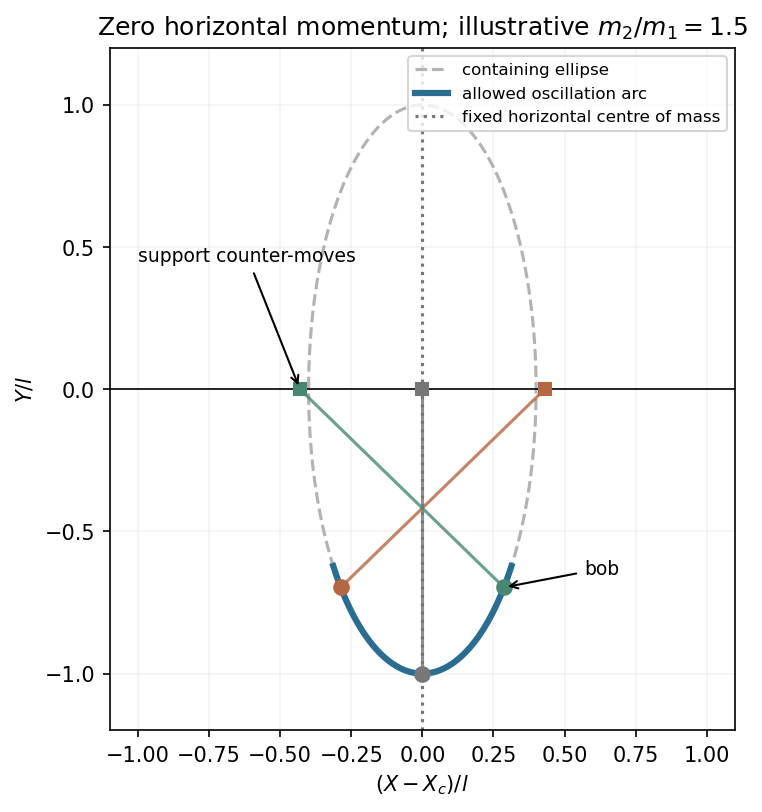

The time-independent Lagrangian conserves . Substitute into the kinetic energy to obtainThis is the angle-dependent effective inertia of a pendulum with a freely sliding support. Solving for the speed givesOn a monotone increasing segment, the travel time is thereforeThe printed oriented integral assumes that increasing-angle branch. For decreasing motion use or interchange the limits; if a turning point lies between the two events, split the trajectory into monotone segments and add their positive times. The numerator remains positive for positive masses. At an ordinary turning point the inverse-square-root singularity is integrable; reaching the unstable upright separatrix takes infinite time.
Articles by others on the same topic
There are currently no matching articles.