Use the figure's upward-positive vertical coordinate. The support is at and the bob at . ThusThe potential is , up to an irrelevant constant. Combining both kinetic energies givesThe cross term expresses the moving support's contribution to the bob velocity; it would be lost by treating the pivot as fixed.
Differentiate with respect to the generalized velocities:The Lagrangian has no explicit , so . This canonical momentum is also the system's total horizontal mechanical momentum. Horizontal translation symmetry conserves even though the support and bob separately accelerate.
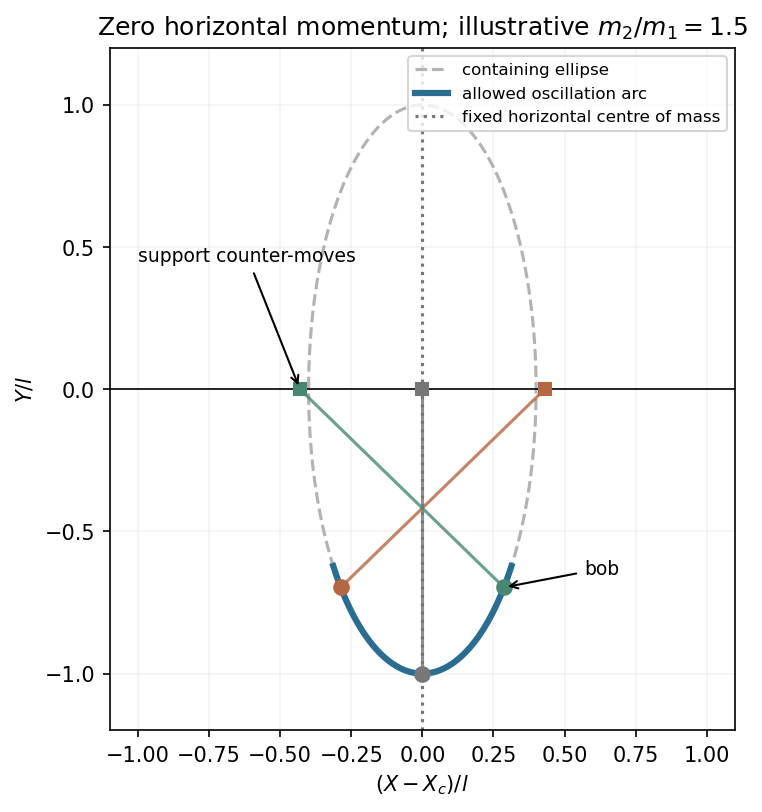
Write . Integrating the zero-momentum condition gives , where is the constant horizontal centre-of-mass position. Therefore the bob coordinates areEliminating the angle gives the elliptic bob path at zero horizontal momentum,The semiaxes are horizontally and vertically. An oscillation traverses only the allowed arc, reversing at its turning points. The support counter-moves to keep the horizontal centre of mass fixed. The heavy-support limit tends to the familiar fixed-pivot circle.
The time-independent Lagrangian conserves . Substitute into the kinetic energy to obtainThis is the angle-dependent effective inertia of a pendulum with a freely sliding support. Solving for the speed givesOn a monotone increasing segment, the travel time is thereforeThe printed oriented integral assumes that increasing-angle branch. For decreasing motion use or interchange the limits; if a turning point lies between the two events, split the trajectory into monotone segments and add their positive times. The numerator remains positive for positive masses. At an ordinary turning point the inverse-square-root singularity is integrable; reaching the unstable upright separatrix takes infinite time.
A one-degree-of-freedom canonical transformation requires the Poisson bracket . To first order,The product of the off-diagonal derivatives contributes only at second order. Consequentlywith and unconstrained at this order. The self-brackets vanish identically. This is perturbative preservation of the symplectic form, not exact canonicity of the truncated polynomial map.
Treat all transformation coefficients as , so products of them with are second order. Substitution into the Hamiltonian gives its harmonic part plusSet these four coefficients to zero and impose the canonical constraints. The result isThus the first-order canonical removal of a cubic oscillator perturbation isup to . It yields . The inverse map, if old initial data are specified, is and to the same order. There is no time-dependent generating term because the map is autonomous.
Hamilton's equations give and . Hence, with constants and fixed by transformed initial data,An equivalent form uses for . The indicated errors are a fixed-time perturbative statement; a higher-order frequency correction can accumulate phase on longer times.
Insert the harmonic variables into the forward map and reduce the squared trigonometric functions. This givesIndeed at this order. The second harmonic and mean displacement of a weakly cubic oscillator show asymmetry of the motion: for positive the mean shifts towards negative . There is no first-order frequency shift, although the waveform is no longer purely sinusoidal.
The small parameter is . A purely cubic perturbation is unbounded in one direction, so these formulas describe small local oscillations around the stable origin, not globally confined motion at arbitrary energy. Amplitude labels the transformed orbit and must be inferred using the inverse map if physical initial position and momentum are supplied.
In Cartesian components, and . The Euler-Lagrange equation therefore givesThus the minimally coupled particle Lagrangian yields the Lorentz force.
For an arbitrary smooth gauge function , take and . Both fields are unchanged, whileThe action changes only by an endpoint term, so fixed-endpoint variation gives the same motion. Canonical momentum shifts by , whereas kinetic momentum and the Lorentz force are gauge invariant. This is the relevant gauge invariance of the classical particle dynamics.
The cylindrical entries of are physical vector components, so , not . The Lagrangian isIts three equations areFor , the angular equation can be expanded as . Directly computing the fields gives and , agreeing with the equations above.
The energy function isThe velocity-linear magnetic term cancels. Since has no explicit time dependence, . Equivalently, magnetic force does no work, and electric work is exactly minus the change of . Energy here is defined in the supplied time-independent gauge and equals physical kinetic plus electrostatic potential energy.
The coordinate is cyclic. Its conjugate momentum is therefore a second conserved quantity,It differs from mechanical angular momentum . The magnetic contribution is essential to the rotational Noether charge in this axisymmetric gauge.
For constant , the radial equation requires . Select the stipulated nonzero angular velocity and define the positive cyclotron frequency . ThenThis is a circle in the transverse plane combined with an independent axial oscillation, as in uniform magnetic field with axial harmonic confinement. Viewed from positive , positive charge rotates clockwise. Its three-dimensional path lies on the cylinder and reverses its vertical motion; it is generally not a constant-pitch helix. For it is a horizontal circle. This orbit has .
For the specified parameter relation,Thus there are axial oscillations per transverse revolution, and the nondegenerate three-dimensional trajectory closes after . Since , the integer is excluded; changing its sign changes nothing. More generally commensurate cyclotron and axial oscillations close for any rational frequency ratio, whereas irrational ratios give quasiperiodic motion when both components are present. An integer ratio is sufficient, not the only closure condition. The same frequency argument also applies to transverse cyclotron circles centred away from the chosen cylindrical origin.
Use metric signature and units with propagation speed one. The scalar Euler-Lagrange equation givesWith the stated spatial Fourier convention, becomes . Each transformed mode obeysHere and are the initial transformed field and velocity. Reality requires and the same for ; the Fourier convention places no extra in these evolution formulas.
Including the interaction gives the two coupled real Klein-Gordon fields,Adding and subtracting diagonalizes them:Both squared masses are positive for . For arbitrary initial data and , defineThen the general solution is , , with the corresponding reality conditions on initial data.
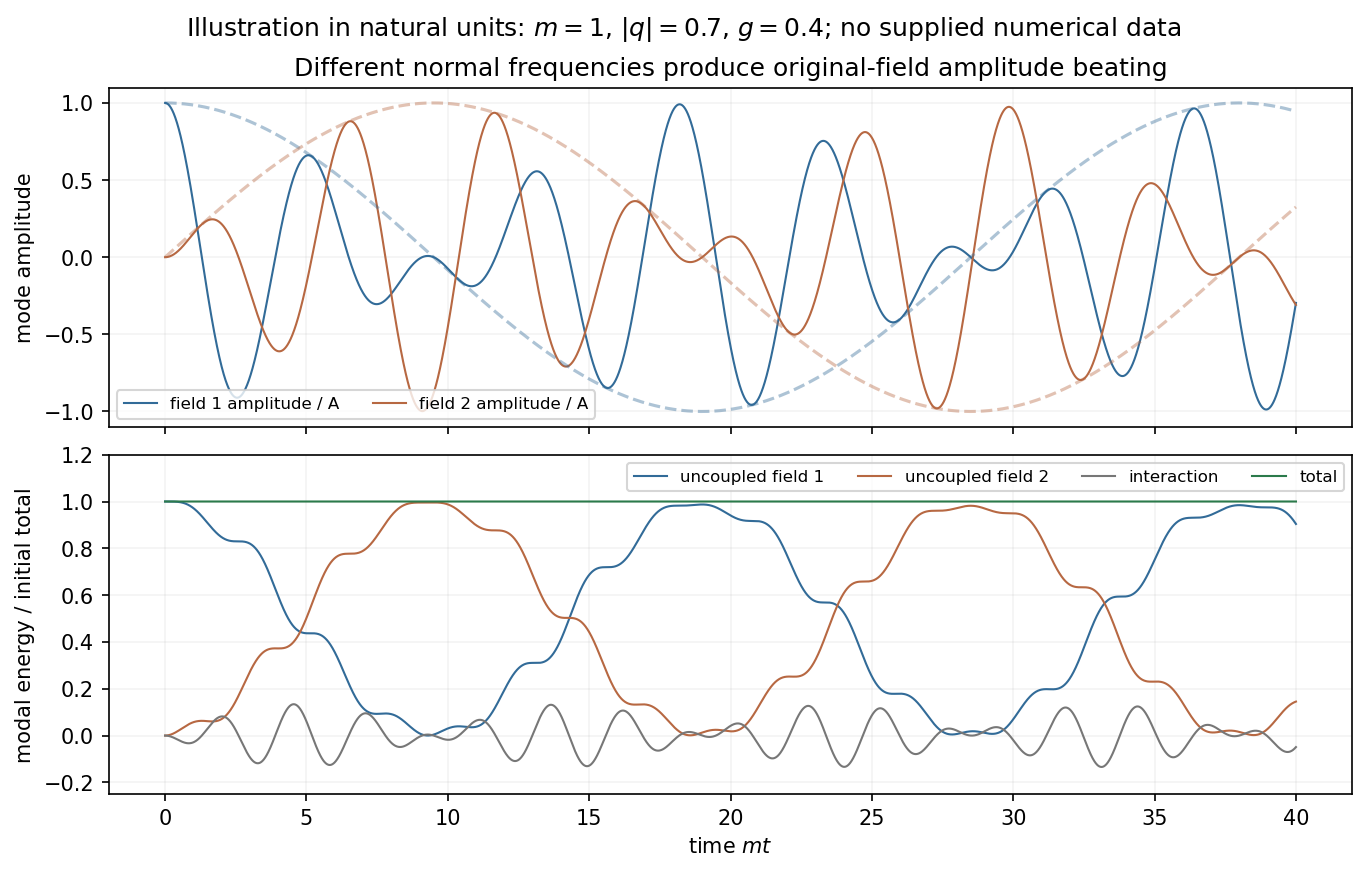
For the specified sinusoidal initial displacement, put . Both normal fields initially have amplitude and zero time derivative. ConsequentlyWriting and gives and . This is field-amplitude beating of coupled Klein-Gordon modes. The conserved energy includes the interaction term ; separate uncoupled-field energies need not be conserved, and an envelope zero is not by itself exact complete energy transfer.
Noether's theorem associates a continuous one-parameter differentiable symmetry of the action with an on-shell conserved current. If a first-derivative Lagrangian density varies by , the current is . The integral of is conserved when the spatial boundary flux vanishes. This connects symmetries to conservation laws; time translation, spatial translation and internal phase symmetry furnish familiar examples.
For the strict fixed-coordinate invariance in the question, . In one space dimension, integration by parts at the density level givesThe bracket vanishes by the field equation. Thus yieldsIn four spacetime dimensions the same identity gives with . In particular, for the usual scalar kinetic term the spatial current has the minus sign inherited from .
For the quartic density in dimensions,To evaluate the displayed dilation current, abbreviate and . Product differentiation givesHere makes the differentiated kinetic terms cancel, and . On shell, the on-shell divergence of a quartic scalar dilation current reduces toHence this current is conserved for generic solutions in four spacetime dimensions. Special field configurations with vanishing density do not alter the generic dimensional statement.
The subtraction has a symmetry explanation: for , direct variation gives . At the action is invariant up to a boundary term, so . Strict invariance of the density is not required. This is a classical result; no claim about quantum scale invariance is needed.
Use the forward spatial transform and inverse . The retarded transformed Green function obeysIt vanishes for negative . Continuity at zero excludes an unwanted term; integrating across zero then fixes . Define and . The two homogeneous exponents are . Imposing the two matching conditions gives the Fourier-mode Green function of the telegraph equation,For an explicit time-Fourier route, use . ThenFor , both poles lie below the real axis. Closing above for gives zero; closing below for is clockwise, giving times the residue sum. Since , this iswhich reduces to the same damped sine or hyperbolic sine above. The pole on the real axis is interpreted by the retarded limiting prescription, or directly by the initial-value matching above.
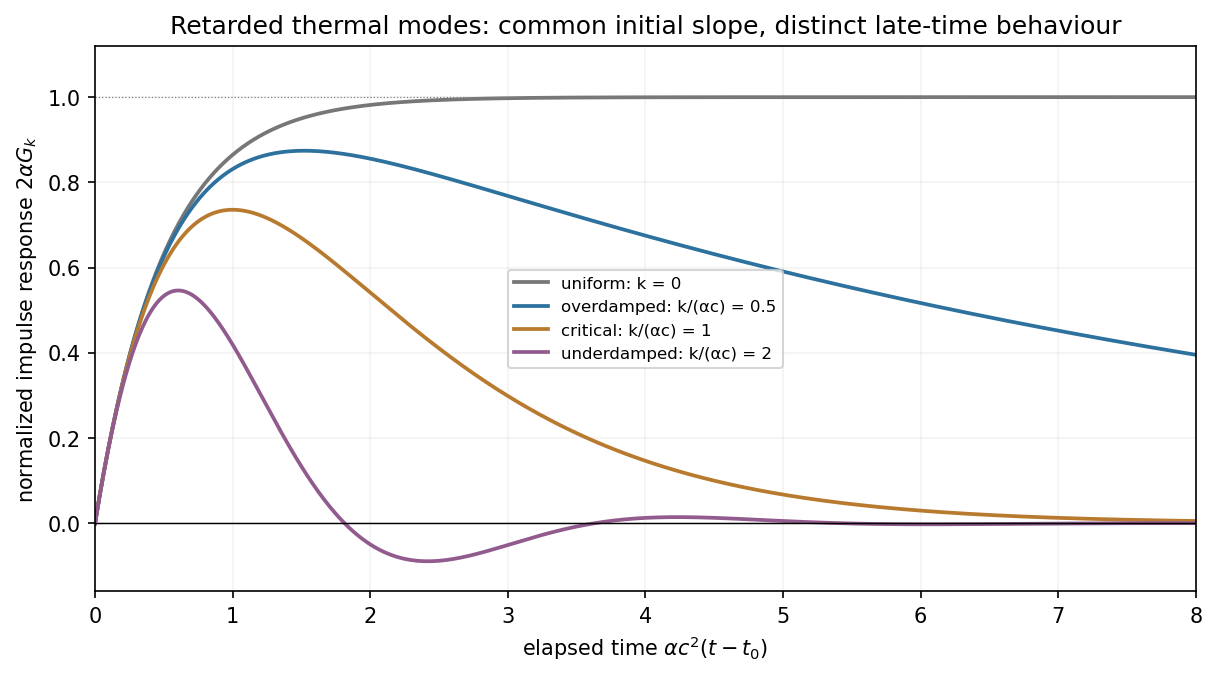
For the response is overdamped and nonoscillatory. For , put ; analytic continuation gives , a real damped oscillation. At equality the finite limit is .
All nonzero Fourier modes decay. The uniform mode instead has for positive time, leaving a constant temperature increment. At small wavenumber the slow decay exponent is , so the diffusion limit of the damped heat-transmission equation has diffusivity . The full hyperbolic equation has finite propagation speed , unlike the limiting parabolic heat equation.
The spatial transform of is . Convolution with the impulsive source and the inverse transform therefore give simply . Take without loss of generality and set .
For , let . ThenFor , let . ThenBoth satisfy and , so the impulse changes the time derivative rather than discontinuously changing temperature. The first case rises and then relaxes without sign oscillations for a nonzero mode; the second oscillates as its amplitude decays. The limiting equality gives , and gives the nondecaying uniform increment discussed above.
A cosine source has both positive and negative regions, so this linear solution can be understood as a temperature perturbation about a background; its negative values are not assertions of negative absolute temperature. The temporal oscillations arise from the second-time-derivative term. Dropping that term changes the initial-jump structure as well as removing the underdamped regime.


Articles by others on the same topic
There are currently no matching articles.