Near zero the Langevin function has expansionFor positive , rises toward one and its ratio decreases from to zero. Therefore a line has only the zero intersection for , and also a nonzero positive intersection for . In a fixed signed component there is a corresponding negative solution; in the isotropic vector problem the nonzero solutions have all spin-space orientations.
The mean-field transition temperature isAt the critical temperature the line is tangent at the origin. Just below it, , the usual mean-field square-root onset. The ordered minimum is stable below this temperature while becomes unstable.
This is a mean-field prediction, not a genuine finite-temperature ordering transition for the ideal two-dimensional short-range isotropic model. Long-wavelength spin fluctuations invalidate the predicted nonzero thermodynamic magnetization at every . The relevant obstruction is the Mermin-Wagner theorem for continuous spin symmetry; anisotropy, long-range interactions or a finite sample change the assumptions. Its original paper establishes the absence of finite-temperature magnetic ordering for one- and two-dimensional finite-range isotropic Heisenberg models.[ref]
Absence of Ferromagnetism or Antiferromagnetism in One- or Two-Dimensional Isotropic Heisenberg Models by N. D. Mermin and H. Wagner. Physical Review Letters 17, 1133 (1966), abstract; physical limitation of finite-temperature mean-field order
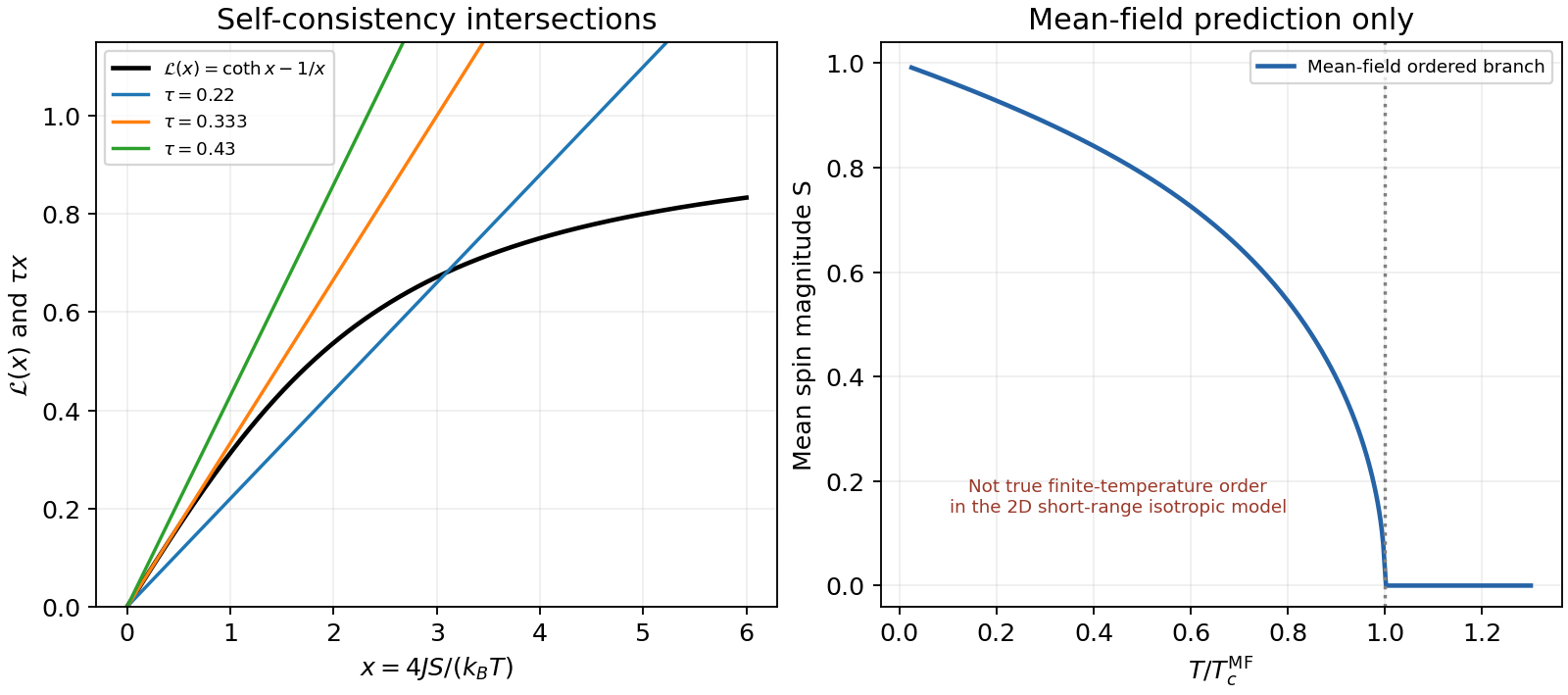
Original Langevin self-consistency plot and the mean-field order parameter, explicitly distinguished from true two-dimensional isotropic long-range order
. Details. 
Articles by others on the same topic
There are currently no matching articles.