Mean-field theory replaces fluctuating interactions with the average field produced by the other degrees of freedom. For an interacting spin system, write and neglect connected products . This reduces the many-body partition function to independent single-site factors coupled through a self-consistency equation for .
The approximation is most reliable when many effectively independent neighbors contribute, for sufficiently long-range interactions, or above the upper critical dimension away from the fluctuation-dominated critical region. It usually becomes least reliable near a continuous transition in low dimensions, where correlations extend over long distances. It can estimate ordering scales and reveal candidate broken symmetries while giving incorrect critical exponents or even a spurious transition. The two-dimensional isotropic model in the later parts is an especially important example of this limitation.
Let the coordination number be , and choose the spin-space axis along . The mean-field decoupling of a bond isThe original directed neighbor sum counts each bond twice, so its factor cancels that double counting. The resulting energy isThe constant prevents double counting of the mean interaction energy and is necessary if free energy is minimized with respect to . With the source's unnormalized solid-angle measure, the single-site integral isThereforeAt take . A normalized solid-angle measure would remove the factor without changing the self-consistency equation. These are three-component classical spins on a two-dimensional positional lattice, not spins constrained to a plane.
The PDF's hint is a correct angular-integration identity for a term with coefficient . That coefficient is not the full single-site molecular field after summing all four neighbors and decoupling both entries of each bond. The net coefficient is , as follows from the explicitly stated Hamiltonian; inserting the hint's coefficient as the total field would lose the coordination and double-counting factors.
In mean-field theory all sites have the same normalized single-site distribution . Consequentlywhere is the Langevin function. Requiring the average used to construct the field to equal the average in that field givesSetSince , the self-consistency equation is exactly . It also follows by stationarity of . This independent route checks the constant term and all neighbor-counting factors in the partition function.
Near zero the Langevin function has expansionFor positive , rises toward one and its ratio decreases from to zero. Therefore a line has only the zero intersection for , and also a nonzero positive intersection for . In a fixed signed component there is a corresponding negative solution; in the isotropic vector problem the nonzero solutions have all spin-space orientations.
The mean-field transition temperature isAt the critical temperature the line is tangent at the origin. Just below it, , the usual mean-field square-root onset. The ordered minimum is stable below this temperature while becomes unstable.
This is a mean-field prediction, not a genuine finite-temperature ordering transition for the ideal two-dimensional short-range isotropic model. Long-wavelength spin fluctuations invalidate the predicted nonzero thermodynamic magnetization at every . The relevant obstruction is the Mermin-Wagner theorem for continuous spin symmetry; anisotropy, long-range interactions or a finite sample change the assumptions. Its original paper establishes the absence of finite-temperature magnetic ordering for one- and two-dimensional finite-range isotropic Heisenberg models.[ref]
Absence of Ferromagnetism or Antiferromagnetism in One- or Two-Dimensional Isotropic Heisenberg Models by N. D. Mermin and H. Wagner. Physical Review Letters 17, 1133 (1966), abstract; physical limitation of finite-temperature mean-field order
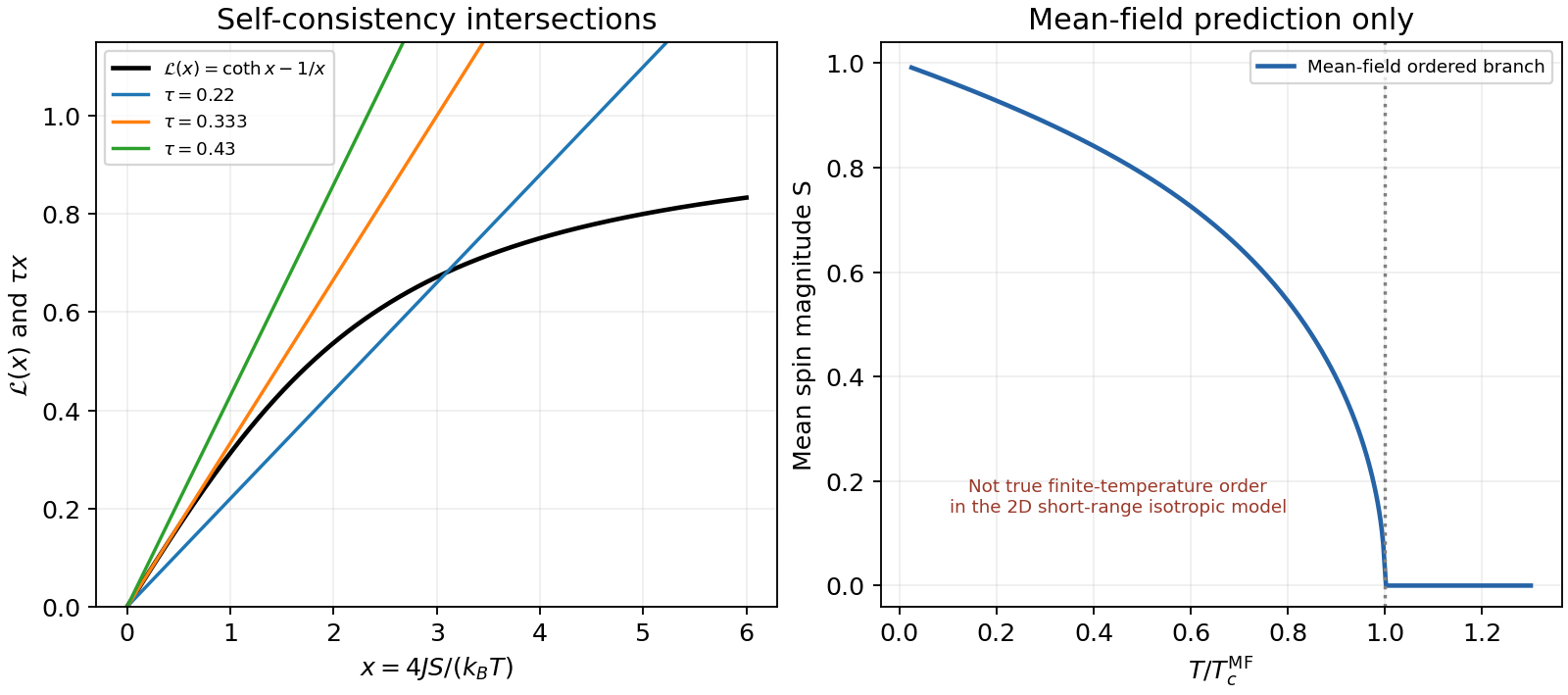
Original Langevin self-consistency plot and the mean-field order parameter, explicitly distinguished from true two-dimensional isotropic long-range order
. Details. 
For uniform unconstrained boundary conditions, the positive gradient coefficient favors a spatially constant minimizer. Put . The remaining free-energy difference is . Its minimum isBelow the amplitude is fixed but its direction is arbitrary; the set of uniform minima is a two-sphere. The free-energy minimum is below and above. The order parameter vanishes continuously, so this is a continuous, second-order transition within Landau theory.
The free energy has internal spin-rotation/reflection symmetry; a chosen nonzero vector leaves an subgroup invariant. Restricting to proper rotations, this is spontaneous symmetry breaking. There are two transverse orientation directions and a massive amplitude direction below the transition. Spatially varying directions cost gradient energy, and imposed boundaries or defects can prevent a uniform minimizer. In strictly two-dimensional equilibrium with short-range interactions, the fluctuation caveat of part (d) still applies: minimizing this polynomial functional at mean-field level does not overturn the absence of finite-temperature spontaneous magnetization.
Articles by others on the same topic
There are currently no matching articles.