Choose a basis whose first axis is . The tensor with uniaxial nematic order then has eigenvalues . Hence , and . Substitution givesFor , remains a local minimum with curvature . Its nonzero stationary points satisfy , soThey first appear at as a stationary inflection point; for more negative , is a local maximum and a local minimum. The latter is initially metastable, becomes degenerate with at , and then becomes the global minimum as decreases further. This is a first-order transition in a cubic-quartic Landau potential: the order changes discontinuously. The saddle-node bifurcation creating a local minimum is not the coexistence condition. The isotropic minimum never loses local stability in this fixed positive- scan.
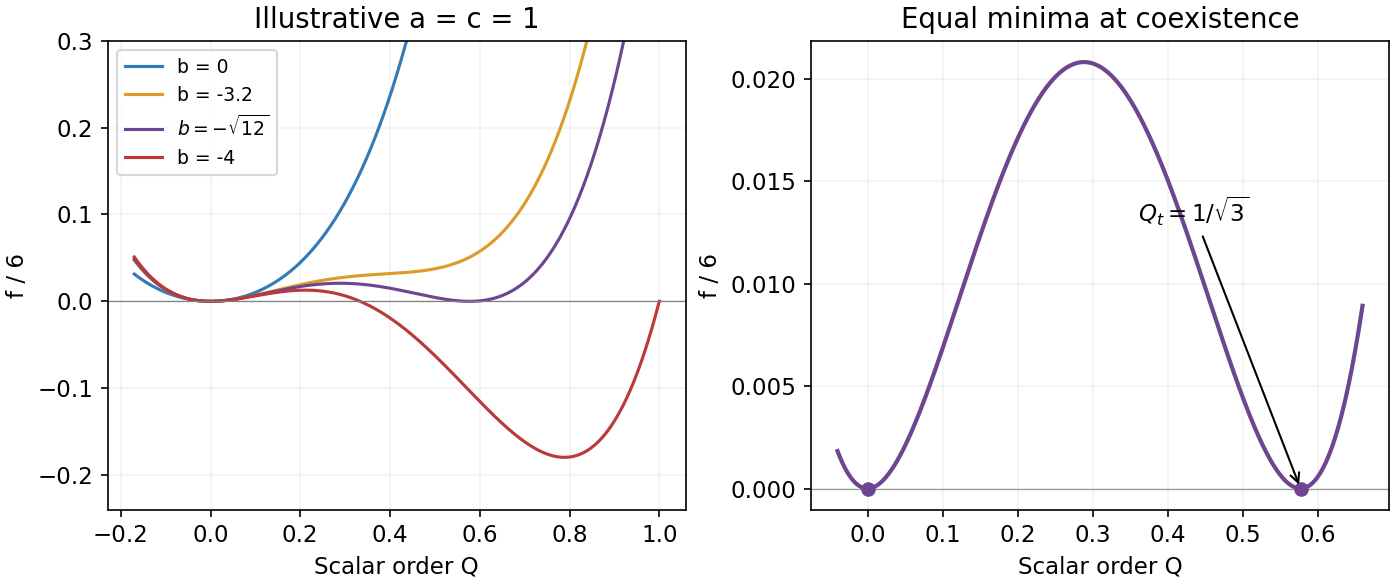

The illustrative plots set and show . A cubic invariant is permitted because head-tail reversal leaves unchanged; it does not implement . The physical range of a uniaxial nematic order parameter imposes ; the usual small-order-parameter Landau result assumes the displayed minimum lies in that interval. The unrestricted quartic graphs express the intended Landau model, with the effect of enforcing the bound stated in part (f).[ref]
Lectures on Landau Theory of Phase Transitions by Peter D. Olmsted. §4.3, printed pp.11–13, tensor invariants and cubic-term-driven coexistence; coefficient normalization here is derived from this paper's definition of
Articles by others on the same topic
There are currently no matching articles.