For the isotropic zero-field classical Heisenberg model of a ferromagnet, the analytic vector Landau expansion uses the Cartesian components of the vector order parameter near . rotational symmetry makes its scalar terms functions of . Global spin inversion symmetry also requires . Through fourth order this givesA positive quartic coefficient stabilizes the unconstrained truncated free energy. The disordered phase has and its minimum at ; the aligned phase has and a minimum at nonzero . At the continuous transition . The attractive alignment interaction supplies an energetic tendency toward negative quadratic curvature; orientational entropy favors the disordered phase at high temperature, so the sign of is a free-energy question rather than a consequence of the pair energy alone.
The analyticity assumption matters: the variable printed as is a nonnegative magnitude, so reversing does not send that scalar to . Terms proportional to or would be rotationally invariant but nonanalytic at the vector origin. Standard analytic Landau theory excludes them. Without that assumption, the stated pair symmetry alone would not exclude odd powers of the magnitude.[ref]
Statistical Field Theory by David Tong. §1.2, small-order-parameter expansion; §4.2, rotationally invariant vector free energy
Differentiation gives . For the origin is the global minimum; for , has and . Therefore, close enough to the transition for the quartic expansion to apply,The order parameter approaches zero continuously with mean-field critical exponent : the transition is continuous. In the aligned phase a particular direction is chosen. The vector-spin rotation symmetry is spontaneously broken from to , or from to including reflections. The manifold of vector order parameter directions is a sphere, so this is not just a two-state sign choice.[ref]
Statistical Field Theory by David Tong. §4.2, Heisenberg model and the continuous set of ordered directions
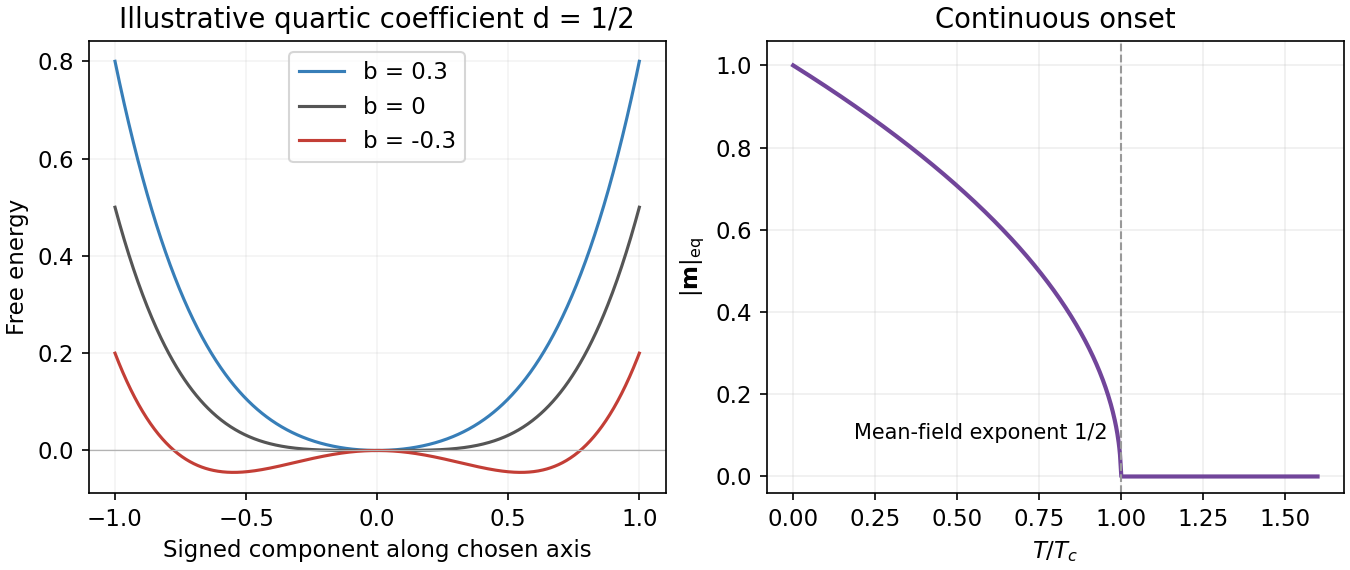
The plot uses illustrative and temperature measured in units of . A unit-spin average must satisfy ; if the quartic model is used literally far below the transition, its constrained minimum is . In practice the near-transition expansion is not a controlled prediction of deep low-temperature saturation. Also, a finite zero-field statistical ensemble that averages all directions has even below ; the curve describes the magnitude in a selected ordered state, obtained by appropriate boundary conditions or the thermodynamic limit before removing a small magnetic field.
The independent head-tail reversal symmetry means that the squared dot product interaction energy is unchanged when any individual is replaced by . All configurations , with independently, attain the aligned ground-state pair energy. There is consequently no energetic preference for either end of a molecular axis. Averaging over these equally weighted signs gives and even in the nematically ordered phase. The surviving order is the unoriented axis, represented by a nematic director with . A second-moment tensor can detect this order while a polar vector cannot.[ref]
Lectures on Landau Theory of Phase Transitions by Peter D. Olmsted. §4.3, printed pp.10–11, head-tail equivalence and the tensor order parameter
The word “always” needs the statistical ensemble or apolar interpretation: it is not an identity for each finite configuration. For example, choosing all is also a ground-state representative and gives . In an unbiased sign statistical ensemble the typical residual polar vector has size of order , because for these independent ground-state signs. This does not make polar order an equilibrium nematic order parameter. The tensor below is unchanged by each sign flip and thus removes the arbitrary labeling of rod ends.
Contract the two Cartesian indices and use the unit length of each molecular orientation:This is exact for each configuration, with no ensemble average assumption. The nematic order parameter is also a real symmetric second-rank tensor. Under a common rotation it transforms as , so its powers give rotational invariants of a symmetric traceless tensor by the cyclic property of the trace. It is unchanged by independent sign flips of the molecular vectors, explaining why it is adapted to nematic rather than polar order.
Choose a basis whose first axis is . The tensor with uniaxial nematic order then has eigenvalues . Hence , and . Substitution givesFor , remains a local minimum with curvature . Its nonzero stationary points satisfy , soThey first appear at as a stationary inflection point; for more negative , is a local maximum and a local minimum. The latter is initially metastable, becomes degenerate with at , and then becomes the global minimum as decreases further. This is a first-order transition in a cubic-quartic Landau potential: the order changes discontinuously. The saddle-node bifurcation creating a local minimum is not the coexistence condition. The isotropic minimum never loses local stability in this fixed positive- scan.
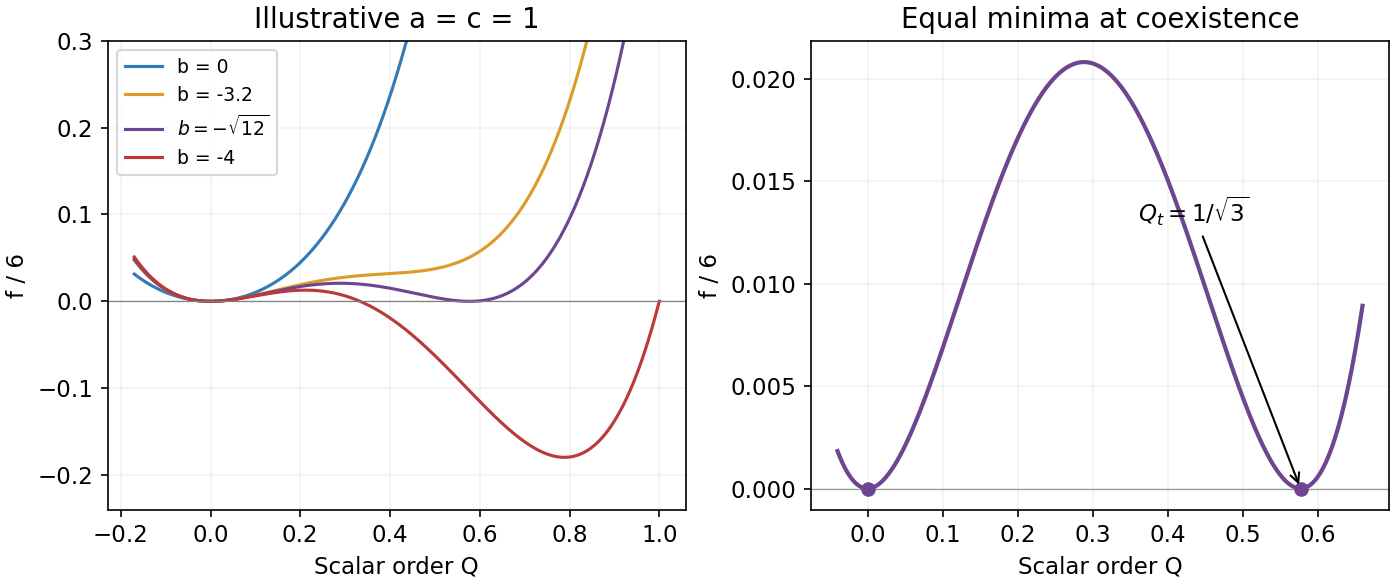


The illustrative plots set and show . A cubic invariant is permitted because head-tail reversal leaves unchanged; it does not implement . The physical range of a uniaxial nematic order parameter imposes ; the usual small-order-parameter Landau result assumes the displayed minimum lies in that interval. The unrestricted quartic graphs express the intended Landau model, with the effect of enforcing the bound stated in part (f).[ref]
Lectures on Landau Theory of Phase Transitions by Peter D. Olmsted. §4.3, printed pp.11–13, tensor invariants and cubic-term-driven coexistence; coefficient normalization here is derived from this paper's definition of
At coexistence a nonzero must be stationary and have the same free energy as . Dividing by and by givesEliminating yields and then . The allowed nonpositive root therefore givesAs is decreased through , the equilibrium scalar order jumps from for to just on the side. At both values coexist; the stable aligned branch below it is from part (e). As a global-minimum check, at coexistenceThere are two equal minima and a barrier at , of height . Comparing these minima, rather than finding only the stationary-point discriminant, determines the transition.
This is the unrestricted Landau answer, compatible with the physical range of a uniaxial nematic order parameter when so that . If one instead enforces for arbitrary positive coefficients, negative cannot win for , and bounded quartic nematic coexistence minimizes over . For its minimum is at the boundary, giving and a jump . No coefficients were supplied to choose this boundary case; the near-transition Landau approximation normally uses the interior result.
Articles by others on the same topic
There are currently no matching articles.