Choose Minkowski metric , so and . In laboratory time the relativistic charged-particle action has LagrangianHere denotes the signed particle charge in the action. The canonical momentum and the position derivative areThe Euler-Lagrange equation therefore givesThe last term is , and the first two terms form the electric field. Thus the relativistic Lorentz force equation isIts power relation and acceleration form areThe power relation follows by taking the scalar product with and using the relativistic energy-momentum relation. It also shows why the magnetic field alone cannot change the particle's energy.
For a uniform constant electric field and zero magnetic field, the mechanical momentum changes linearly even though the velocity does not:Invert using . The result for arbitrary initial direction isEquivalently, . This gives and guarantees at every finite momentum. The transverse momentum stays constant, but its velocity component generally decreases because the Lorentz factor increases. Thus an initial transverse velocity must not be treated as constant during the electric acceleration; this is the relativistic motion in a constant electric field with transverse momentum effect.
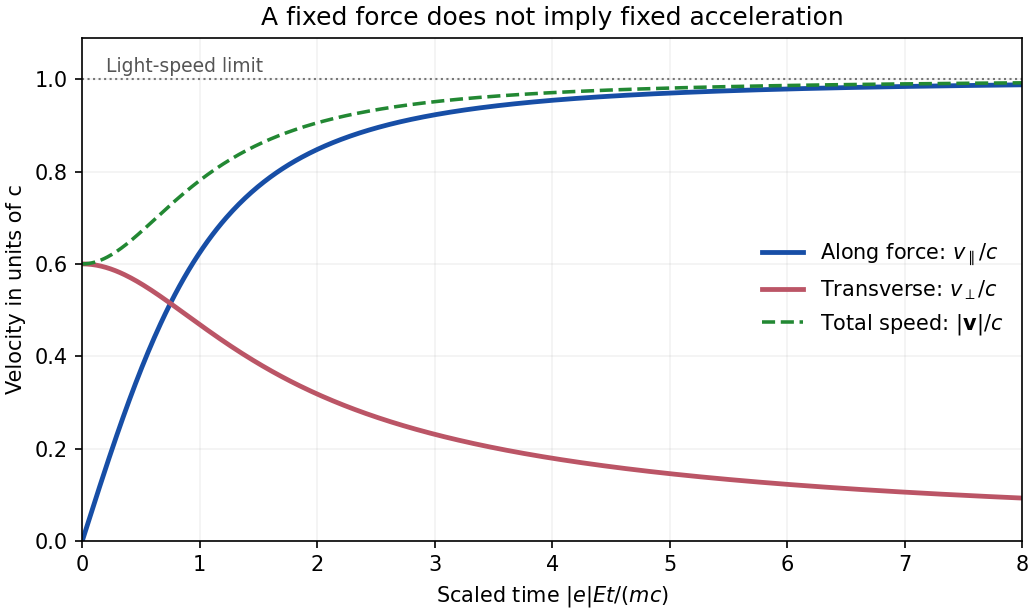

If , then , and the relativistic energy-momentum relation givesThe particle approaches the speed of light in the direction of the electric force, independently of its initial velocity. For positive the limiting direction is along ; for negative it is opposite. A massive particle never reaches that limiting speed in finite time. If the force is zero, the velocity remains instead.
With no electric field, the power relation from part (a) givesConsequentlyThe magnetic part of the relativistic Lorentz force changes the direction of mechanical momentum, but performs no work. This conclusion does not require the magnetic field to be spatially uniform: it follows from the local orthogonality of and .
Let for a nonzero constant magnetic field. Since is constant, the relativistic Lorentz force reduces toThe projection along is constant. In the perpendicular plane define the signed cyclotron frequency ; thenThe explicit rotating velocity isThis is the relativistic cyclotron orbit frequency in laboratory time, reduced from the nonrelativistic frequency by . With nonzero parallel velocity, the trajectory is a helix. If , that perpendicular vector stays zero and has no nontrivial fundamental period; the displayed is the period of a nonzero transverse orbit.
Articles by others on the same topic
There are currently no matching articles.