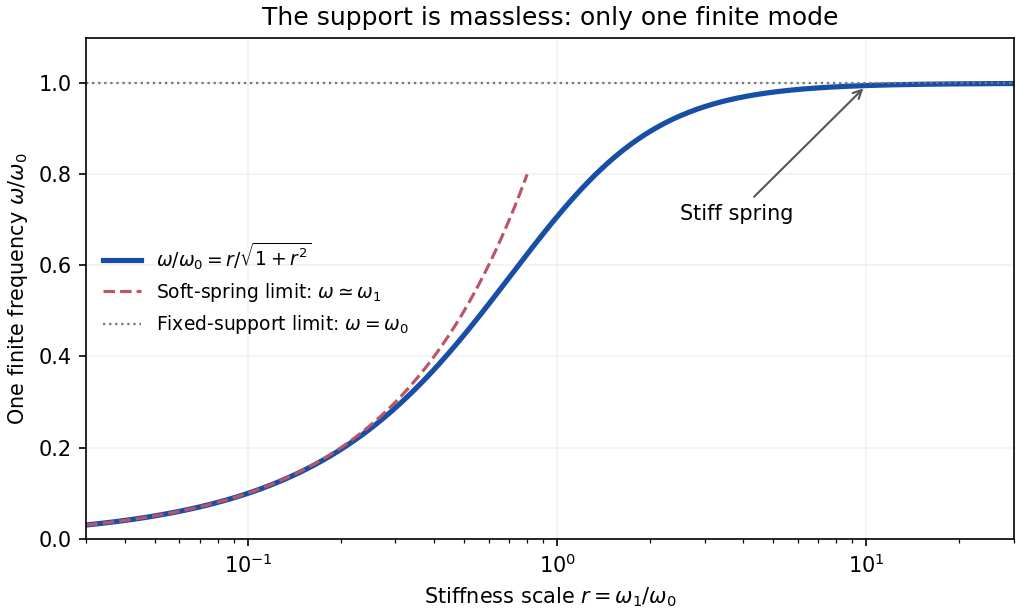
Subtracting the two linearized equations eliminates their acceleration terms:For , the assumed nontrivial simple harmonic motion therefore hasThe support displacement and pendulum angle oscillate in phase. Inserting this relation into either Euler-Lagrange equation yieldsso the one positive finite angular frequency isThe negative frequency describes the same real oscillation after a phase change. For a general phase, replace the sine in both coordinates by .
There is no missing second finite branch. The quadratic Lagrangian iswhose kinetic matrix is and has rank one. Its characteristic determinant is , not a quadratic polynomial in . This singular kinetic matrix in small oscillations results from taking the support mass to be exactly zero. Adding a small support mass restores a second mode that runs to infinite frequency as that mass vanishes.
For a stiff spring,The hinge becomes fixed, recovering the simple pendulum frequency, as expected for the pendulum with a massless spring-mounted support. At finite , horizontal support motion makes the frequency smaller.

Articles by others on the same topic
There are currently no matching articles.