For one spin channel, let and . The number-operator commutators giveMoving a boson from to raises the number difference by two. On a number-difference eigenstate , , while . ThusSubtracting the reversed products yieldsThis number-difference shift identity fixes the ordering. The placement of the coefficient to the left matters: it acts on the state after the hop. This spectral argument applies to any function defined on the accessible number-difference eigenvalues, without requiring a power-series expansion.
For a unitary transformation , take and . Operator conjugation by an exponential givesSeparate the unperturbed energy from . To first order,Therefore eliminating the first-order hopping requiresThis is a Schrieffer-Wolff transformation: virtual transitions are removed from the leading Hamiltonian and reappear as higher-order effects within a retained occupation sector. The same canonical-elimination strategy relates localized-moment and effective-exchange descriptions in the original construction.[ref]
Such a choice requires the hopping to connect separated unperturbed energies. If it connects exactly degenerate states, those states must remain in the retained degenerate block; a singular perturbative generator is not an acceptable replacement.
Put and , and take real hopping amplitude and real . Write the anti-Hermitian ansatz with its ordering visible:Using , its commutator with isBoth terms equal their required hopping coefficients ifThe shifted expression is then . For a transition from difference to , the left-ordered factor evaluates as , the final-minus-initial energy denominator.
The formula describes occupation-dependent virtual hopping on actual transitions with nonzero energy gaps. Perturbation theory also requires the hopping matrix element, including its bosonic occupation factors, to be small compared with that gap. The resonance obstruction to perturbative elimination at a zero denominator on a nonzero hop requires degenerate perturbation theory. Values on unreachable states whose hopping amplitude vanishes need not determine the generator.
The second-order terms aresoHere is the first-order generator. The full second-order commutator includes terms changing the number difference by four. To retain only fixed site occupancies, keep the products and .
With and , the mixed commutators giveThus occupancy-preserving second-order bosonic hopping givesFor bosons, normal ordering givesConsequently an explicit form in terms of the supplied function isThe operator exchanges spin labels between sites while preserving their total occupancies. Defining dimensionless Schwinger-boson spins and similarly for ,No factor of is needed for these dimensionless spins; for physical spin operators it becomes . The spin exchange belongs in the occupancy-preserving part, whereas two hops in the same direction do not.
A linear number-difference energy gives only a one-body level renormalization. Let , with . Then is constant, so the exchange coefficient cancels. Since ,The same-direction commutators vanish as well, so this is the whole second-order term. This agrees with expanding the two-site single-particle splitting with the appropriate assignment of levels. A collection of noninteracting bosons remains noninteracting after a change of single-particle basis. The case is resonant and cannot be treated by this elimination.
A nonlinear energy generally makes the virtual denominators occupancy-dependent. Then and need not agree, and the occupancy-preserving effective Hamiltonian contains density-dependent shifts and a spin-exchange coefficientmultiplying . Its sign depends on the function and sector; nonlinearity alone does not fix a universal exchange sign. The full second-order result can additionally contain pair hopping between different occupation sectors.
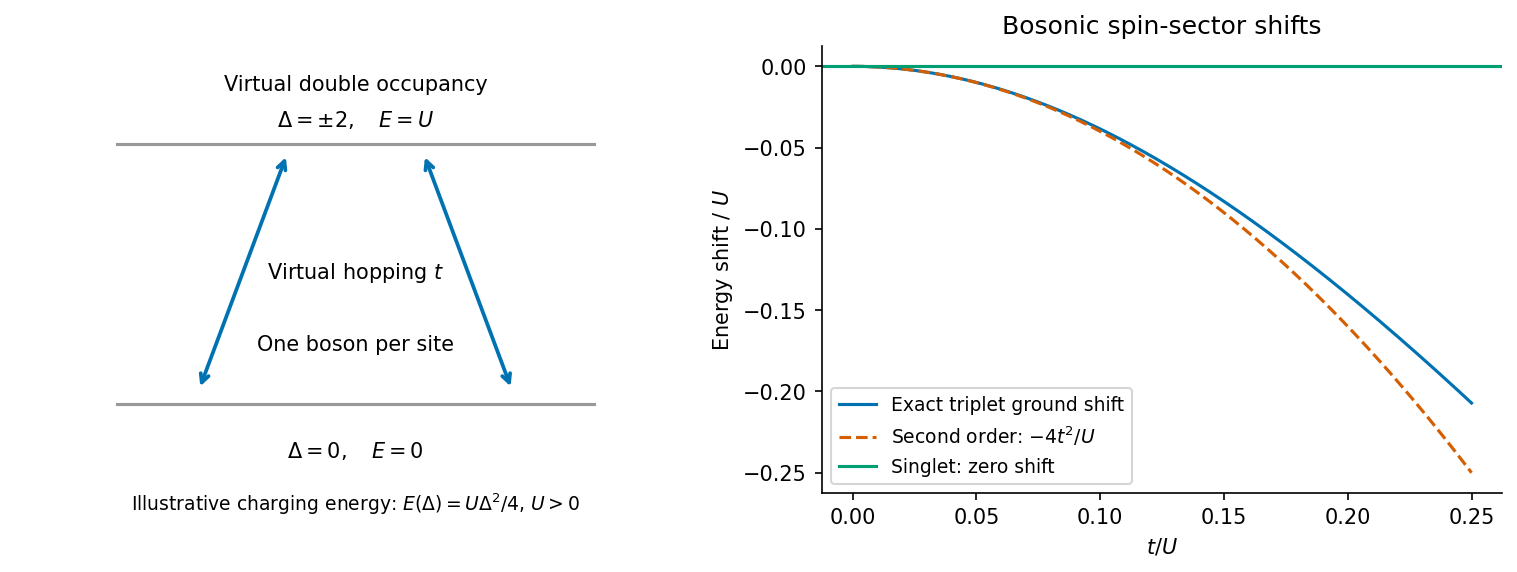
For a concrete repulsive example, take , , and restrict to two bosons with one on each site. Here , , , givingThe triplet energy shift is and the singlet shift is zero. This is ferromagnetic bosonic superexchange in this example: the symmetric spin sector can lower its energy through virtual double occupancy. The sign must not be imported from the fermionic Hubbard problem. The example specifies an additional energy function solely to illustrate the general expression; it is not an asserted numerical input.

Articles by others on the same topic
There are currently no matching articles.