Original paper: Public original PDF, physical pages 421–426; question pages 422–426.
Take periodic orbital wavefunctions on the ring, and write . Between kicks the evolution over one period isIntegrating through an infinitesimal kick givesThe free-motion contribution during the vanishing kick duration disappears in the ideal impulsive limit. The sign of the phase follows from the negative kick potential.
Starting just after a kick, the particle evolves freely first and is kicked at the end of the interval. Operators act right to left, so one step is , andThe one-period product is the Floquet operator of this quantum kicked rotor. There is no additional kick at the initial endpoint . Changing the stroboscopic convention to just before each kick would change the displayed order; it is not appropriate for these endpoints.
Put . The function solves the two-dimensional Helmholtz equation, . Expand its angular dependence as a Fourier series,Substitution into the polar-coordinate Laplacian,givesWith , this is the Bessel differential equation. Regularity of the original plane wave at the origin excludes the singular second-kind solution. Thus is a constant multiple of the regular first-kind function, andFor integer negative orders, , so this indexing still supplies the regular radial solution. The radial equation fixes the form of each term; the small-radius plane-wave expansion fixes its coefficient.
For a nonnegative integer , expand the plane wave in powers of :The first contribution to the positive angular harmonic occurs at . Its coefficient is . Comparing this with gives for .
The plane wave is even in , so its and Fourier coefficients agree. Therefore , implying . HenceThis is the cosine form of the Jacobi-Anger expansion. The factorial asymptotic stated in the source is used for nonnegative order; applying it literally to negative integers would introduce an undefined factorial. The Integer-order Bessel reflection identity is the required extension, not a separate set of divergent radial solutions.
Define . The free propagator acts diagonally on each angular harmonic:The kick multiplies by the Jacobi-Anger seriesMultiply the two series and collect the output harmonic . The one-step coefficient update iswhere both sampling times are just after their respective kicks. Free evolution supplies the input-index phase before the kick mixes angular momenta.
The source uses the unnormalized basis functions . Thus a unit-norm wavefunction satisfies . If the basis is instead , its amplitudes have sum of squared moduli one and obey the same matrix update. Mixing these normalization conventions would change an energy expectation incorrectly.
On periodic ring states the angular-momentum index is an integer. At the stated resonance,so is the identity on every orbital state. After steps from the normalized ground state,Its phase varies in space but its position probability density remains uniform. Periodicity permits integration by parts, givingConsequentlyEquivalently, the angular-momentum probabilities are , with . The mean angular momentum remains zero while its variance grows as . This quantum resonance of the kicked rotor gives coherent ballistic energy growth. The Bessel second-moment identity connects the momentum spreading to that quadratic energy law; an incoherent random walk would instead give linear energy growth.
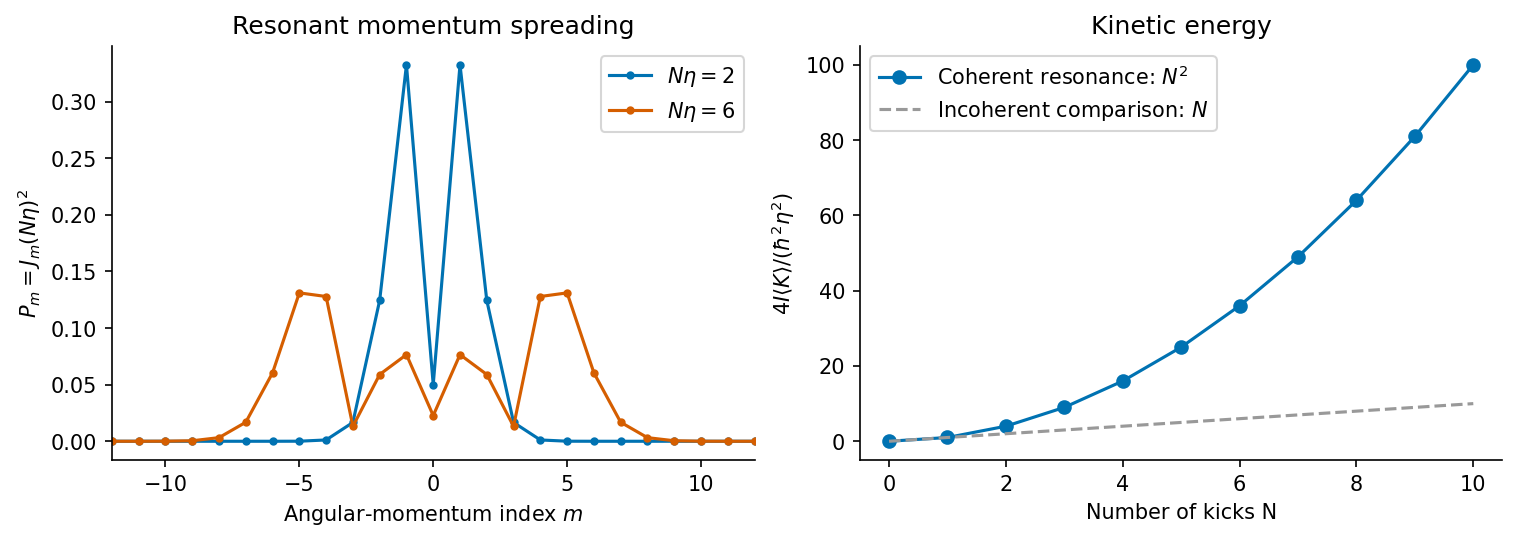
Original resonant kicked-rotor calculation: angular-momentum probabilities and the quadratic kinetic-energy law
. Details. Assume the composite pure state has unit norm. Put its amplitudes into the matrixThe partial trace contracts the same index between ket and bra:ThusIt is Hermitian, positive semidefinite and has trace one. Its determinant is particularly useful:This follows from multiplicativity of the determinant, or by expanding the two-by-two expression. If the supplied amplitudes were not normalized, the physical reduced state would be instead.
The specified Bell-state phases giveThereforeThe sum contains complex squares, not squared moduli. Define and . Normalization gives , so the triangle inequality ensures .
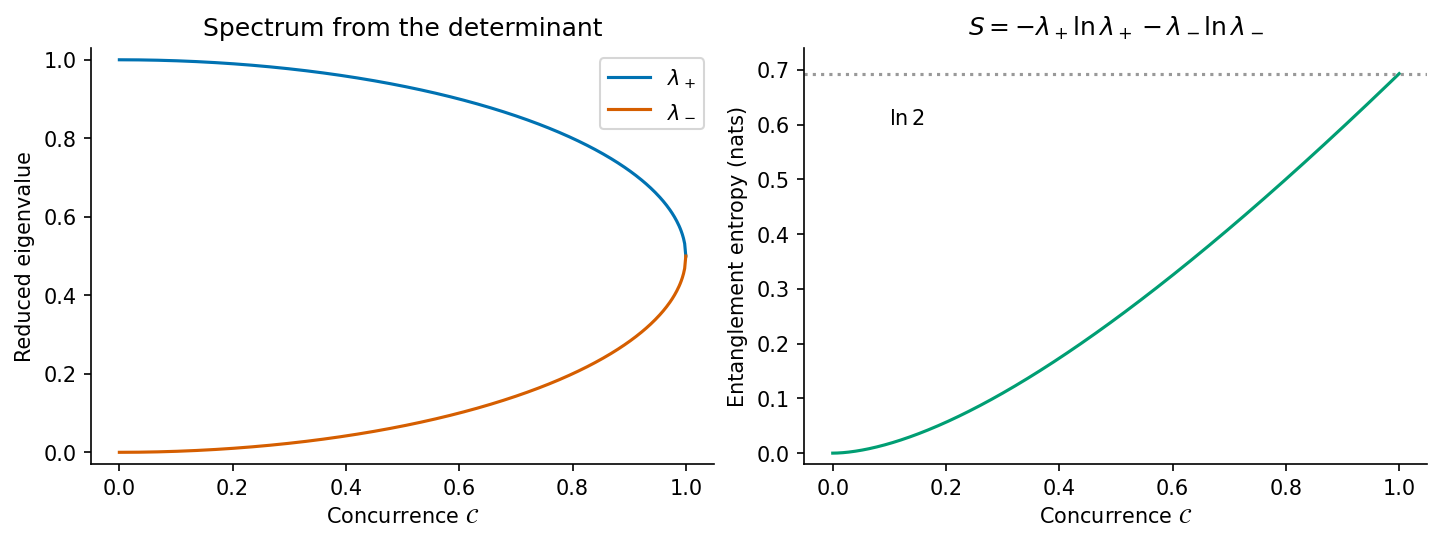
The characteristic polynomial is . HenceHere logarithms are natural and means its limiting value zero. Using logarithms to base two gives entropy in bits instead. Product states have , spectrum and entropy zero; maximally entangled states have , spectrum and entropy .
This phased Bell basis is a magic basis, and is the pure-state concurrence. The paper's ordering is a permutation of the usual magic-basis ordering, which leaves unchanged.[ref]


A matrix belongs to the special orthogonal group in four dimensions precisely whenDifferentiating the orthogonality relation along a path gives . Thus its Lie algebra consists of real antisymmetric four-by-four matrices. Such a matrix has one free entry for each unordered coordinate pair, giving dimension .
Each displayed generator has a single two-coordinate antisymmetric block. The matrices cover planes ; the matrices cover , with their printed orientations. These are all six distinct planes. Therefore the generators are linearly independent and span the full antisymmetric space: they form a basis of .
Conversely, exponentiating any real antisymmetric gives and . This verifies that the infinitesimal matrices generate proper rotations rather than reflections.
Use and the supplied commutators. Antisymmetry also gives . Expanding the combinations,The mixed commutator cancels:ThusThere are two mutually commuting three-generator rotation algebras. As real compact Lie algebras,For example, the anti-Hermitian basis obeys the same commutation convention in each factor. This is an algebra statement. Globally, the simply connected group is , andDropping that central quotient would incorrectly identify the global groups.
In the printed phased Bell basis, the actions on its four kets areEach matrix is purely imaginary and antisymmetric. Let have these four basis kets as columns in the computational basis. The infinitesimal generators of the standard rotation areUsing the displayed actions gives the phase-convention-specific identitiesThey are real antisymmetric matrices. A finite rotation on therefore acts on the magic-basis coefficient vector as , with . ConsequentlyIt preserves concurrence and hence preserves the reduced eigenvalues and entanglement entropy. A general operation adds a common phase to ; that changes by a phase of twice the angle but leaves unchanged. The real-rotation description of local transformations is a characteristic property of the magic basis.[ref]
Entanglement of a Pair of Quantum Bits by Scott Hill and William K. Wootters. After Eq.(6), real magic-basis matrices and independent local transformations
As an independent direct check, a local unitary sends to , which is a unitary similarity transformation and cannot change its spectrum. This local-unitary invariance of entanglement entropy also explains why merely rotating one subsystem cannot create entanglement.
For one spin channel, let and . The number-operator commutators giveMoving a boson from to raises the number difference by two. On a number-difference eigenstate , , while . ThusSubtracting the reversed products yieldsThis number-difference shift identity fixes the ordering. The placement of the coefficient to the left matters: it acts on the state after the hop. This spectral argument applies to any function defined on the accessible number-difference eigenvalues, without requiring a power-series expansion.
For a unitary transformation , take and . Operator conjugation by an exponential givesSeparate the unperturbed energy from . To first order,Therefore eliminating the first-order hopping requiresThis is a Schrieffer-Wolff transformation: virtual transitions are removed from the leading Hamiltonian and reappear as higher-order effects within a retained occupation sector. The same canonical-elimination strategy relates localized-moment and effective-exchange descriptions in the original construction.[ref]
Such a choice requires the hopping to connect separated unperturbed energies. If it connects exactly degenerate states, those states must remain in the retained degenerate block; a singular perturbative generator is not an acceptable replacement.
Put and , and take real hopping amplitude and real . Write the anti-Hermitian ansatz with its ordering visible:Using , its commutator with isBoth terms equal their required hopping coefficients ifThe shifted expression is then . For a transition from difference to , the left-ordered factor evaluates as , the final-minus-initial energy denominator.
The formula describes occupation-dependent virtual hopping on actual transitions with nonzero energy gaps. Perturbation theory also requires the hopping matrix element, including its bosonic occupation factors, to be small compared with that gap. The resonance obstruction to perturbative elimination at a zero denominator on a nonzero hop requires degenerate perturbation theory. Values on unreachable states whose hopping amplitude vanishes need not determine the generator.
The second-order terms aresoHere is the first-order generator. The full second-order commutator includes terms changing the number difference by four. To retain only fixed site occupancies, keep the products and .
With and , the mixed commutators giveThus occupancy-preserving second-order bosonic hopping givesFor bosons, normal ordering givesConsequently an explicit form in terms of the supplied function isThe operator exchanges spin labels between sites while preserving their total occupancies. Defining dimensionless Schwinger-boson spins and similarly for ,No factor of is needed for these dimensionless spins; for physical spin operators it becomes . The spin exchange belongs in the occupancy-preserving part, whereas two hops in the same direction do not.
A linear number-difference energy gives only a one-body level renormalization. Let , with . Then is constant, so the exchange coefficient cancels. Since ,The same-direction commutators vanish as well, so this is the whole second-order term. This agrees with expanding the two-site single-particle splitting with the appropriate assignment of levels. A collection of noninteracting bosons remains noninteracting after a change of single-particle basis. The case is resonant and cannot be treated by this elimination.
A nonlinear energy generally makes the virtual denominators occupancy-dependent. Then and need not agree, and the occupancy-preserving effective Hamiltonian contains density-dependent shifts and a spin-exchange coefficientmultiplying . Its sign depends on the function and sector; nonlinearity alone does not fix a universal exchange sign. The full second-order result can additionally contain pair hopping between different occupation sectors.
For a concrete repulsive example, take , , and restrict to two bosons with one on each site. Here , , , givingThe triplet energy shift is and the singlet shift is zero. This is ferromagnetic bosonic superexchange in this example: the symmetric spin sector can lower its energy through virtual double occupancy. The sign must not be imported from the fermionic Hubbard problem. The example specifies an additional energy function solely to illustrate the general expression; it is not an asserted numerical input.
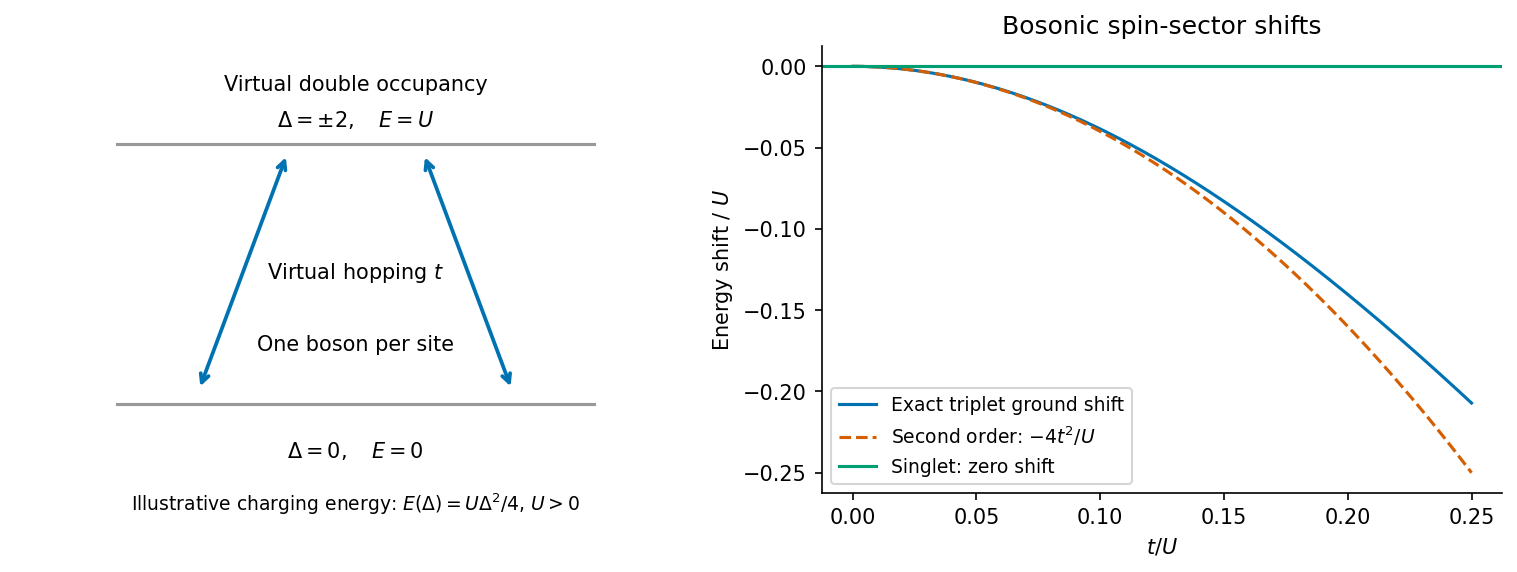
Original virtual-hopping construction and exact versus perturbative spin-sector energies for the illustrative repulsive two-boson model
. Details. 
A Klein-Gordon solution is second order in time: both and are needed as initial data. Its free modes have both signs of frequency,This differs from the first-order Schrödinger evolution of a fixed one-particle wavefunction.
Moreover, does not generally obey the required probability continuity equation. The conserved Klein-Gordon density is proportional toup to a positive conventional constant. A pure positive-frequency mode gives and a negative-frequency mode gives . This density is not positive definite and cannot be a universal position probability density.
For a free field, one can choose a positive-frequency subspace with a positive integrated inner product. Time-dependent backgrounds generally mix it with the negative-frequency subspace, so simply deleting the latter is not dynamically consistent. In quantum field theory the complex Klein-Gordon field instead has particle and antiparticle sectors; its conserved current is interpreted as charge current, and creation or annihilation of pairs need not fit a fixed-particle-number wavefunction. These are limitations of the naive single-particle interpretation, not a failure of the relativistic field equation.
Work in temporal gauge, with zero scalar potential, and use the charge sign exactly as in the given covariant spatial derivative. A spatially uniform vector potential acts on a Fourier mode asThere are no spatial derivatives of . Substitution into the field equation and multiplication by therefore givesThe canonical wavevector is conserved by spatial translation symmetry; the kinetic momentum is . The absence of a term involving in this mode equation follows from temporal gauge and the spatial minimal-coupling operator. The electric field still affects evolution through the changing oscillator frequency.
For this mode, abbreviateThe electric pulse is . In temporal gauge the mode equation has a finite step in its frequency squared, with no delta multiplying the mode. Thus both and its first time derivative are continuous at zero.
Writing the positive-frequency incident amplitude as , the matched solution isIts initial value is and its initial derivative is , as required. In the normalized outgoing-frequency basis it isThe negative-frequency contribution appears even though only positive frequency was incident. These are temporal-mode matching coefficients, so their conserved difference is hyperbolic rather than the sum-one rule of ordinary spatial reflection and transmission probabilities.
Distinguish in-operators and out-operators before identifying the symbols in the final vacuum condition. The full charged-field Fourier component before the pulse containsThe conjugate incoming mode has the conjugate matched solution. Collecting the coefficients of and after the pulse gives the real Bogoliubov mapSince , the inverse map isThe Inverse Bogoliubov vacuum condition therefore yieldsHere the inside mean out-operators. Using the forward-map coefficient with the same plus sign would be inconsistent with this convention. Mode rephasings can change a displayed coefficient sign, but the map and squeezed-state exponent must change together.
The complete in-vacuum also obeys the antiparticle annihilation condition. In out-operators this is . The two conditions jointly select the vacuum sector used below; the particle condition alone would not exclude arbitrary incoming antiparticle excitations.
Suppress the mode label temporarily and let be out-operators. With , the commuting-mode identityshows that . The analogous relation for gives the antiparticle condition. Thus in a finite regulated collection of modes,For one particle-antiparticle mode pair, . The exponential's factorial therefore cancels:The resulting particle-antiparticle two-mode squeezed vacuum has the geometric pair-number distributionHere one pair means one particle in canonical mode and one antiparticle in mode . They are distinct species, and the state has equal particle and antiparticle occupation. In particular,For a finite set, . An overall phase is arbitrary. With no pulse, , so and only the zero-pair state remains.
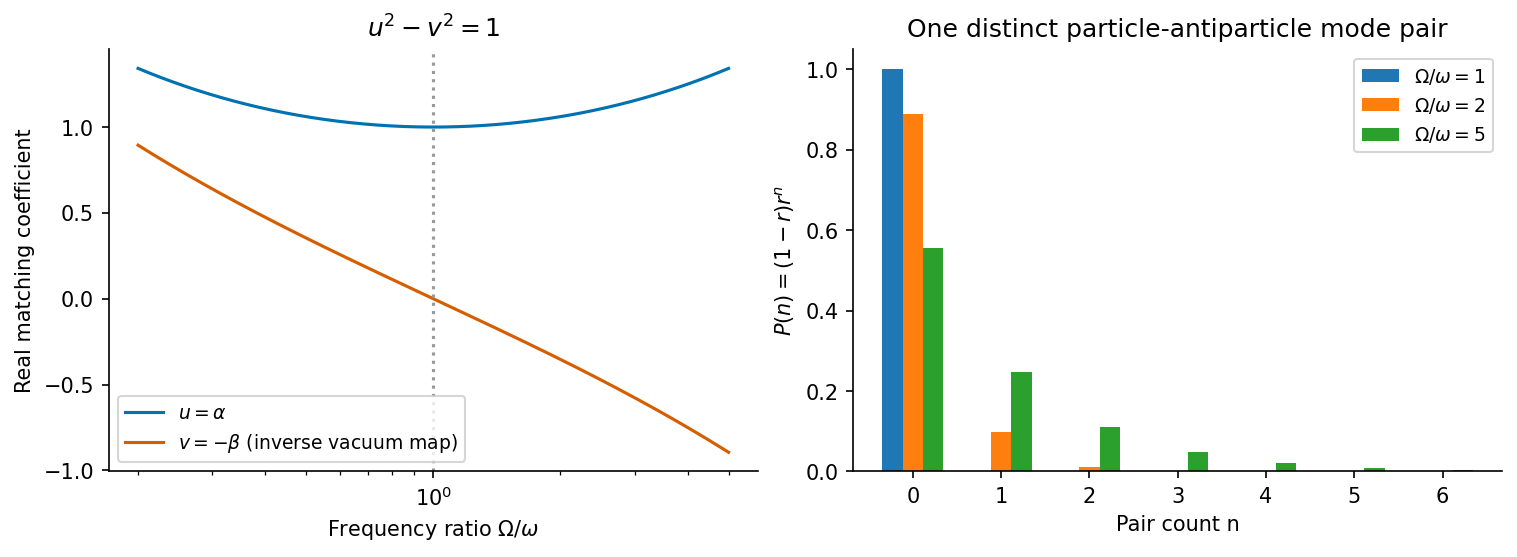
Original sudden-pulse calculation: normalized frequency-matching coefficients and the resulting geometric pair-number distributions
. Details. 
The ultraviolet divergence of an instantaneous vector-potential quench qualifies this formal product. For an exactly instantaneous vector-potential step in three spatial dimensions, at large the mixing behaves as . Thus diverges in the ultraviolet. In a finite quantization box, a finite momentum cutoff makes the product a normalized Fock-space vector; a sufficiently smooth finite-duration pulse removes this particular instantaneous-quench pathology. The per-mode distribution remains the result above, while the unregulated infinite product should not be asserted to have a finite nonzero global normalization.
Articles by others on the same topic
There are currently no matching articles.