A Klein-Gordon solution is second order in time: both and are needed as initial data. Its free modes have both signs of frequency,This differs from the first-order Schrödinger evolution of a fixed one-particle wavefunction.
Moreover, does not generally obey the required probability continuity equation. The conserved Klein-Gordon density is proportional toup to a positive conventional constant. A pure positive-frequency mode gives and a negative-frequency mode gives . This density is not positive definite and cannot be a universal position probability density.
For a free field, one can choose a positive-frequency subspace with a positive integrated inner product. Time-dependent backgrounds generally mix it with the negative-frequency subspace, so simply deleting the latter is not dynamically consistent. In quantum field theory the complex Klein-Gordon field instead has particle and antiparticle sectors; its conserved current is interpreted as charge current, and creation or annihilation of pairs need not fit a fixed-particle-number wavefunction. These are limitations of the naive single-particle interpretation, not a failure of the relativistic field equation.
Work in temporal gauge, with zero scalar potential, and use the charge sign exactly as in the given covariant spatial derivative. A spatially uniform vector potential acts on a Fourier mode asThere are no spatial derivatives of . Substitution into the field equation and multiplication by therefore givesThe canonical wavevector is conserved by spatial translation symmetry; the kinetic momentum is . The absence of a term involving in this mode equation follows from temporal gauge and the spatial minimal-coupling operator. The electric field still affects evolution through the changing oscillator frequency.
For this mode, abbreviateThe electric pulse is . In temporal gauge the mode equation has a finite step in its frequency squared, with no delta multiplying the mode. Thus both and its first time derivative are continuous at zero.
Writing the positive-frequency incident amplitude as , the matched solution isIts initial value is and its initial derivative is , as required. In the normalized outgoing-frequency basis it isThe negative-frequency contribution appears even though only positive frequency was incident. These are temporal-mode matching coefficients, so their conserved difference is hyperbolic rather than the sum-one rule of ordinary spatial reflection and transmission probabilities.
Distinguish in-operators and out-operators before identifying the symbols in the final vacuum condition. The full charged-field Fourier component before the pulse containsThe conjugate incoming mode has the conjugate matched solution. Collecting the coefficients of and after the pulse gives the real Bogoliubov mapSince , the inverse map isThe Inverse Bogoliubov vacuum condition therefore yieldsHere the inside mean out-operators. Using the forward-map coefficient with the same plus sign would be inconsistent with this convention. Mode rephasings can change a displayed coefficient sign, but the map and squeezed-state exponent must change together.
The complete in-vacuum also obeys the antiparticle annihilation condition. In out-operators this is . The two conditions jointly select the vacuum sector used below; the particle condition alone would not exclude arbitrary incoming antiparticle excitations.
Suppress the mode label temporarily and let be out-operators. With , the commuting-mode identityshows that . The analogous relation for gives the antiparticle condition. Thus in a finite regulated collection of modes,For one particle-antiparticle mode pair, . The exponential's factorial therefore cancels:The resulting particle-antiparticle two-mode squeezed vacuum has the geometric pair-number distributionHere one pair means one particle in canonical mode and one antiparticle in mode . They are distinct species, and the state has equal particle and antiparticle occupation. In particular,For a finite set, . An overall phase is arbitrary. With no pulse, , so and only the zero-pair state remains.
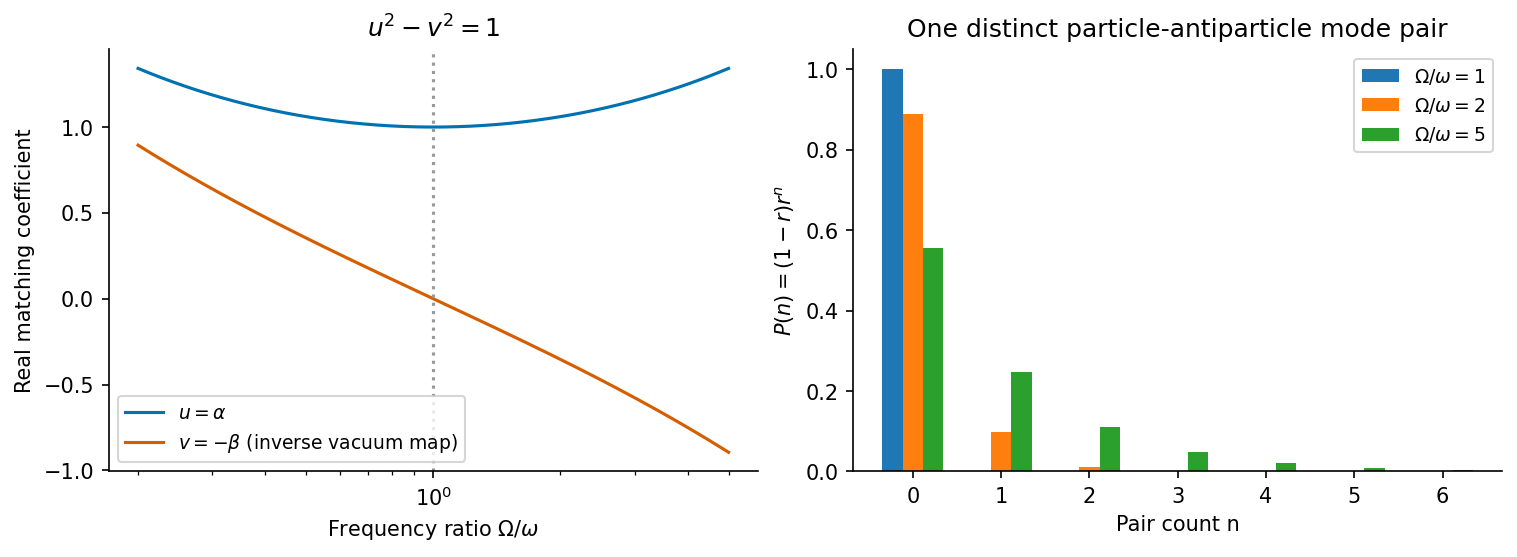
Original sudden-pulse calculation: normalized frequency-matching coefficients and the resulting geometric pair-number distributions
. Details. 
The ultraviolet divergence of an instantaneous vector-potential quench qualifies this formal product. For an exactly instantaneous vector-potential step in three spatial dimensions, at large the mixing behaves as . Thus diverges in the ultraviolet. In a finite quantization box, a finite momentum cutoff makes the product a normalized Fock-space vector; a sufficiently smooth finite-duration pulse removes this particular instantaneous-quench pathology. The per-mode distribution remains the result above, while the unregulated infinite product should not be asserted to have a finite nonzero global normalization.
Articles by others on the same topic
There are currently no matching articles.