Brownian motion is the irregular motion of a mesoscopic particle caused by thermal molecular impacts. A colloidal sphere in a fluid provides a physical example. The random force competes with dissipative drag; averaging many trajectories produces diffusion even though each trajectory fluctuates.
A free-particle Langevin equation with thermal Langevin force normalization isThe noise has zero mean, and its strength is linked to drag by the fluctuation-dissipation theorem. The velocity relaxes on the time scale . At long times , the Einstein diffusion relation isFor a slowly moving no-slip sphere of radius in a continuum fluid of dynamic viscosity , Stokes drag law gives . The particle probability density obeys ; a localized initial position develops a Gaussian profile. The ballistic-to-diffusive Brownian displacement changes character: at , equilibrium velocities instead give ballistic mean-square displacement .
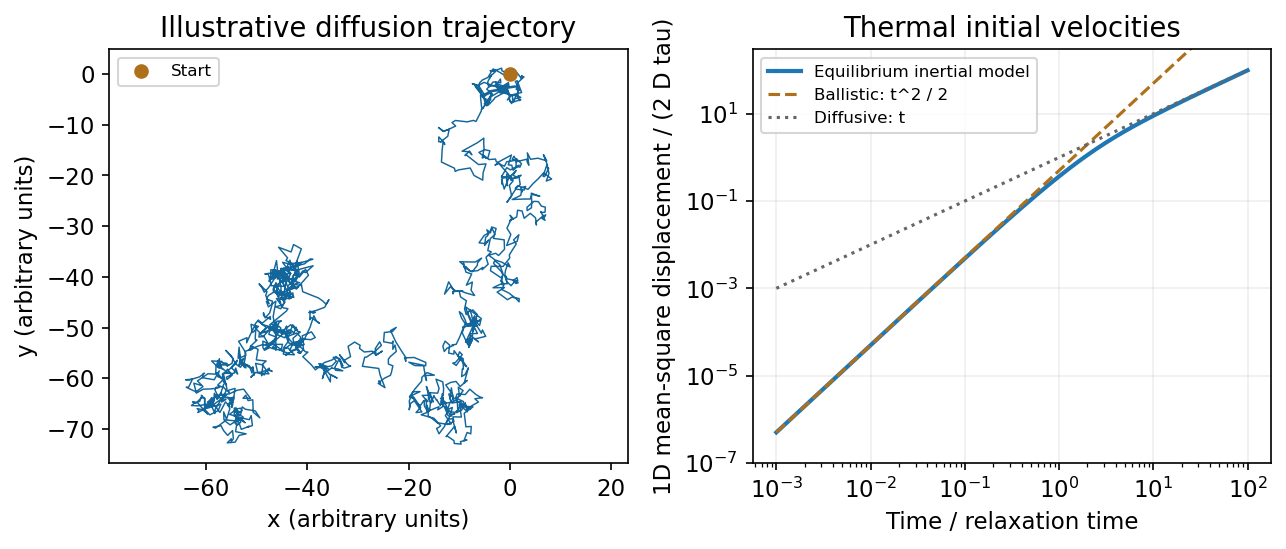
An illustrative random trajectory and the inertial crossover from ballistic to diffusive mean-square displacement
. Source. Details. 
The drag-noise model assumes a classical bath with a sufficiently short correlation time; a mathematical white-noise trajectory does not resolve individual molecular collisions. Tracking nonliving colloidal particles measures diffusion and tests the connection between thermal fluctuations and dissipation.[ref]
Stochastic Processes by David Tong. Sections 3.1–3.2: Brownian motion, Langevin equation, diffusion and the Einstein relation
Articles by others on the same topic
There are currently no matching articles.