An statistical ensemble specifies probabilities of microstates under particular macroscopic constraints. It represents statistical information about a system; the reservoir constraints of equilibrium ensembles specify what it can exchange with its surroundings.
- The microcanonical ensemble has fixed . Accessible states in a narrow energy shell are equally probable, with , where counts the states in that shell. It describes an isolated system.
- The canonical ensemble has fixed and can exchange energy with a heat reservoir. A microstate has probability , with and . The energy fluctuates; its mean is not imposed independently.
- The grand canonical ensemble has fixed and exchanges both particles and energy. Its probabilities are proportional to , with and grand potential . For a homogeneous extensive equilibrium system, .
The thermodynamic potentials generate mean quantities and response functions. For example, canonical energy variance is . With short-range interactions and stable bulk phases, relative fluctuations usually vanish for large systems and these ensembles give equivalent bulk predictions after matching their mean variables. Finite systems, constraints and long-range interactions require greater care; the ensembles retain different fluctuating variables.[ref]
The Fundamentals of Statistical Mechanics by David Tong. Sections 1.2–1.4: microcanonical, canonical and grand canonical ensembles
Brownian motion is the irregular motion of a mesoscopic particle caused by thermal molecular impacts. A colloidal sphere in a fluid provides a physical example. The random force competes with dissipative drag; averaging many trajectories produces diffusion even though each trajectory fluctuates.
A free-particle Langevin equation with thermal Langevin force normalization isThe noise has zero mean, and its strength is linked to drag by the fluctuation-dissipation theorem. The velocity relaxes on the time scale . At long times , the Einstein diffusion relation isFor a slowly moving no-slip sphere of radius in a continuum fluid of dynamic viscosity , Stokes drag law gives . The particle probability density obeys ; a localized initial position develops a Gaussian profile. The ballistic-to-diffusive Brownian displacement changes character: at , equilibrium velocities instead give ballistic mean-square displacement .
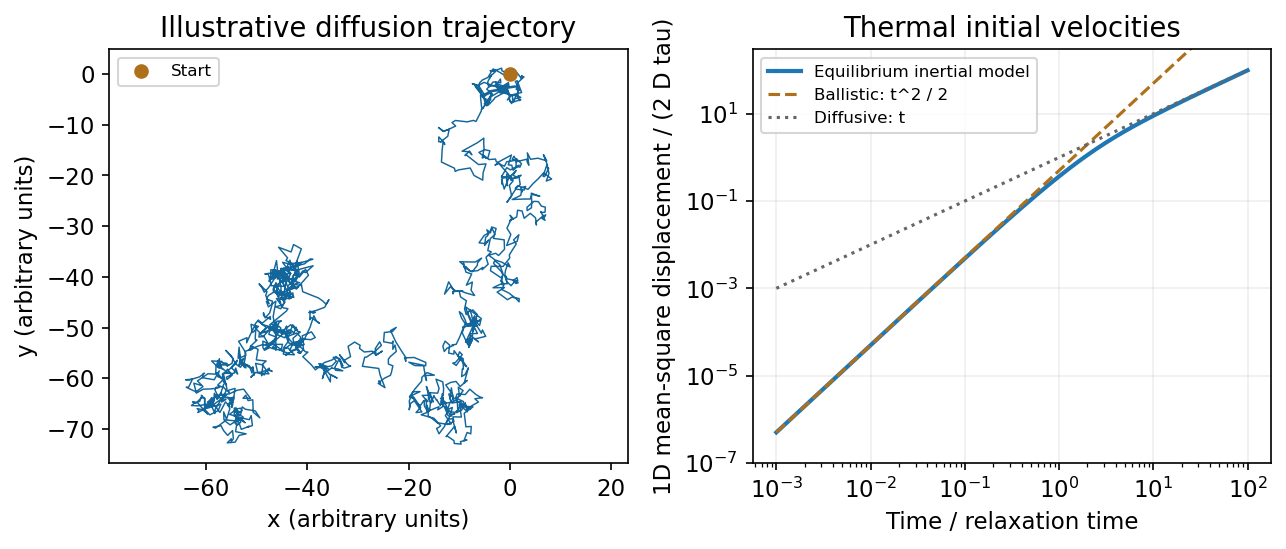
An illustrative random trajectory and the inertial crossover from ballistic to diffusive mean-square displacement
. Source. Details. 
The drag-noise model assumes a classical bath with a sufficiently short correlation time; a mathematical white-noise trajectory does not resolve individual molecular collisions. Tracking nonliving colloidal particles measures diffusion and tests the connection between thermal fluctuations and dissipation.[ref]
Stochastic Processes by David Tong. Sections 3.1–3.2: Brownian motion, Langevin equation, diffusion and the Einstein relation
Landau theory expands the free energy in a small order parameter and keeps terms allowed by the system's symmetries. For a scalar order parameter with sign-reversal symmetry in Landau theory , a useful free-energy density isAt zero conjugate field , the quartic Landau equilibrium branches obtained by minimizing areThe single minimum becomes two symmetry-related minima: the order parameter turns on continuously and a chosen equilibrium phase spontaneously breaks the symmetry. At the critical temperature the quadratic restoring term vanishes. The mean-field exponent is ; the susceptibility above is .
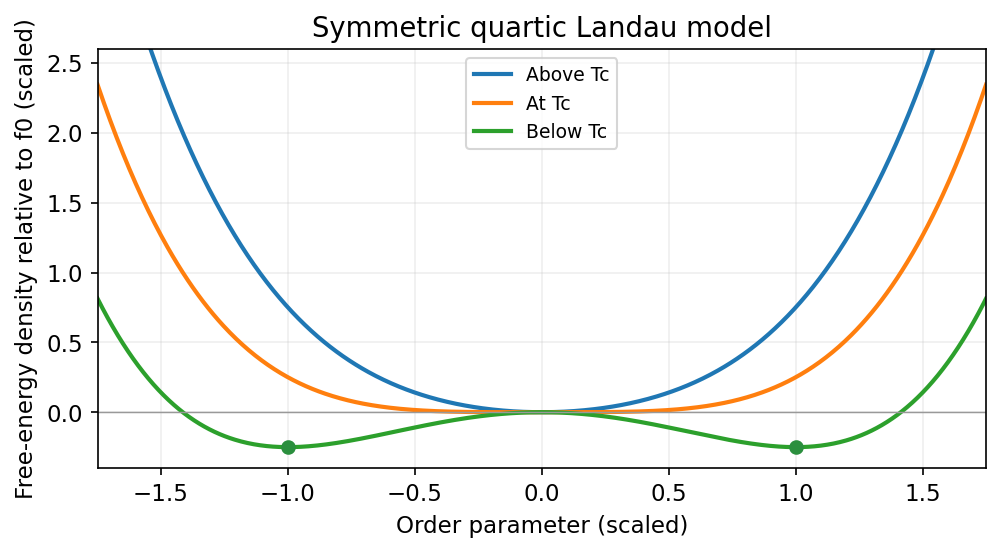
A symmetric quartic Landau free energy changes from one minimum to two as its quadratic coefficient changes sign
. Source. Details. 
More general allowed terms describe other transitions. A negative quartic term, stabilized by a positive sixth-order term, can give a first-order transition with a discontinuous order parameter and metastable minima. Without the sign-reversal symmetry, a cubic term may also be allowed. The expansion is phenomenological: its coefficients depend on microscopic physics. Minimizing a uniform polynomial neglects important spatial fluctuations, particularly near a critical point, so its critical exponents need not be exact.[ref]
Phase Transitions by David Tong. Section 5.4: Landau free energy, symmetry and mean-field transitions
Articles by others on the same topic
There are currently no matching articles.