Landau theory expands the free energy in a small order parameter and keeps terms allowed by the system's symmetries. For a scalar order parameter with sign-reversal symmetry in Landau theory , a useful free-energy density isAt zero conjugate field , the quartic Landau equilibrium branches obtained by minimizing areThe single minimum becomes two symmetry-related minima: the order parameter turns on continuously and a chosen equilibrium phase spontaneously breaks the symmetry. At the critical temperature the quadratic restoring term vanishes. The mean-field exponent is ; the susceptibility above is .
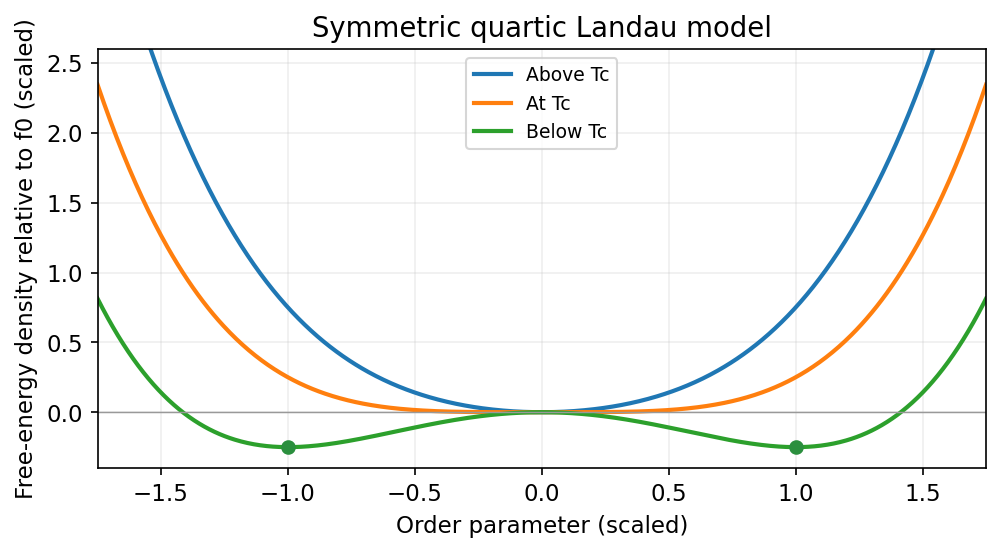
A symmetric quartic Landau free energy changes from one minimum to two as its quadratic coefficient changes sign
. Source. Details. 
More general allowed terms describe other transitions. A negative quartic term, stabilized by a positive sixth-order term, can give a first-order transition with a discontinuous order parameter and metastable minima. Without the sign-reversal symmetry, a cubic term may also be allowed. The expansion is phenomenological: its coefficients depend on microscopic physics. Minimizing a uniform polynomial neglects important spatial fluctuations, particularly near a critical point, so its critical exponents need not be exact.[ref]
Phase Transitions by David Tong. Section 5.4: Landau free energy, symmetry and mean-field transitions
Articles by others on the same topic
There are currently no matching articles.